The I Ching and Four Pillars writings both discuss yin and yang. That invites comparison, but shared vocabulary and shared computational steps require different evidence. Omitting inputs, operations and textual locations can turn an intellectual background into the unsupported claim that a chart rule is already written in the Changes.
This article sets a finite Xici yin-yang statement beside a definition of year, month, day and hour in San Ming Tong Hui, then returns to the preceding Great Expansion passage. The manuscript's classical-Wing layer, the Four Pillars discussion in the Qin Shen'an-corrected Wenming witness, and this article's comparison retain separate responsibilities.[1–3]
Ask what the shared word does in its sentence
The Xici statement 一陰一陽之謂道 says that one yin and one yang are called dao.[1] This finite sentence supplies neither four birth-time pillars nor an instruction deriving an hour stem from a day stem. It contains no modern time-zone conversion table. Adding those operations requires separate sources.
That does not require reading the sentence in isolation. It can enter the Wings' discussion of change and serve as an intellectual resource for later yin-yang discourse. A conceptual explanation and an operational instruction turning specified inputs into outputs nevertheless do different work in a text.
Shared vocabulary first supplies a comparison question: which relationship does yin-yang explain at each location? The word alone does not answer it or establish identical objects, ordering and selection rules.
The Four Pillars passage specifies a different structure
San Ming Tong Hui's juan-two discussion of year, month, day and hour states: when discussing a person's ming, year, month, day and hour are arranged into four pillars; deriving the month proceeds from the year, taking the year as the basis; deriving the hour proceeds from the day, taking the day as primary.[2]
This is a concrete methodological description to set beside Great Expansion. The selected Wing passage contains dividing, hanging, counting and remainder operations with symbolic explanations. This passage supplies time fields, pillars and month/hour derivation relationships. Method comparison starts with those distinctions. Both discuss yin-yang cannot replace the actual objects.
This finite definition lets us record input fields and two derivation relationships; it is not a complete calendrical implementation. It is also not an I Ching statement recording Four Pillars history. The origins of those rules need dated and transmitted evidence; a methodological description alone is not a complete origin history.
| Comparison field | I Ching material checked here | Selected Four Pillars definition |
|---|---|---|
| Textual entry | Xici yin-yang statement and Great Expansion | Discussion of year, month, day and hour |
| Listed objects | Yin-yang, procedural numbers and actions | Year, month, day, hour and four pillars |
| Explicit relationship | Symbolic explanations and ordered actions | Month derived from year; hour from day |
| Reading output | Hexagram/line reading through identified interpretive layers | Pillar and relationship discussion in relevant Four Pillars writings |
| Not established here | Every divination procedure or Four Pillars origins | Modern implementation details or predictive efficacy |
Checked here matters. The table does not claim that all Changes traditions lack stems and branches, or that later techniques never interacted. It limits comparison to these passages and methods. A finite difference does not prove complete historical isolation.
A conversion claim needs an actual specification
To convert a Qian line position into a particular day pillar, specify the input. Is it a static figure or a divination record? Which change information is preserved? Which rule selects stems and branches? Does one input produce one result? Where is the rule documented?
Shared yin-yang language resolves none of these questions. Without them, the mapping cannot be repeated or checked for the use of another tradition. This article does not invent a line-to-stem table and attribute its design to the classic.
Conversely, a Four Pillars implementation can produce repeatable pillar records under explicit calendrical conventions. That does not computationally validate every classical interpretation. Reproducing an input record and predicting someone's employment, health or assets are different tasks. Cultural comparison need not pretend that the latter has been completed.
A claim about origins needs intermediate evidence
A term in two books supports lexical comparison. An explicitly located citation can support a claim that one passage invokes another. Adoption of another tradition's operations requires comparison of the full relevant steps. Establishing where a rule came from requires chronology, transmission and intermediate documents as well.
This evidence ladder avoids opposite overstatements. Same word, same method and origin exceeds lexical evidence. Different operations, no intellectual relationship neglects the reuse of concepts. Comparison is useful when the scope of each kind of evidence survives.
These materials share yin-yang vocabulary while the operations checked here differ is a bounded conclusion. We have proved that all Four Pillars rules originate in Great Expansion is not. Nor is every connection false. Finite passages cannot carry either comprehensive historical judgement.
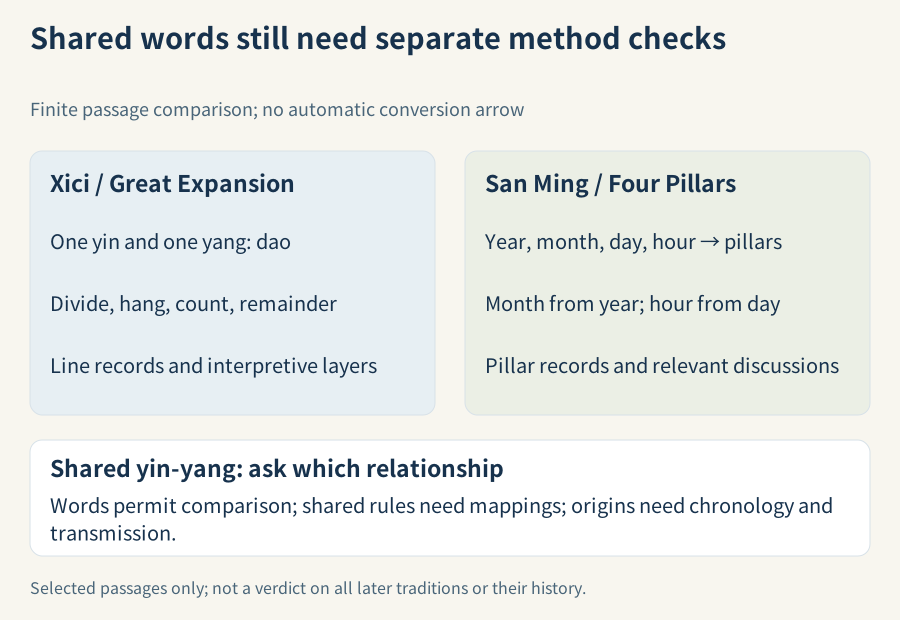
The complete figure is shown below. Select it to enlarge the labels. Open full-size figure · PNG
Keep a checkable boundary for this collection
These five readings establish entries into the material: separate classical text, Wings, annotation and subcommentary; retrieve line positions; retain whole and local situations; distinguish procedure from practice evidence; and test whether shared vocabulary carries shared operations. They are original interpretations, not a complete critical edition or an unverified classical authorization for a chart algorithm.
The following paired readings develop actual hexagram and line statements. Returning to passages with the five comparison fields preserves real points of connection without quietly transferring another literature's methods into them.
Sources and further reading
繫辞上阴阳句; 卷10, scan16, folio unverified, left blank. Selected witness/source page
論年月日時; 卷2, scan110, folio 三二. Selected witness/source page
繫辞上大衍程序有限段; 卷11, scan8, folio unverified, left blank. Selected witness/source page
卷十与繫辞上篇题; 卷10, scan2, folio unverified, left blank. Selected witness/source page
三命秦校文明传本书目字段(Commons转入); Scholarly/catalogue layer; ancient image/folio inapplicable. Selected witness/source page
Punctuation, translations, comparisons and diagrams are original. Classical statements, Wings, annotation, subcommentary and modern scholarship retain their layers; original scans are not republished. Finite interpretation, not a complete critical edition or validated life prediction.
Evidence and source roles
These roles distinguish ancient text, older commentary, historical scholarship and tool reproduction. The numbered notes in the article retain the precise scan pages and explanations. Library and academic sources do not endorse predictive claims.
- YC1-E05-YINYANG · Ancient text evidence: 繫辞上阴阳句
Text layer in the witness: Xici shang Wing wording; interposed annotation is excluded. - YC1-E05-FOUR-PILLARS · Ancient text evidence: 論年月日時
Text layer in the witness: Single-line discussion in the identified San Ming witness; not modern Xu commentary. - YC1-E04-DAYAN · Ancient text evidence: 繫辞上大衍程序有限段
Text layer in the witness: Xici shang Wing wording; interposed annotation is excluded. - YC1-E00-V10 · Historical edition evidence: 卷十与繫辞上篇题
Text layer in the witness: Visible manuscript juan and section headings; this witness’s actual numbering retained. - YC1-E00-SANMING · Library catalogue fields imported by Commons: 三命秦校文明传本书目字段(Commons转入)
Text layer in the catalogue: Catalogue fields imported by Commons; not an independently witnessed1926 colophon or a newly read official catalogue.