A page of the I Ching may contain a hexagram figure, a classical statement, a passage from the Wings, an annotation and a subcommentary. Their presence in one witness does not make every sentence the work of one author. Nor does an explanation automatically become part of the sentence it explains. Separating layers answers a practical question: who is explaining what here?
This collection uses the manuscript set of Zhou yi zhu shu held under one National Archives of Japan shelfmark. Its catalogue date, a heading actually visible in the manuscript and the wording of a selected passage are different kinds of evidence. The analysis concerns finite pages. Scan numbers locate images; they do not supply unverified printed folio numbers.[1]
A repeated word does not collapse two layers
The opening Qian figure accompanies 乾元亨利貞, while another passage begins 彖曰大哉乾元. The first is Qian's classical text. The second explicitly begins with Tuan says and belongs to its interpretive Wing.[2,3] Both contain Qian yuan. Their shared words make the need for a layer distinction especially clear.
The classical statement is brief. How its four terms should be divided or translated still requires interpretation. The Wing places yuan in an exclamation and a developing discussion. Joining both passages and labelling the result Qian's original statement would conceal the transition from a statement to a text interpreting it. Calling the Wing's expansion the four terms' sole, transparent literal meaning would also hide the work of interpretation.
This article retains yuan, heng, li and zhen rather than settling all competing English equivalents in the opening lesson. Identify the sentence's layer first; then ask how a particular interpreter understands it. A translation is a reading choice. It does not authenticate the original author of that layer.
Annotation and subcommentary have different objects
The witness includes markers such as 注云, annotation says, and 疏 or 正義曰, subcommentary or the Correct Meaning says.[3] They help distinguish classical and Wing passages from annotations and their further exposition. Type or character size alone cannot complete this task: a page can use size for several purposes, and more than one voice can occupy the same size.
When looking up yuan, locate the classical statement, check whether the Wing has expanded its scope, identify the word or sentence addressed by the annotation, and then determine whether the subcommentary explains the classical passage, the Wing or the annotation. Nearby smaller writing is not automatically the original author's own explanation.
A more concrete example follows initial nine. The brief annotation 注云文言備矣 directs the reader to Wenyan, saying that the explanation is supplied there. The subcommentary 陽爻故稱九潛者隱伏之名 explains separately why the yang line is designated nine and that 潛 denotes concealment.[5–7] One points to an interpretive location; the other explains a designation and a term. Labelling both initial nine's original statement would lose both their layers and their different tasks.
This order retrieves responsibility; it does not establish a complete genealogy of the book's composition. A subcommentary that cites another opinion still needs its quotation marker retained. An annotation on a different page does not become classical text because of that placement. Only after identifying the object can two explanations be compared as genuinely addressing the same question.
A heading supports a bounded attribution
The opening heading credits Kong Yingda with composition by imperial command.[1] That supports a description of the responsibility recorded in this manuscript. It does not assign the classical statements, Ten Wings and all annotations to him, or authenticate this surviving copy as his holograph.
Traditional attributions also need their own evidence. This subcommentary actually says 夫子所作彖辭統論一卦之義: the Tuan statements made by the Master discuss the meaning of a hexagram as a whole.[8] That is the subcommentary's traditional attribution and description of scope, not our authentication of the Tuan's author. Establishing an author, date and composition history requires further historical evidence. The label classic cannot resolve those questions by itself.
Modern scholarship forms another layer. Tze-Ki Hon's Stanford Encyclopedia of Philosophy entry approaches the Changes as a composite text, distinguishing symbols, hexagram and line statements, and interpretive writings.[4] Here that is a scholar's organizing perspective. Its modern translations are not copied, and its historical summary is not presented as our independent authentication of this manuscript set.
Preserve four fields in a reading note
| Field | Application here | Risk if omitted |
|---|---|---|
| Passage and boundary marker | Qian statement, Tuan says, annotation says, Correct Meaning says | Multiple voices become one author |
| Object being explained | A term, classical sentence, Wing sentence or annotation | Different objects appear to be contradictory opinions |
| Witness and location | Shelfmark, juan and scan | A familiar text is substituted for the image actually consulted |
| Kind of explanation | Quotation, historical interpretation or current analysis | A paraphrase is presented as original wording |
Asking which layer says this improves a connected reading of the page. Connections become checkable: one layer may answer another, add a premise or change the object. Each move has a location.
The fluent phrase the ancients believed makes verification harder. If an explanation occurs only in the subcommentary, say that this subcommentary explains it that way. If the claim is this article's synthesis, identify it as such.
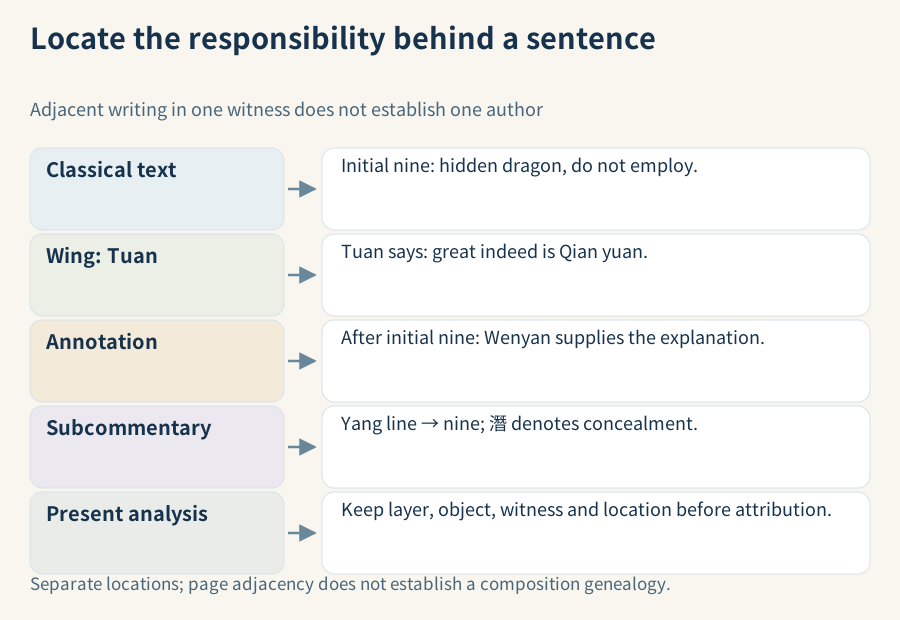
The complete figure is shown below. Select it to enlarge the labels. Open full-size figure · PNG
Test two rewritten notes
An over-combined note might say: the original author wrote Qian yuan heng li zhen and then explained it with great indeed is Qian yuan. This bypasses the distinction between classical text and Wing, along with the authorship evidence. A more defensible note says that this witness separately contains the Qian statement and the opening Tuan passage; their interpretive relationship must be described by layer.
An over-separated note might say: because the classical text and Wing are different layers, the Wing cannot help us read the classical text. That also goes too far. The Wing is an actual interpretive tradition and can enter the reading. The qualification is that it offers an interpretation rather than silently replacing the sentence.
These tests show that layers need not be sealed off from one another. Preserve their responses and responsibilities. The next article starts with Qian's actual figure and line designations, linking symbol, position and statement before considering their interpretation.
Sources and further reading
卷一题署与责任层; 卷1, scan2, folio unverified, left blank. Selected witness/source page Separate location: Catalogue fields imported by Commons / metadata
乾卦形与经句; 卷1, scan2, folio unverified, left blank. Selected witness/source page
乾彖传起首; 卷1, scan10, folio unverified, left blank. Selected witness/source page
Chinese Philosophy of Change (Yijing): opening multilayer overview; Scholarly/catalogue layer; ancient image/folio inapplicable. Selected witness/source page
乾初九; 卷1, scan3, folio unverified, left blank. Selected witness/source page
初九后的短注; 卷1, scan3, folio unverified, left blank. Selected witness/source page
初九疏释爻称与潜字; 卷1, scan3, folio unverified, left blank. Selected witness/source page
彖辞疏的传统题述; 卷1, scan10, folio unverified, left blank. Selected witness/source page
Punctuation, translations, comparisons and diagrams are original. Classical statements, Wings, annotation, subcommentary and modern scholarship retain their layers; original scans are not republished. Finite interpretation, not a complete critical edition or validated life prediction.
Evidence and source roles
These roles distinguish ancient text, older commentary, historical scholarship and tool reproduction. The numbered notes in the article retain the precise scan pages and explanations. Library and academic sources do not endorse predictive claims.
- YC1-E00-TITLE · Historical edition evidence: 卷一题署与责任层
Text layer in the witness: Visible manuscript heading and responsibility inscription; physical 勅 retained. Copy date and other duties are separately catalogued. - YC1-E01-QIAN · Ancient text evidence: 乾卦形与经句
Text layer in the witness: Classical hexagram figure and statement in this manuscript; original schematic in the article is newly drawn. - YC1-E01-TUAN · Ancient text evidence: 乾彖传起首
Text layer in the witness: Tuan Wing wording; not a hexagram or line statement and not a modern translation. - YC1-M01-SEP · Modern scholarly analysis: Chinese Philosophy of Change (Yijing): opening multilayer overview
Text layer in the modern scholarly analysis: Modern scholarly discussion of a composite text; neither an ancient manuscript image nor an authenticated original author’s account. No modern translation copied. - YC1-E02-INITIAL · Ancient text evidence: 乾初九
Text layer in the witness: Classical line statement in this manuscript; designation and position retained. - YC1-E01-NOTE · Older commentary evidence: 初九后的短注
Text layer in the witness: Older annotation marked 注云; distinct from classical/Wing wording and the subcommentary. - YC1-E01-GLOSS · Older subcommentary evidence: 初九疏释爻称与潜字
Text layer in the witness: Subcommentary marked 疏 or 正義曰; its traditional attribution and interpretation are not authenticated ancient authorship. - YC1-E01-TRADITIONAL-ATTRIBUTION · Older subcommentary evidence: 彖辞疏的传统题述
Text layer in the witness: Subcommentary marked 疏 or 正義曰; its traditional attribution and interpretation are not authenticated ancient authorship.