With a six-line hexagram, ask which position, which line and which statement before looking for a fortune label. The figure and line statements locate one another, but they are different records. Nine in a line designation is not automatically a ninth position or someone's age.
This article uses the Qian figure and visible designations such as initial nine and upper nine in the same Zhou yi zhu shu manuscript. The originals support finite readings. The diagram below is a newly drawn six-line structure, not a reproduced institutional image or a claim to have collated the complete classic and Wings.[1–4]
Separate four kinds of information
First is the figure: Qian has six solid lines on this page. Second is position: initial, second, third, fourth, fifth and upper distinguish locations within the hexagram. Third is the line designation, such as initial nine, nine in the second position or upper nine. Fourth is the statement attached there. Keeping these fields separate prevents six similarly drawn lines from becoming six identical sentences.[1–4]
Retrieve the positions from bottom to top: initial is lowest and upper is at the top. A modern diagram can add numbers 1–6 as a convenient index. Those Arabic numerals are editorial aids; they are not an assertion that the manuscript prints modern coordinates.
Initial nine and upper nine both contain nine but occupy different locations. Nine in the second position and nine in the fifth also share nine while distinguishing second from fifth.[5,6] Consequently, nine cannot mean the ninth line of this figure. This simple test identifies which part of a repeated designation does the locating work.
A line designation is not a stem-branch label
The selected Qian lines are designated nine. This subcommentary states 九為老陽六為老陰, nine is old yang and six old yin, and says that old yin and old yang both change.[4] That is its explanation of numbers and change, not a reference to elderly people. Nor does a static Qian figure record six changing lines in a particular cast. The first task here is to identify how a label attaches to a position. A number alone does not turn it into a birth month, an annual-cycle index or an ancient computer encoding.
The stems and branches of the Four Pillars belong to another record system. Six line positions and four pillars have different structures. Nine in the second position has no automatic conversion into a particular day stem. Anyone proposing a conversion needs an actual mapping, its inputs and its evidence. A shared occurrence of yin-yang vocabulary cannot supply those operations.
Recognizing designations and positions therefore does not establish a divination procedure for obtaining numbers. How an operation produces a line, how change is determined and which statements are selected are further questions. Article four separates received procedural wording from reconstruction; this static diagram does not replace either.
Similar marks can accompany different statements
Qian's initial-nine and upper-nine statements differ.[2,3] That is enough to reject the simplified note every solid line gives the same advice. Line shape supplies one identifying layer. Position and wording still have to be retained separately.
A note containing only Qian, nine and dragon cannot identify initial or upper, or retain the action or restriction at either location. Qian / initial nine / statement at that position is retrievable. Replacing the statement with the first stage must succeed adds a factual prediction absent from the designation itself.
Bottom-to-top is likewise a direction for retrieving the figure, not someone's inevitable life course. A reading of six positions as a necessary timeline needs additional textual and interpretive evidence. Position may carry temporal significance in an interpretation, but the drawing's vertical arrangement alone does not assign every person six age bands.
| Recorded information | Directly retrievable | Not established by that information |
|---|---|---|
| Qian's six solid lines | The figure on this page | Identical meanings for every line statement |
| Initial nine and upper nine | Different designations within the hexagram | Fixed beginning and ending ages |
| Nine in positions two and five | Different functions for nine and the position | Nine as a stem-branch label or score |
| A selected line statement | Its wording and restrictions | Every divination tradition's selection rules |
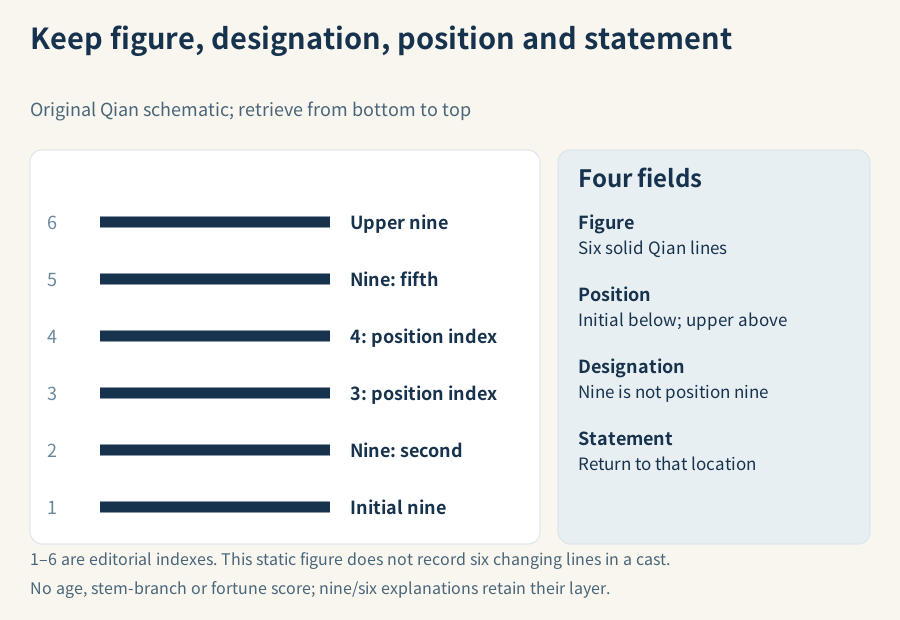
The complete figure is shown below. Select it to enlarge the labels. Open full-size figure · PNG
Reverse the lookup to expose missing fields
Begin with the index upper nine, identify its top position within the named hexagram, and then return to the statement. Try an index containing only nine: it cannot identify one location, so the hexagram and position must be restored. That is why a complete designation is more useful than an isolated term.
Six solid lines locates the figure but does not specify which statement to read. Qian initial nine provides a particular entry, yet cannot recover wording already omitted from a note. An index brings the reader back to the text; it does not replace it.
This check does not determine one unique procedure for all divination traditions. It identifies the fields needed to verify a diagram. The next article compares the scope of Qian's whole-hexagram statement with selected line statements and their particular situations.
Sources and further reading
乾卦形与经句; 卷1, scan2, folio unverified, left blank. Selected witness/source page
乾初九; 卷1, scan3, folio unverified, left blank. Selected witness/source page
乾上九; 卷1, scan9, folio unverified, left blank. Selected witness/source page
疏的九六与变化分述; 卷1, scan5, folio unverified, left blank. Selected witness/source page Separate location: 卷1 / 4
乾九二; 卷1, scan5, folio unverified, left blank. Selected witness/source page
乾九五; 卷1, scan9, folio unverified, left blank. Selected witness/source page
疏对初与上称呼的讨论; 卷1, scan4, folio unverified, left blank. Selected witness/source page
Punctuation, translations, comparisons and diagrams are original. Classical statements, Wings, annotation, subcommentary and modern scholarship retain their layers; original scans are not republished. Finite interpretation, not a complete critical edition or validated life prediction.
Evidence and source roles
These roles distinguish ancient text, older commentary, historical scholarship and tool reproduction. The numbered notes in the article retain the precise scan pages and explanations. Library and academic sources do not endorse predictive claims.
- YC1-E01-QIAN · Ancient text evidence: 乾卦形与经句
Text layer in the witness: Classical hexagram figure and statement in this manuscript; original schematic in the article is newly drawn. - YC1-E02-INITIAL · Ancient text evidence: 乾初九
Text layer in the witness: Classical line statement in this manuscript; designation and position retained. - YC1-E02-UPPER · Ancient text evidence: 乾上九
Text layer in the witness: Classical line statement in this manuscript; designation and position retained. - YC1-E02-NINE-SIX · Older subcommentary evidence: 疏的九六与变化分述
Text layer in the witness: Subcommentary marked 疏 or 正義曰; its traditional attribution and interpretation are not authenticated ancient authorship. - YC1-E02-SECOND · Ancient text evidence: 乾九二
Text layer in the witness: Classical line statement in this manuscript; designation and position retained. - YC1-E02-FIFTH · Ancient text evidence: 乾九五
Text layer in the witness: Classical line statement in this manuscript; designation and position retained. - YC1-E02-POSITIONS · Older subcommentary evidence: 疏对初与上称呼的讨论
Text layer in the witness: Subcommentary marked 疏 or 正義曰; its traditional attribution and interpretation are not authenticated ancient authorship.