A whole-hexagram statement and a statement at one line have different scopes. In Qian, retaining only dragon, favorable or regret loses the location and the connection with an action. Arranging its six positions as everyone's inevitable ladder of success adds a separate rule.
This article compares the Qian statement with three finite line selections: initial nine, nine in the second position and upper nine. The task is to preserve whole and local scope. It is not a complete paired reading of Qian and Kun; the next collection develops representative hexagram pairs.[1–4]
The hexagram statement does not finish every line's argument
乾元亨利貞 is the entry to Qian as a whole.[1] The four terms are retained here rather than making one modern rendering the predetermined conclusion of every line statement. Hexagram and line already have different scopes: the hexagram name retrieves the group, while a line designation narrows the location.
A retrieval experiment makes this visible. Qian alone does not identify whether the quotation is the whole-hexagram statement or a particular line. Qian initial nine identifies a local entry. Changing its local restriction into Qian always says this expands a precise location into an unconditional claim about the whole hexagram.
The reverse inference also fails. A statement for the whole hexagram does not require identical advice at every position. Compare the actual sentences to ask how whole and local scopes constrain one another, rather than attaching an eternally positive or negative label first.
A repeated dragon image carries different actions
Initial nine reads 潛龍勿用: hidden dragon, do not employ. Nine in the second position reads 見龍在田利見大人: a dragon appears in the field; favorable to see a great person. Upper nine reads 亢龍有悔: an elevated or overreaching dragon has regret.[2–4] Punctuation and these renderings are editorial. The selections are located separately; unquoted intervening text is not represented as one continuous passage.
The dragons invite comparison without making the sentences synonymous. Hidden, appearing and kang differ, as do do not employ, favorable to see and has regret. Reducing all three to dragon represents ability cannot explain their different actions and assessments.
Do not employ preserves the prohibition. Great person retains a contextual term without assigning a modern job title or a Four Pillars auxiliary-star label. The sense of kang can be examined through annotations and subcommentary. The minimum checkable point here is that the upper-nine sentence includes regret; it is not simply higher is better. Interpretation should retain the lexical question rather than fill it with an invented modern story.
Bottom-to-top is not a compulsory biography
Initial to upper is a retrieval direction. The preceding article separated location and designation. Assigning initial nine to childhood, second nine to youth and upper nine to old age would still need an age mapping and evidence for it. Six rows by themselves do not establish those assignments.
Using the three images for a comparison of situations is a different, explicitly identified reading operation. What remains hidden and restricted from employment? What appears and involves seeing a great person? What is elevated or overreaching and carries regret? Such questions return to words rather than fit someone's actual experience into a predetermined six-part biography.
They also do not turn the initial-nine restriction into never act. The sentence belongs to initial nine. To discuss another location, return to its statement. Do not universalize a local prohibition, or delete a prohibition actually present because a more encouraging summary is desired.
An interpretive Wing retains its own identity
The Tuan passage separately opens 彖曰大哉乾元, Tuan says, great indeed is Qian yuan.[5] It marks an interpretive voice. Using it to read Qian requires identifying the transition from classical statement to Wing. The Tuan opening is not part of the original initial-nine or upper-nine sentence.
This distinction also separates two kinds of dispute. Different renderings of kang concern wording and interpretation. A subcommentary linking six positions to a temporal scheme concerns that layer's organization of situations. Identify the objects before comparing opinions. An encouraging sentence and a cautionary sentence do not by themselves make the whole classic contradictory.
The current evidence consists of finite passages and locations in this witness. It supports a reading exercise, not a complete survey of historical interpretations or independent proof that one explanation has unique original-author authority.
| Extracted summary | Omitted information | Retrievable record |
|---|---|---|
| Qian always favors action | Initial nine's prohibition | Identify initial nine and retain do not |
| An appearing dragon guarantees success | In the field and the object great person | Record the situation and favorable-to-see clause |
| An upper position is always better | Upper nine's regret | Keep position and assessment as separate fields |
| The three sentences are three age bands | These statements supply no such age table | Locate the age interpretation separately |
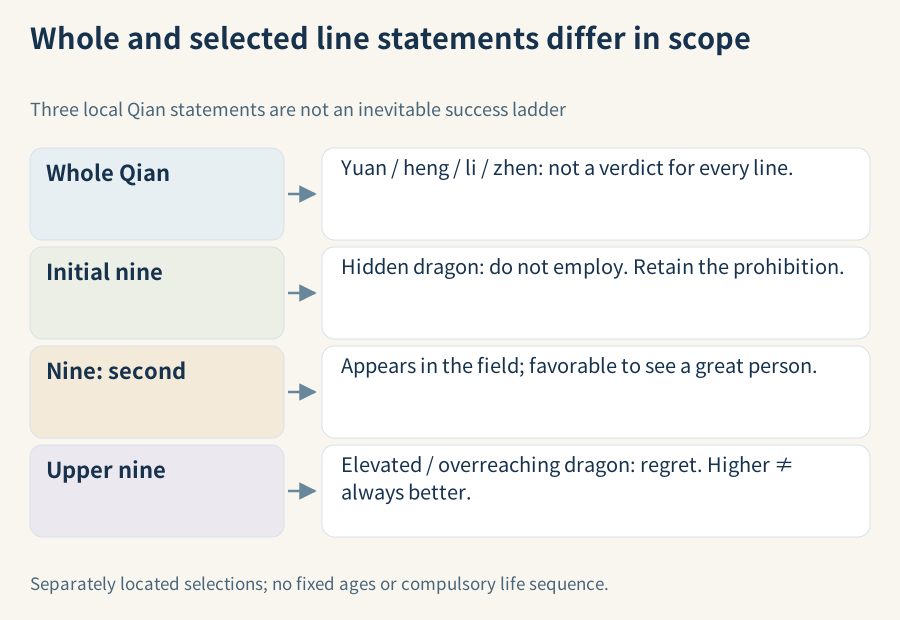
The complete figure is shown below. Select it to enlarge the labels. Open full-size figure · PNG
A note must lead back to its sentence
A useful situation note records hexagram, position, image, action or restriction, and assessment. Leave a field blank if the selected statement does not supply it; do not borrow from another line. If suitable for action cannot be traced to an actual action and its qualification, reduce the claim.
Try removing initial nine: can a reader still locate the prohibition? Remove do not: has the relationship reversed? Remove great person: has a specified object become a universal benefit? These tests need no fictional birth chart and establish no predictive efficacy. They check whether the sentence survives its summary.
Return to the whole statement after that check and ask which interpretation connects it to the lines. The next article moves to the actions and numbers of Great Expansion, distinguishing procedural wording from reconstruction and evidence of practice.
Sources and further reading
乾卦形与经句; 卷1, scan2, folio unverified, left blank. Selected witness/source page
乾初九; 卷1, scan3, folio unverified, left blank. Selected witness/source page
乾九二; 卷1, scan5, folio unverified, left blank. Selected witness/source page
乾上九; 卷1, scan9, folio unverified, left blank. Selected witness/source page
乾彖传起首; 卷1, scan10, folio unverified, left blank. Selected witness/source page
Punctuation, translations, comparisons and diagrams are original. Classical statements, Wings, annotation, subcommentary and modern scholarship retain their layers; original scans are not republished. Finite interpretation, not a complete critical edition or validated life prediction.
Evidence and source roles
These roles distinguish ancient text, older commentary, historical scholarship and tool reproduction. The numbered notes in the article retain the precise scan pages and explanations. Library and academic sources do not endorse predictive claims.
- YC1-E01-QIAN · Ancient text evidence: 乾卦形与经句
Text layer in the witness: Classical hexagram figure and statement in this manuscript; original schematic in the article is newly drawn. - YC1-E02-INITIAL · Ancient text evidence: 乾初九
Text layer in the witness: Classical line statement in this manuscript; designation and position retained. - YC1-E02-SECOND · Ancient text evidence: 乾九二
Text layer in the witness: Classical line statement in this manuscript; designation and position retained. - YC1-E02-UPPER · Ancient text evidence: 乾上九
Text layer in the witness: Classical line statement in this manuscript; designation and position retained. - YC1-E01-TUAN · Ancient text evidence: 乾彖传起首
Text layer in the witness: Tuan Wing wording; not a hexagram or line statement and not a modern translation.