A worked reading is most useful when another reader can see where each conclusion came from. This example therefore keeps the birth record, the calculated symbols, the text's reasoning, and our editorial judgment separate. It uses a complete fictional chart, without inventing a career, marriage, illness, or event history to make the reading seem accurate.
The purpose is to demonstrate an auditable traditional reading process. It is not a prediction for a real person or a test of predictive validity.
1. Check the input before interpreting its labels
The fictional record is 18 April 2001, 12:18 local civil time, Los Angeles, California. The selected city record uses longitude −118.24368 and time zone America/Los_Angeles. The site's male option is selected for the traditional cycle-direction calculation; the reading year is 2026.
The current calculation was reproduced from the site's source. Its runtime returns UTC−7 for the record, against the configured UTC−8 reference, a 60-minute difference. Longitude contributes about +7.03 minutes and the equation-of-time estimate about +0.52 minutes. Together they adjust the civil clock by about −52.45 minutes. The calendar library receives 11:25 on the same date. This is the site's automatic convention; there is no manual solar-time switch. [1]
The resulting pillars are:
| Year | Month | Day | Hour |
|---|---|---|---|
| 辛巳 | 壬辰 | 辛亥 | 甲午 |
The record is away from midnight and the hour-branch boundary. That makes this example less vulnerable to a small time change, but does not erase implementation limits. In particular, the site does not independently align overseas solar-term instants on an absolute UTC timeline. A near-boundary record needs another calculation audit before interpretation. [1]
2. Make an inventory without a verdict
辛, yin Metal, is the day reference. The visible year 辛 is Companion; month 壬 is Hurting Officer; hour 甲 is Direct Wealth. The day 辛 itself is the reference, not a second Companion added to a score.
The branch inventory is:
| Branch | Contained stems | Relations to 辛 |
|---|---|---|
| 巳 | 丙、戊、庚 | Direct Officer, Direct Resource, Rob Wealth |
| 辰 | 戊、乙、癸 | Direct Resource, Indirect Wealth, Eating God |
| 亥 | 壬、甲 | Hurting Officer, Direct Wealth |
| 午 | 丁、己 | Seven Killings, Indirect Resource |
This table establishes presence and location. It does not make hidden 丙 a visible natal Officer, turn 丁 into a dominant Seven Killings pattern, or decide whether the Resource relations are sufficient.
3. Build the seasonal argument and preserve contrary evidence
The month is 辰, a late-spring context in the traditional seasonal sequence. Its contained 戊, 乙 and 癸 give Resource, Wealth and Output relations, rather than one undifferentiated Earth vote.
Support for the day reference can be investigated through the visible year 辛, the Earth Resource in 辰 and other branches, and the Metal contained in 巳 as 庚. These are concrete entries, but their existence is not a complete strength judgment.
The other side of the argument is equally visible. 壬 is Output, with the same stem contained in 亥. 甲 is Wealth, also contained in 亥. Output and Wealth introduce demands on the day reference within the traditional model. The Fire controlling relations occur in 巳 and 午. The natal 巳亥 clash is a further relationship to record, especially because 亥 supplies the exact contained-stem links for 壬 and 甲. A clash label does not authorize deleting all those contents from the inventory or claiming that a life event occurred.
The defensible intermediate result is a two-sided note: “Several supports exist, while visible Output and Wealth have identifiable branch links; controlling relations and the 巳亥 interaction also require attention.” This is more informative than a one-word strength label and more honest than pretending the competing evidence has already been resolved.
4. Compare two candidate organizing relations
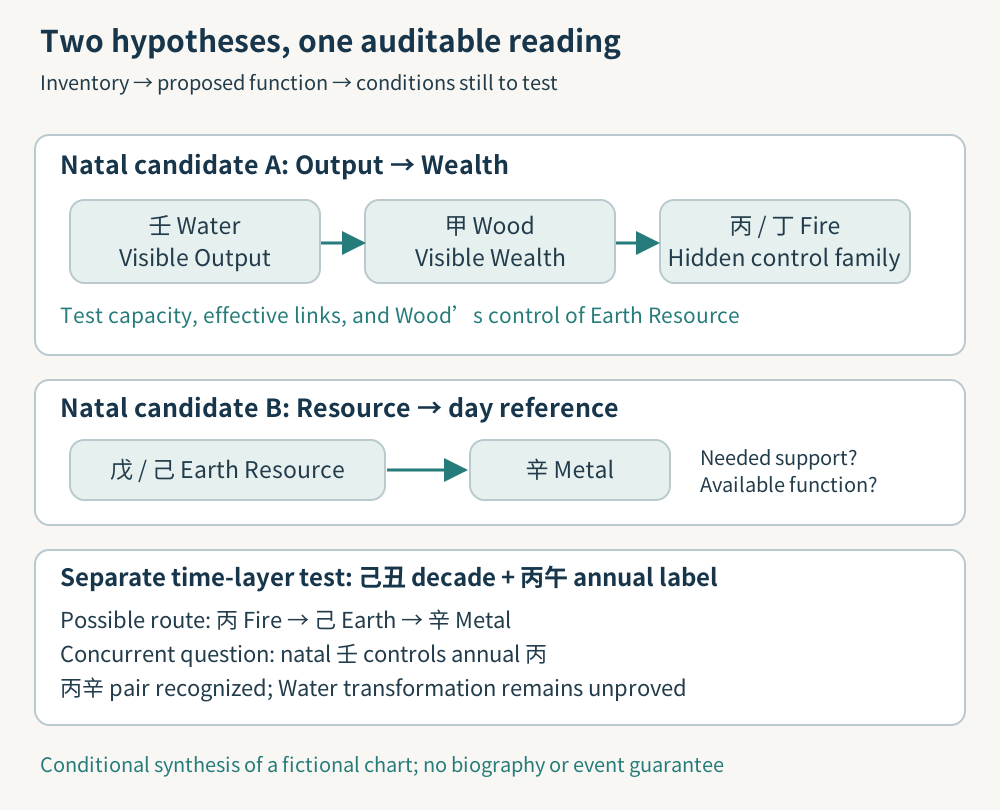
Scroll horizontally to read the figure; open the original for a full-size view. Open full-size figure · PNG
The diagram is an editorial synthesis. Its arrows identify symbolic routes, not calculated quantities.
Candidate A: Output leading to Wealth. The visible 壬 Water generates the visible 甲 Wood. Both have exact contained-stem links in 亥. This makes the route easy to identify and worth examining. It does not establish its suitability: can the day reference sustain the Output, and can the resulting Wealth operate without undermining needed Resource?
The Hurting Officer chapter provides a relevant conditional discussion:
“如遇傷官者,須見其財為妙,是財能生官也。”
Our translation: “Where Hurting Officer is encountered, seeing its Wealth is considered appropriate, because Wealth can generate Officer.” [2]
In this example, Water generates Wood and Wood generates Fire. That is the structural route described by the explanation. But Wood also controls Earth Resource. The passage cannot be used to declare every appearance of 甲 desirable while ignoring that competing relation.
Candidate B: Resource supporting the day reference. Earth generating Metal is also an identifiable route. The question is whether that support is needed and effectively available. Wood's control of Earth and Earth's control of Water then become part of the same inquiry. More Resource is not automatically an improvement if an effective Output route is the function being preserved.
These candidates are not mutually exclusive dictionary names. They are competing proposals for what organizes this particular reading. To choose between them, a reader must make the strength and availability argument explicit. The current inventory supports investigation of both; it does not justify announcing a final exclusive 用神. An undecided result is useful when it names the exact decision still missing.
5. Do not convert the calculator's summary into a book conclusion
The current tool labels this chart “comparatively balanced” and lists Water and Earth as helpful. Those labels come from its engineering weights and category rules. We have reproduced them, but do not use them as a ruling from Yuanhai or as proof that both Water and Earth should be added indiscriminately. [1]
Jishan pian says “用神不可損傷,日主最宜健旺”: “The operative factor should not be damaged; a supported day reference is preferred.” [3] To apply this passage, we must first state what function we are proposing to preserve. That inquiry has not been completed simply because a program printed two element names.
6. Introduce the decade and annual layers separately
Under the selected traditional male/yin-year rule, the library calculates reverse direction. It gives a start interval of 4 years, 5 months and 20 days and a first start date of 8 October 2005, 11:25 in its adjusted date-time fields. The sequence begins 辛卯, then 庚寅, then 己丑. The site's target-year selection places 2026 in the 己丑 decade, grouped as 2025–2034. This year bucket is not a claim that an exact changeover occurs on 1 January. [1]
The decade introduces visible 己, Indirect Resource relative to 辛, and 丑, whose inventory includes 己, 癸 and 辛. These are additional time-layer entries; they do not rewrite the natal chart.
The annual pillar for the selected 2026 label is 丙午. 丙 is Direct Officer relative to 辛. Now several routes deserve inspection:
丙 Fire can generate the decade's 己 Earth, which generates 辛 Metal: a potential Officer–Resource–day-reference route
Natal 壬 Water controls annual 丙 Fire: the Output/control issue has not disappeared
Natal 甲 Wood can connect Water to Fire through generation, but this proposal still needs effective Wood and cannot erase its control of Earth
丙 and 辛 are a recognized combination pair, but pair recognition does not establish transformation into Water
Annual 午 repeats the natal hour branch; its relation with decade 丑 can also be recorded without making either label an event forecast
A useful annual question is therefore: “Does the introduced Officer find suitable support and mediation, or does it intensify an unresolved tension?” “2026 guarantees a promotion” has no warrant in this exercise.
7. Add one auxiliary lookup without letting it take over
Using the declared natal day-stem reference 辛 and the scanned Tianyi rule, the target branches are 午 and 寅. Natal 午 matches. The annual 午 also matches if the search area is explicitly changed to the annual layer. These are two labeled queries, not two guaranteed helpers. [4]
The label does not settle the Officer–Output tension or remove the hidden 丁 and 己 relations in 午. After recording the lookup, return to the structure already under discussion.
8. End with a reading record someone else can challenge
For this fictional chart, the completed record contains:
Checked facts: input convention, four pillars, contained stems, reverse cycle sequence, and selected annual pillar
Supported reading questions: seasonal support, the visible Output–Wealth route, Resource availability, and the separately introduced Officer
Open decisions: the final strength argument, the operative function to preserve, and whether the intermediary relations meet the needed conditions
Rejected shortcuts: biography invented from labels, automatic transformation, numerical scores presented as ancient doctrine, and guaranteed events
This is a complete demonstration of the reading process, including its honest stopping point. It leaves the reader with a traceable set of propositions to examine, rather than a polished story that conceals its assumptions. That is the standard to carry back to any difficult passage in Yuanhai: show the relation, show the condition, and show what would make the conclusion change.
Sources and reading notes: ancient scans, scholarship, and calculation
Current site methodology, checked against the calculation source and reproduced input on 7 October 2026. The example's data and outputs are recorded in the accompanying calculation record. Software conventions are not claimed to be identical across all schools.
1634 Shanchengtang witness, juan 2, Lun shangguan, fascicle 2 scan image 18, right lower-band large text. Output, Wealth and Officer passage. The candidate routes and diagram are our explanation, not copied life examples.
Same witness, juan 2, Jishan pian, fascicle 2 scan image 2, large-character verse. Operative factor and day reference.
Same witness, juan 1, Lun qi Yutang Tianyi guiren, fascicle 1 scan image 15, right lower band. Xin lookup. Day-stem reference and target layer are expressly declared for this exercise.
Classical quotations use editorial punctuation and limited normalization of common character forms (such as 于/於 and 强/強). Uncertain readings are identified or avoided, not silently supplied. Ancient scan links are textual evidence; scholarly history and software reproduction have separate roles.
Evidence and source roles
These roles distinguish ancient text, older commentary, historical scholarship and tool reproduction. The numbered notes in the article retain the precise scan pages and explanations. Library and academic sources do not endorse predictive claims.
- P03 · Ancient text evidence: 繼善篇
Text layer in the witness: 下欄大字正文 - P19 · Ancient text evidence: 論傷官
Text layer in the witness: 下欄大字正文 - P28 · Ancient text evidence: 論起玉堂天乙貴人
Text layer in the witness: 下欄大字正文 - E03 · Ancient text evidence: 論天干相合
- C01 · Site calculation reproduction: Fictional Los Angeles input under current site convention