A small label can acquire a surprisingly large meaning. A chart marks an “auspicious star,” and someone assumes help will arrive. A threatening historical name appears, and a reader begins worrying about an accident. Before considering either interpretation, ask a simpler question: what was looked up, from which reference, in which part of the chart?
The Yuanhai Ziping witness used in this series contains auxiliary markers called 神煞, shensha. Leaving them out would misrepresent the book. Treating their names as complete readings would also misrepresent its structure. The opening of the Jishan pian directs attention to the month command and then to the day stem as the main reference. These instructions give us a reason to keep an auxiliary lookup inside a wider structural reading. [Source 1]
This article separates three tasks: reproducing a rule, identifying a match, and deciding what a match contributes to textual interpretation. They require different evidence. None establishes a scientifically validated forecast.
Read the lookup before reading the name
Under the small-type heading 論起玉堂天乙貴人, “On Setting out the Jade Hall Tianyi Noble Person,” fascicle 1, scan-image 15, the lower-band large text contains this lookup. Two clear entries read:
甲戊庚牛羊
六辛逢馬虎,此是貴人方。
An original working translation is: “For Jia, Wu, and Geng, ox and sheep”; and “The six Xin meet horse and tiger: these are the Noble Person locations.” These are separate excerpts, not the entire poem. [Source 2]
The animals encode branches. The two entries we need give 甲 / 戊 / 庚 → 丑 Chou and 未 Wei, and 辛 → 午 Wu and 寅 Yin. Here 午, the horse branch, must not be confused with 戊, the Wu stem. English romanization alone can hide that difference. The Yi–Ji entry contains a disputed animal glyph in this impression, so we do not silently print a normalized full poem as an exact quotation.
“The six Xin” refers to the six Xin-headed pairs in the sixty-pair cycle. It does not instruct us to count six appearances of Xin in a chart. The verse compresses a stem-to-branch lookup. Its appealing name does not supply a mechanism by which a helper must appear.
Just as importantly, this quoted verse does not itself settle a universal choice between the year stem and day stem. A reader must specify the reference actually used. In the exercise below we choose the natal day stem. That choice is declared as the exercise’s convention; we do not silently turn it into wording found in this verse. A year-stem lookup, if used, should occupy its own record with its own declared convention.
A lookup with all its fields visible
Our complete fictional example uses 18 April 2001, 12:18 local civil time, Los Angeles, with the traditional male cycle option. The website’s reproduced calculation adjusts the time to 11:25 and produces 辛巳 / 壬辰 / 辛亥 / 甲午. This reproduces the calculator’s convention. It is not a claim that every school will calculate identically.
For one transparent query, write down:
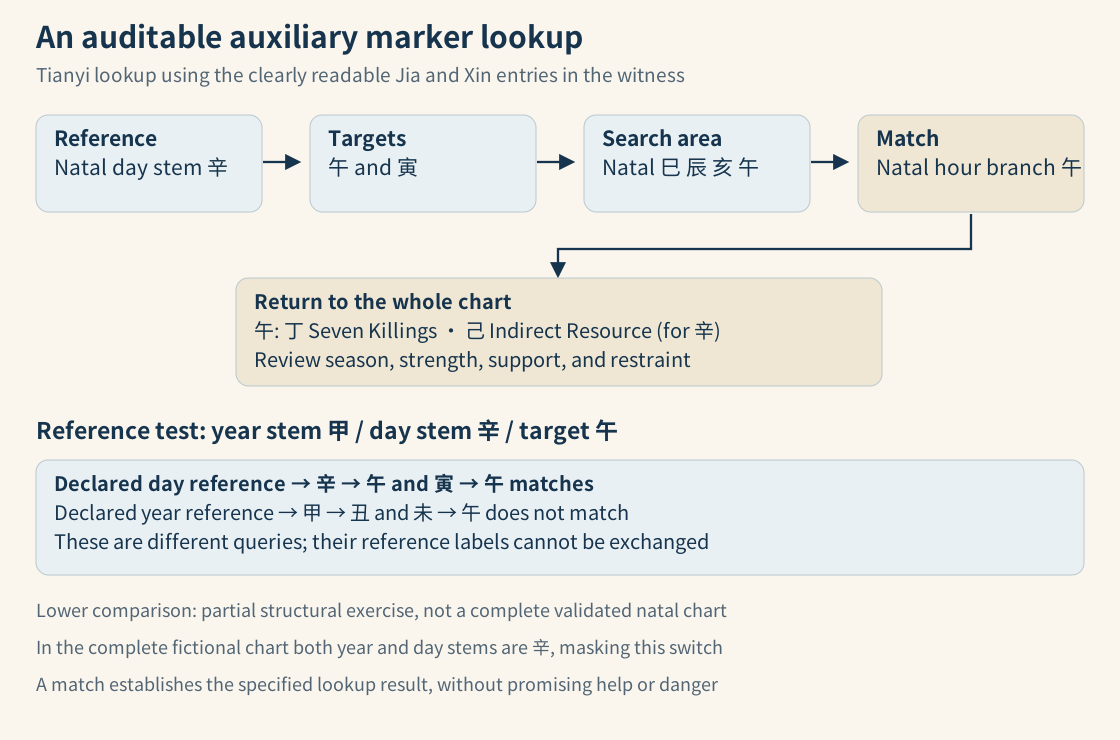
Marker: Tianyi Noble Person, using the scanned verse above
Reference: natal day stem 辛 Xin
Lookup targets: 午 Wu and 寅 Yin
Search area: the four natal branches, 巳 / 辰 / 亥 / 午
Result: the hour branch 午 matches; 寅 is absent
The result is reproducible. A second reader can check every step without accepting an interpretation of fortune. The natal year stem is also 辛 in this example, so a year-stem query produces the same target set. That agreement does not prove that the references are interchangeable. This particular chart simply cannot reveal the mistake of switching between them.
Figure F09 follows this query through reference, rule, search area, and match. A separate path carries the result back to the whole-chart reading. There is no arrow from “match” to a promised event.
Scroll horizontally to read the figure; open the original for a full-size view. Open full-size figure · PNG
Change the reference and test the difference
Partial structural exercise, not a complete validated natal chart. Let the year stem be 甲 Jia, the day stem 辛 Xin, and one target branch 午 Wu. These symbols isolate a lookup; their arrangement is not offered as a possible birth record.
With a declared day-stem reference, 辛 leads to 午 and 寅, so 午 matches. With a declared year-stem reference, 甲 leads to 丑 and 未, so 午 does not match. Both queries follow the same scanned table. They answer different questions.
The error appears when the record says “day-stem Tianyi” but the calculation uses 甲 from the year. Likewise, a result obtained from the day cannot be described as a year-reference match. When two methods legitimately use different references, keep two labeled results rather than choosing whichever produces the more attractive story.
This is also why a list copied from another calculator needs checking. A label may be correct under its own reference convention while being unsuitable for the question being asked here. The current site’s output should never be presented as offering every historical lookup discussed in this article.
Put the result back into the branch
Return to the full fictional chart’s 午. Under the site’s verified hidden-stem convention, 午 contains 丁 Ding and 己 Ji. Relative to a 辛 Day Master, 丁 is Seven Killings and 己 is Indirect Resource. The branch therefore participates in the chart’s control and support relations while also matching our chosen Tianyi query.
The marker does not remove 丁’s controlling relation, make 己 automatically helpful, or resolve the chart’s seasonal strength. Those questions still require the month context, roots, visible stems, and other branches. Similarly, a branch clash is a structural relation; an auxiliary label cannot simply cancel it by sounding more auspicious.
Fascicle 1 also contains 論驛馬, “On the Travelling Horse.” Its large-text lookup gives 申子辰馬在寅, “For Shen, Zi, and Chen, the horse is at Yin,” followed by the other branch-group entries. [Source 3] This is a different kind of reference: a branch group leads to a target branch. A Tianyi stem table cannot be used to calculate it. Recognizing that distinction is more useful than memorizing a long collection of star names.
Read historical judgments critically
Accurate transcription does not require agreement with the book’s judgments. In the small-text old commentary under 論天羅地網, “On the Heavenly Net and Earthly Mesh,” fascicle 1, scan-image 19, we find 男子忌之於天羅,女人忌之於地網: “Men are to avoid the Heavenly Net; women are to avoid the Earthly Mesh.” [Source 4]
That is a gendered assertion in this witness. It is not evidence that a man or woman faces a particular danger, and we do not adopt it as the website’s conclusion. Terms involving nobility, criminality, widowhood, or social rank likewise need their historical frame identified. A technical match cannot establish someone’s moral character, sexual behavior, value, or rightful place in society.
The distinction matters when translating. Replacing a harsh old phrase with a comforting personality trait may feel kinder, but it still invents a modern psychological claim. A better reading explains the old language, marks its limits, and declines to assign the person an unsupported trait or outcome.
A practical four-line record
For each auxiliary marker, keep four lines:
State the rule and its source, including the edition and scan-image.
Name the reference precisely: year stem, day stem, year branch, day branch, or another specified input.
Name the target layer: natal branches, a decade-cycle branch, or an annual branch. List the actual matches.
Explain its limited relevance after reviewing the branch’s ordinary structural relations. Leave unsupported conclusions open.
If you later search the annual branch 午 in 2026 using the same natal 辛 reference, label it an annual-layer match. Do not rewrite it as another natal star. Nor should a fresh lookup based on the annual stem 丙 be substituted without declaring that entirely different question.
The useful endpoint is a reading someone else can audit: “This specified rule, using this reference, matches this branch in this layer.” That small sentence protects the larger reading from both glamorous promises and frightening names.
Sources and reading notes: ancient scans, scholarship, and calculation
1634 Yu-family Shanchengtang witness, fascicle 2, scan-image 2, 繼善篇, lower-band large verse: the reading priority of the month and the day-stem reference. The book’s rank language is historical, not a measure of human worth. View scan-image 2
Same witness, fascicle 1, scan-image 15, 論起玉堂天乙貴人, small-type heading, with the quoted poem in lower-band large text. Animal-to-branch expansion and English translation are ours. View scan-image 15
Same witness, fascicle 1, scan-image 16, 論驛馬, lower-band large text. View scan-image 16
Same witness, fascicle 1, scan-image 19, 論天羅地網, lower-band small old commentary. View scan-image 19
All punctuation in the short classical quotations is editorial. Scan-image numbers are one-based PDF images, not traditional leaf numbers.
Classical quotations use editorial punctuation and limited normalization of common character forms (such as 于/於 and 强/強). Uncertain readings are identified or avoided, not silently supplied. Ancient scan links are textual evidence; scholarly history and software reproduction have separate roles.
Evidence and source roles
These roles distinguish ancient text, older commentary, historical scholarship and tool reproduction. The numbered notes in the article retain the precise scan pages and explanations. Library and academic sources do not endorse predictive claims.
- P01 · Ancient text evidence: 繼善篇
Text layer in the witness: 下欄大字正文 - P02 · Ancient text evidence: 繼善篇
Text layer in the witness: 下欄大字正文 - P28 · Ancient text evidence: 論起玉堂天乙貴人
Text layer in the witness: 下欄大字正文 - P29 · Ancient text evidence: 論驛馬
Text layer in the witness: 下欄大字正文 - P30 · Older commentary evidence: 論天羅地網
Text layer in the witness: 下欄小字雙行夾注(舊注),非大字正文 - C01 · Site calculation reproduction: Fictional Los Angeles input under current site convention