Selecting a new year in a calculator adds a new question to a chart. It does not replace the birth chart or turn one annual symbol into a complete account of the year ahead. A careful timing reading keeps three layers visible: the natal configuration, the ten-year cycle, and the annual pillar.
Yuanhai Ziping gives different emphases to these layers and warns against treating its examples as fixed formulas. This article reads that warning alongside one fully specified fictional calculation. The aim is to understand how a relationship changes when a symbol enters at a different time scale, without inventing annual events or a biography.
Three layers answer different questions
The natal configuration, 原局, supplies the four birth pillars and their relations. Its month command records the seasonal birth context. Its day stem supplies the relational reference used in this series. Neither becomes a different birth symbol merely because the selected year changes.
A ten-year cycle, 大運, introduces a stem–branch pair for a longer period under the calculation method being used. Its sequence and entry point require their own calculation. It can be compared with the natal structure, but it is not a fifth birth pillar.
The annual pillar, 流年, adds another pair for the selected year. The text also uses 歲君, “ruler of the year.” This is the book’s historical language for the annual factor, not an actual authority governing a person’s decisions.
In 論大運, “On the Major Cycles,” fascicle 3, scan-image 12, the lower-band large prose says:
子平之法,大運看支,歲君看干。
An original translation is: “In the Ziping method, examine the branch for the major cycle and the stem for the year’s ruler.” [Source 1]
This sentence states an emphasis. It should not be expanded into a claim that the book never examines a cycle stem or an annual branch. Nor does it instruct us to merge the two into one unlabeled pair. At minimum, the reader must know which symbol comes from which layer before discussing its relation to the natal chart.
The chapter limits its own examples
The same chapter goes on to say:
此乃死法譬喻,須隨格局喜忌推之,不可執一,妙在識其通變。
“These are rigid schematic illustrations; they must be interpreted according to the configuration’s preferences and objections. One must not cling to a single rule; the skill lies in recognizing how the reading changes.” [Source 2]
The word 此, “these,” points back to the discussion and its examples. The qualification belongs with them. Extracting an earlier alarming statement while dropping this qualification changes how the chapter can be read.
格局喜忌 asks what the configuration in question needs or resists. Article 7 showed why those conditions vary between regular and exceptional readings. Here the same discipline applies to time: a newly introduced relation must be considered in a specific configuration, including counteracting and supporting relations. The separate chapter 論太歲吉凶 adds 八字有救,無畏: “If the four pillars have a rescuing relation, there is no fear.” [Source 5] The exception requires us to identify what provides the “rescue,” rather than treating an annual factor as an unconditional verdict. These qualifications do not validate the book’s historical claims about illness, family harm, or fortune. We discuss its method without adopting those claims as factual predictions.
Calculate the entry separately
Fascicle 1, scan-image 20, 論起大運法, “On Calculating the Start of the Major Cycles,” gives forward and reverse counting directions and says 三日以為一歲, “three days are reckoned as one year.” [Source 3]
This is a conversion ratio in a traditional cycle-entry calculation, using an interval from birth toward a specified seasonal term. It is not a statement about ordinary calendar aging. Applying it requires the direction rule, which term is used, the birth-time convention, and the calculation’s treatment of the interval. The printed ratio alone cannot certify a modern calculator’s precise output.
Our fictional record is 18 April 2001 at 12:18 local civil time, Los Angeles, with the traditional male cycle option selected. The reproduced website calculation adjusts the time to 11:25 and returns 辛巳 / 壬辰 / 辛亥 / 甲午. It uses a reverse cycle sequence and returns an entry interval of four years, five months, and twenty days, with initial entry at 8 October 2005, 11:25 under that implementation.
The library also groups cycle records by calendar-year labels: 辛卯 for 2005–2014, 庚寅 for 2015–2024, 己丑 for 2025–2034, and 戊子 for 2035–2044. The current site matches its selected year to those records. These labels must not be presented as independently verified exact changeover instants on 1 January. The initial entry timestamp and the later year-bin labels are different kinds of output.
Sex selection here belongs to a traditional direction rule. It does not justify a sex-based psychological interpretation or a judgment of anyone’s worth. This reproduction documents the site’s convention rather than declaring one universal calculation across schools.
Read the selected year without losing the natal chart
For selected year 2026, the reproduced output is:
Natal pillars: 辛巳 / 壬辰 / 辛亥 / 甲午
Matched ten-year cycle: 己丑
Annual pillar: 丙午
Keep these on separate lines. Figure F08 uses a fixed natal row, a cycle timeline, and a selected-year row. Its 2026 pointer links to 己丑 while the birth row stays unchanged. The timeline labels reflect the library’s grouping; they do not pretend to resolve exact boundary times.
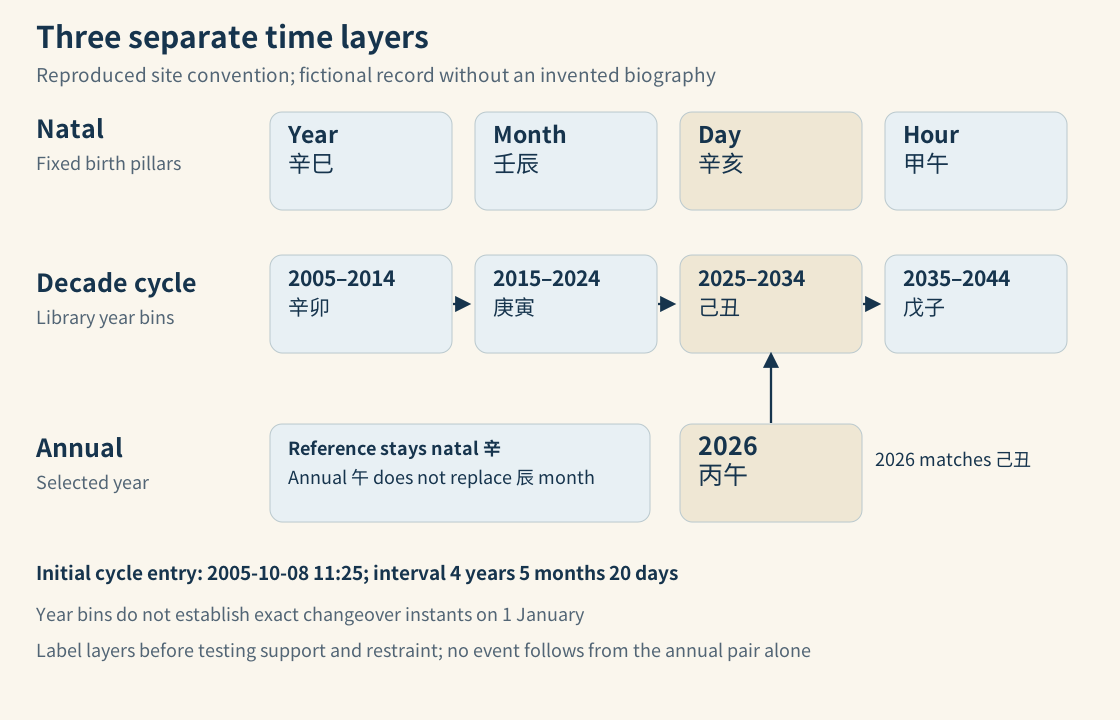
Scroll horizontally to read the figure; open the original for a full-size view. Open full-size figure · PNG
The natal Day Master remains 辛 Xin. Relative to it, the cycle stem 己 Ji is Indirect Resource: Earth generates Metal and both stems are yin. The annual stem 丙 Bing is Direct Officer: Fire controls Metal with opposite polarity. These are classifications, not promises of support or career advancement.
We can now draw a limited stem-relation exercise using the complete chart’s verified symbols. Annual 丙 Fire generates cycle 己 Earth, and 己 Earth generates natal 辛 Metal. At the same time, natal 壬 Water controls 丙 Fire, while 丙 and 辛 form a recognized stem-combination pair. The combination table appears in fascicle 1, scan-image 5. [Source 4]
That gives us several questions rather than one verdict. Does the Resource relation effectively support the Day Master? How does natal Output 壬 interact with the introduced Officer 丙? Is the combination pair merely present, or are the requirements for a further transformation argument actually met? A pair alone does not prove transformation. A generation path alone does not prove that a controlling relation has been canceled.
This stem exercise also leaves the cycle branch 丑 unfinished. The chapter explicitly emphasizes cycle branches; a complete application must examine its branch contents and relations, not stop after classifying 己. Naming what remains unread is part of an accurate explanation.
Repetition is a layer question
午 already appears as the fictional chart’s natal hour branch. In 2026, 午 also appears in the annual layer. These are two occurrences with different positions and time scopes. The annual 午 does not turn the natal 辰 month into a 午 month or move the birth into summer.
Likewise, selecting another annual pillar changes the annual comparison, not the original stem inventory. A reader can ask which previously identified relation is being revisited or newly connected. That is more precise than counting an extra Fire symbol and immediately announcing an inevitable event.
The site’s displayed year output is what we are documenting here. We do not infer an unverified 1 January annual-pillar changeover from a calendar-year selector. A boundary-sensitive reading needs the underlying annual convention and an actual date checked separately.
A repeatable timing worksheet
Use five steps for a timing comparison:
Fix the natal baseline: input convention, four pillars, month context, and day-stem reference.
Record the cycle method and entry output. Separate precise timestamps from display bins.
Add the selected annual pillar in its own layer.
Identify each changed relation by both symbols and both layers, then inspect support, restraint, and competing relations.
State the remaining uncertainty. Keep symbolic conditions separate from events you do not have evidence to predict.
A useful conclusion can be quite specific: “The selected annual Officer enters a chart that already has Output, while the matched cycle supplies a Resource relation; the branch-level and functional assessment remain open.” That is a substantive structural reading. It leaves the person’s year available to actual choices, circumstances, and evidence.
Sources and reading notes: ancient scans, scholarship, and calculation
1634 Yu-family witness, fascicle 3, scan-image 12, 論大運, right half, lower-band large prose. View scan-image 12
Same witness and image, left half, lower-band large prose. The qualification must be read with the chapter’s preceding illustrations. View scan-image 12
Same witness, fascicle 1, scan-image 20, 論起大運法, lower-band large prose. View scan-image 20
Same witness, fascicle 1, scan-image 5, 論天干相合, lower-band text. View scan-image 5
Same witness, fascicle 3, scan-image 13, 論太歲吉凶, lower-band large prose. View scan-image 13
Classical punctuation and translations are editorial. Scan-image numbers are one-based PDF images. The fictional calculation was reproduced from the current website implementation; its method and limitations are described above.
Classical quotations use editorial punctuation and limited normalization of common character forms (such as 于/於 and 强/強). Uncertain readings are identified or avoided, not silently supplied. Ancient scan links are textual evidence; scholarly history and software reproduction have separate roles.
Evidence and source roles
These roles distinguish ancient text, older commentary, historical scholarship and tool reproduction. The numbered notes in the article retain the precise scan pages and explanations. Library and academic sources do not endorse predictive claims.
- P25 · Ancient text evidence: 論起大運法
Text layer in the witness: 下欄大字正文 - P26 · Ancient text evidence: 論大運
Text layer in the witness: 下欄大字正文 - P27 · Ancient text evidence: 論大運
Text layer in the witness: 下欄大字正文 - P34 · Ancient text evidence: 論太歲吉凶
Text layer in the witness: 下欄大字正文 - E03 · Ancient text evidence: 論天干相合
- C01 · Site calculation reproduction: Fictional Los Angeles input under current site convention