A chart can contain an Officer, Wealth, Resource, and several named combinations. That inventory does not establish several complete patterns. A pattern claim is an argument: particular symbols meet particular conditions, and the remaining chart either supports that argument, interrupts it, or leaves it unresolved.
The practical question is therefore, “What would make this proposed reading fail?” Asking it early prevents a recognizable feature from becoming an impressive but untested label. Yuanhai Ziping offers a useful place to practice because its ordinary relational discussions and its exceptional named configurations do not all use the same entrance conditions.
We will read the 1634 witness’s general guidance and two exceptional chapters, test a regular Officer-oriented candidate, and compare it with 歸祿格, the Returning to Lu configuration. “Established” here describes a supported interpretation of a traditional text. It does not mean the configuration has been scientifically shown to predict a life.
Start with the scope of the sentence
In 繼善篇, Jishan pian, the large text connects the three constituent layers with configurations and asks that the operative factor be protected, with a supported Day Master. [Source 1]
The chapter 論三元 illustrates the three layers as a stem, a branch, and a stem stored within that branch. [Source 7] That layered reading makes a simple point: an isolated visible label is only part of the evidence. We also need the branch contents and seasonal context. The requirement to protect the operative factor asks whether the operative relation can function and whether the Day Master has sufficient support. It does not give a universal numerical threshold for strength or identify one helpful element for every chart.
For regular Officer discussion, 正官論, “Discussion of the Direct Officer,” defines the relation through Jia encountering Xin. It also gives the month an organizing priority, followed by examination of the rest of the chart. [Source 2]
There are two separate tasks. First classify 辛 Xin relative to a 甲 Jia Day Master: Metal controls Wood, with opposite polarity, so this is a Direct Officer. Then ask whether the seasonal framework and the rest of the structure sustain an Officer-oriented reading. The first task is a lookup. The second is a configuration argument.
A regular candidate and one changed symbol
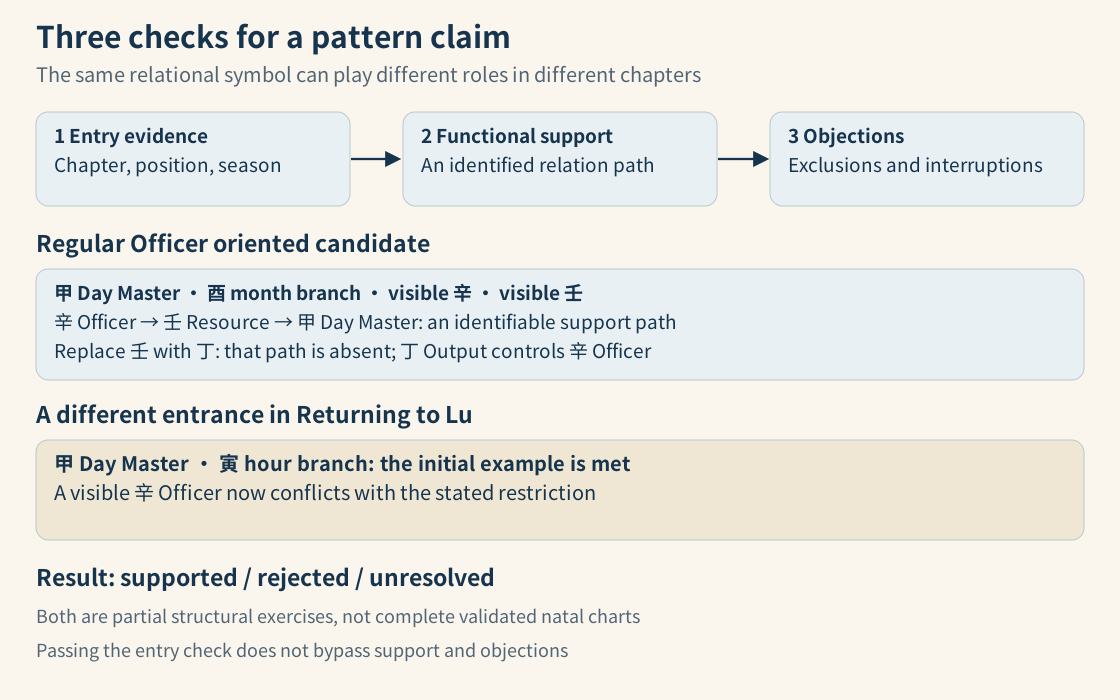
Partial structural exercise, not a complete validated natal chart. Begin with a 甲 Day Master, an 酉 You month branch, a visible 辛 Direct Officer, and a visible 壬 Ren Resource. No other pillars, roots, or cycle information are supplied.
The exercise gives us a concrete candidate. 酉 contains 辛 in the hidden-stem convention used here, so the Officer is linked to the month context rather than being only a stray visible stem. 辛 generates 壬 Water, and 壬 generates 甲 Wood. This creates an Officer–Resource–Day Master support path. The book’s 論印綬, “On Resource,” explicitly discusses generation from Officer to Resource. [Source 3]
That path supports the proposed reading. It is still not enough to announce a completed pattern: we have not checked the Day Master’s roots, competing relations, all branch contents, or whether another factor undermines the path. The honest status is “an Officer-oriented candidate with an identifiable support relation.”
Now replace 壬 with 丁 Ding while keeping the other supplied symbols. 丁 is Hurting Officer, an Output relation, for 甲. Wood generates Fire, and Fire controls 辛 Metal. The changed symbol therefore introduces an Output-to-Officer control relation and also draws on the Day Master’s Wood. The original Resource support path is no longer present in the supplied exercise.
This is a specific objection to the candidate, not a judgment that Ding or Output is inherently bad. To assess its weight in a full chart we would need season, roots, other restraints, and the surrounding relations. A reader who keeps the same pattern verdict after changing the symbol should explain why. A reader who immediately announces a ruined life has gone far beyond the evidence.
Figure F07 puts the candidate through three gates: entry evidence, functional support, and objections. A final branch reads “supported,” “rejected,” or “unresolved.” Passing the first gate never bypasses the other two.
Scroll horizontally to read the figure; open the original for a full-size view. Open full-size figure · PNG
A special configuration has its own entrance
The lower-band large text under 歸祿格, “Returning to Lu,” says 此格假令六甲日生人,得寅時,謂之歸祿: “For this configuration, suppose a person is born on one of the six Jia days and has the Yin hour; this is called Returning to Lu.” It then adds 四柱全不見官殺,見之則難歸矣: “The four pillars contain no Officer or Killings; if these appear, returning is difficult.” [Source 4]
Here 寅 is the Lu location associated with 甲, and the passage specifies its occurrence in the hour. Finding any supported Day Master, or finding a Lu branch somewhere else, does not reproduce that stated entry example. The exclusion of Officer and Killings is also part of this particular argument.
Partial structural exercise, not a complete validated natal chart. Keep a 甲 Day Master and a 寅 hour branch. These selected features meet the passage’s initial example. Now supply a visible 辛 elsewhere. 辛 is the same Direct Officer encountered in our regular exercise, but here it raises the chapter’s explicit objection to Returning to Lu.
The symbol did not change its relational classification. The configuration being tested changed. In the regular candidate, an Officer was a defining relation to examine and support. In this exceptional configuration, its presence conflicts with a stated restriction. “Officer is present” therefore cannot serve as a universal verdict of either success or failure.
Without the rest of the chart, absence is especially hard to establish. We can demonstrate that a visible 辛 is present; we cannot certify that an incomplete example contains no Officer or Killings. A full reading must define what counts as “appearing” in the passage being used and inspect the remaining stem, branch, and hidden-stem evidence accordingly.
The word “this” limits a rule
Another exceptional chapter, 六乙鼠貴格, “Six Yi Mouse Noble configuration,” says 此格如月內有官星則不用之: “For this configuration, if an Officer is present within the month, it is not used.” [Source 5]
Read the grammar carefully. 此格, “this configuration,” confines the statement to the configuration under discussion. 如 introduces a condition. 不用之 tells the reader not to use that route of interpretation when the condition applies. It does not say that every chart with an Officer in the month is defective. Transferring this restriction into the regular Direct Officer discussion would erase the very distinction the two chapters require.
These passages are enough to disprove a one-rule-fits-every-pattern approach. They are not a complete handbook of exceptional configurations, nor an invitation to bypass the month framework whenever a special name looks attractive. Each further claim needs its own entry conditions and exclusions checked.
Later systems can help readers compare ideas, but they must be named as later systems. We should not silently import the organization of Ziping Zhenquan, or a modern balancing algorithm’s definition of 用神, and present it as the exclusive structure of this Yuanhai witness.
Write a claim someone can challenge
The chapter 看命入式, “Entering the Method of Chart Reading,” warns learners against rigid application. [Source 6] That warning asks for attentive judgment, not permission to ignore inconvenient conditions.
To test a pattern claim, make a short record:
Name the actual chapter and state the exact configuration being proposed.
List its required features, including position and seasonal conditions where specified.
Show a support relation in the complete chart rather than relying on a favorable name.
List the chapter’s exclusions and any relations that interrupt the proposed function.
Mark the result supported, rejected, or unresolved, and explain what evidence would change it.
This method also allows a useful answer of “not yet established.” It distinguishes missing evidence from a failed condition and keeps a pattern label proportionate to what has actually been read.
Sources and reading notes: ancient scans, scholarship, and calculation
1634 Yu-family witness, fascicle 2, scan-image 2, 繼善篇, lower-band large verse. View scan-image 2
Same witness, fascicle 2, scan-image 10, 正官論, lower-band large prose. View scan-image 10
Same witness, fascicle 2, scan-image 14, 論印綬, lower-band large prose. View scan-image 14
Same witness, fascicle 2, scan-image 29, 歸祿格, lower-band large prose. View scan-image 29
Same witness, fascicle 2, scan-image 27, 六乙鼠貴格, lower-band large prose. View scan-image 27
Same witness, fascicle 2, scan-image 10, 看命入式, lower-band large prose. View scan-image 10
Same witness, fascicle 1, scan-image 16, 論三元, lower-band large prose. View scan-image 16
Translations and structural exercises are original. Classical punctuation is editorial. Scan-image numbers refer to one-based PDF images, not printed leaf numbering.
Classical quotations use editorial punctuation and limited normalization of common character forms (such as 于/於 and 强/強). Uncertain readings are identified or avoided, not silently supplied. Ancient scan links are textual evidence; scholarly history and software reproduction have separate roles.
Evidence and source roles
These roles distinguish ancient text, older commentary, historical scholarship and tool reproduction. The numbered notes in the article retain the precise scan pages and explanations. Library and academic sources do not endorse predictive claims.
- P01 · Ancient text evidence: 繼善篇
Text layer in the witness: 下欄大字正文 - P02 · Ancient text evidence: 繼善篇
Text layer in the witness: 下欄大字正文 - P03 · Ancient text evidence: 繼善篇
Text layer in the witness: 下欄大字正文 - P32 · Ancient text evidence: 論三元
Text layer in the witness: 下欄大字正文 - P07 · Ancient text evidence: 正官論
Text layer in the witness: 下欄大字正文 - P16 · Ancient text evidence: 論印綬
Text layer in the witness: 下欄大字正文 - P20 · Ancient text evidence: 看命入式
Text layer in the witness: 下欄大字正文 - P21 · Ancient text evidence: 六乙鼠貴格
Text layer in the witness: 下欄大字正文 - P22 · Ancient text evidence: 歸祿格
Text layer in the witness: 下欄大字正文 - P35 · Ancient text evidence: 正官論
Text layer in the witness: 下欄大字正文 - P33 · Ancient text evidence: 歸祿格
Text layer in the witness: 下欄大字正文