Adding a Wealth factor does not add only a Wealth relationship. It may receive what Output generates, control Resource, and generate Officer. Resource may support the Day Master while restraining that same Output. The resulting question is not “Which of these role names is good?” It is “Which function is needed, and what else changes when we try to supply it?”
Yuanhai Ziping does more than define isolated roles. Its chapters describe chains whose links can interfere with one another. We will read a concrete example from the book and then make two original structural comparisons. These comparisons do not represent birth records or investment advice. They show how to keep several textual relations in view before adopting a configuration label.
Start by reading the grammar correctly
The Resource chapter, 論印綬, defines 印 with 生我者, “that which generates me.” Here “me” is the day stem serving as the relational reference. Resource is the generating element, not automatically education, a mother, or a psychological trait.
The Eating God chapter says:
食神者,生我財神之謂也。
Our translation: “Eating God refers to that which generates my Wealth factor.” The grammar matters. It does not mean that Eating God generates the Day Master. The sequence is: the Day Master generates Output; that Output generates the element classified as its Wealth. For 甲 Wood, 丙 Fire is Eating God; Fire generates Earth, which Wood controls and therefore classifies as Wealth.
Resource and Output consequently occupy different sides of the day stem: one generates it, the other is generated by it. The names identify relations. They do not tell us whether the current structure needs more support or more Output, or whether either can act effectively.
The book's example connects support with obstruction
Fascicle 2, scan image 17, 論倒食, gives this example:
如甲見丙為食神,能生土財;然壬尅丙火,丙火不能生甲木之土財。
Our translation: “For example, when Jia encounters Bing, it is Eating God and can generate Earth Wealth. But Ren controls Bing Fire, so Bing Fire cannot generate the Earth Wealth belonging to Jia Wood.”
For 甲, 壬 Water is Indirect Resource. It generates Wood, but Water also controls Fire. The text's concern is therefore a chain being interrupted: 丙's generation of Earth is obstructed by 壬's control of 丙. Its term 倒食 names this particular problem; it is not a reason to treat every appearance of Indirect Resource as an accomplished obstruction.
This is already more informative than “Resource is supportive” or “Indirect Resource is bad.” The same Water has two relations: it can support the day stem and restrain its Output. Whether either relation dominates still depends on condition and configuration. The quoted example supplies a structural argument, not a measured threshold for declaring every Ren/Bing encounter effective.
Add one factor and watch three relations change
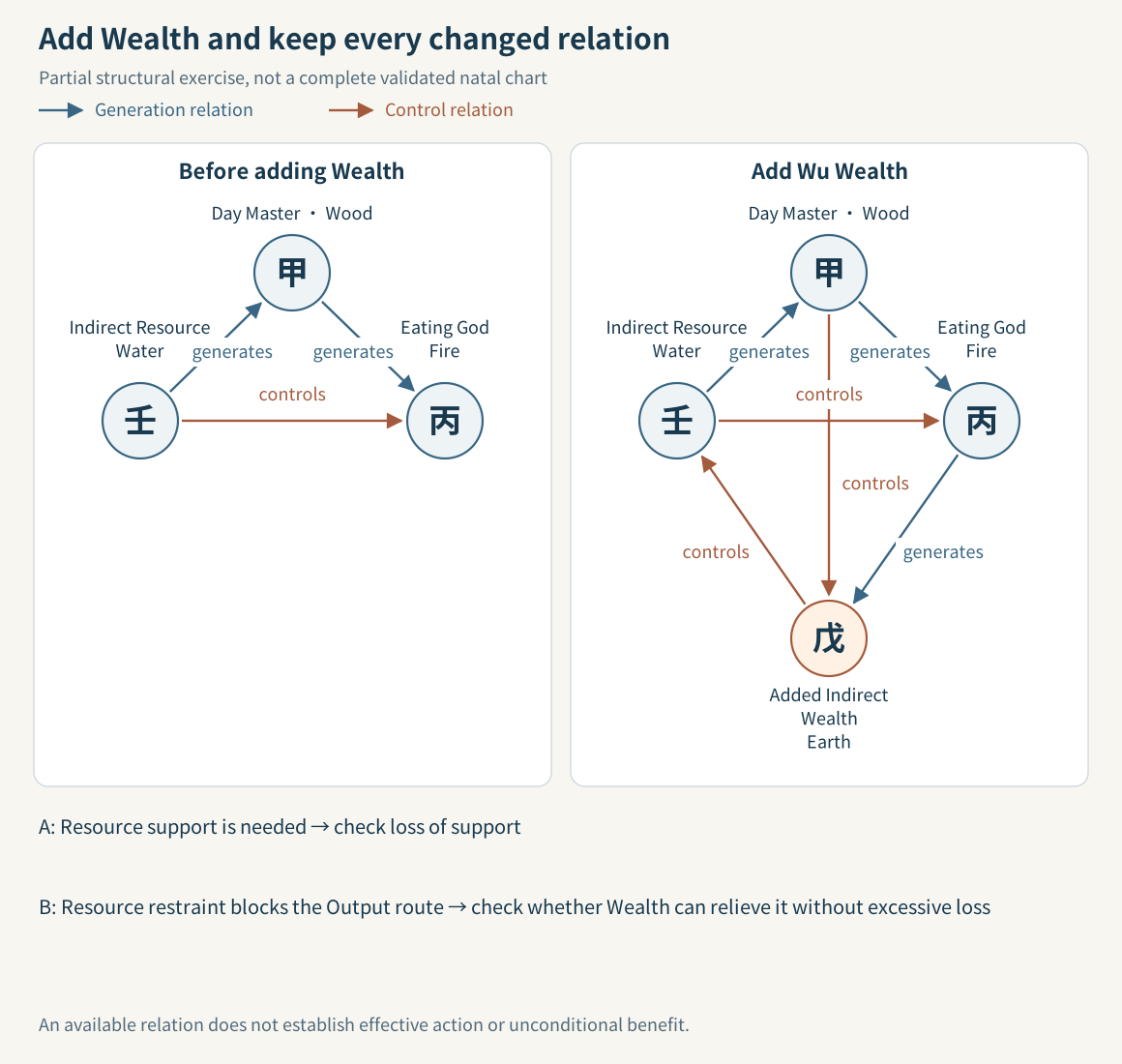
Partial structural exercise, not a complete validated natal chart. Begin with 甲 as Day Master, 壬 as Indirect Resource and 丙 as Eating God. These are isolated symbols, not assigned birth positions. Now add 戊, Yang Earth, which is Indirect Wealth relative to 甲.
The addition introduces several arrows. 丙 generates 戊, so Output now has a displayed Wealth target. 戊 controls 壬, so Wealth can restrain the Resource that controls Output. 甲 also controls 戊; the Wealth relationship belongs in the assessment of what the Day Master can sustain. None of these arrows automatically disappears because one seems useful.
Compare two explicit premises.
Premise A: Resource is needed for support. Stipulate limited support for 甲 and important effective support from 壬. If effective 戊 substantially restrains 壬, the added Wealth threatens a needed function. It would be misleading to celebrate only its receipt of 丙's Output. One must examine whether the Output-and-Wealth route remains sustainable after Resource is reduced.
Premise B: Resource's restraint of Output is the problem. Stipulate adequately supported 甲 and an effective 壬-to-丙 restraint that obstructs the Output route being studied. 戊's control of 壬 is now a candidate for relieving that obstruction. But “candidate” is essential. Unsupported 戊 will not perform the task merely because its arrow is available; dominant 戊 may remove more Resource than the structure can afford. We must also check whether 丙 can actually generate the proposed Wealth factor.
These are different premises, not contradictory verdicts on the same unseen chart. Figure 6.1 shows what changed when 戊 was added and places both interpretations beside the same relation map. The intervention has a possible benefit and a possible cost because it acts on a factor with more than one function.
Scroll horizontally to read the figure; open the original for a full-size view. Open full-size figure · PNG
Figure 6.1. Add one factor and examine both the gain and the cost. Partial structural exercise, not a complete validated natal chart.
Wealth can damage Resource and support a route back to Resource
The Resource chapter states:
官星生印,忌財旺破印。
Our translation: “Officer generates Resource; abundant Wealth damaging Resource is to be avoided.” The warning concerns the Resource function under discussion in that chapter. It does not mean Wealth and Resource can never coexist.
Elsewhere, the Hurting Officer chapter says 財能生官, “Wealth can generate Officer,” in its discussion of encountering Wealth. Put the two textual relations together and the diagram becomes more interesting than a single hostile arrow.
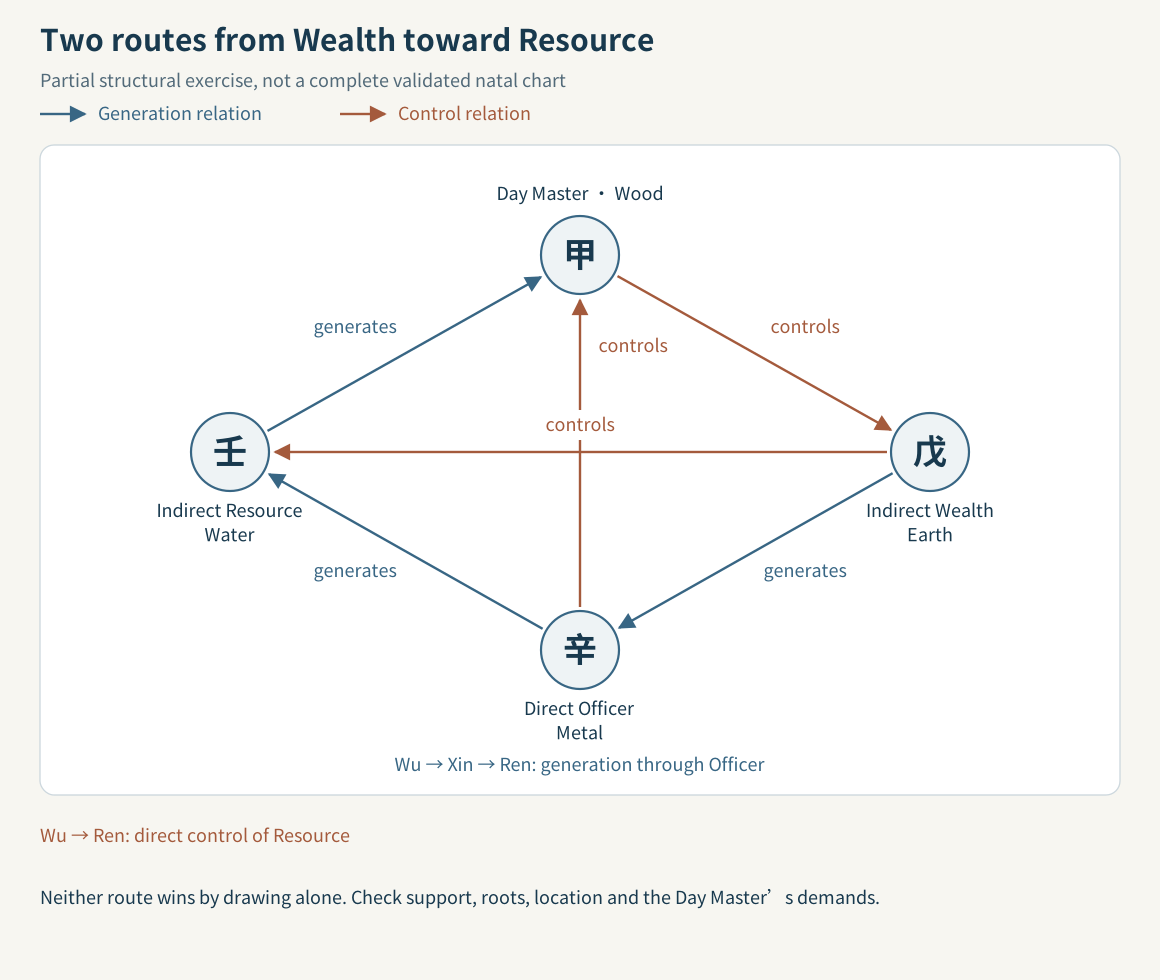
Partial structural exercise, not a complete validated natal chart. Use 甲, 壬, 戊 and 辛, without assigning four pillar positions. 辛, Yin Metal, is Direct Officer relative to 甲. Earth Wealth 戊 directly controls Water Resource 壬. Yet Earth generates Metal 辛, and Metal generates Water 壬. Thus the same Wealth factor participates in a direct control route and an indirect generation route toward Resource.
Retain 辛 controlling 甲, and 壬 generating 甲, as well. A route back to Resource does not erase Officer's control of the Day Master. Nor does the longer generation route automatically cancel the direct Wealth-to-Resource control. No ancient numerical cancellation rule has been established by drawing these arrows.
The actionable question is where each route obtains support. Is 辛 actually available and supported as an intermediary? Is 壬 rooted or otherwise supported? Does 戊's direct control remain substantial? What can 甲 sustain? Figure 6.2 presents the competing routes for investigation; it does not mark the longer one as the winner.
Scroll horizontally to read the figure; open the original for a full-size view. Open full-size figure · PNG
Figure 6.2. Competing routes remain visible together. Partial structural exercise, not a complete validated natal chart.
Output needs its own distinctions
Eating God and Hurting Officer belong to the Output family, but their polarity and other relations differ. For 甲, 丙 is same-polarity Eating God; 丁, Yin Fire, is opposite-polarity Hurting Officer. The Hurting Officer chapter describes the relation as 我生彼, “I generate it,” and specifies opposite polarity.
Our first diagram used 壬 and 丙, exactly the stems in the book's example. Do not silently expand its 倒食 argument into an identical verdict for every Direct Resource, Indirect Resource and Output pairing. Water controlling Fire remains the phase relation if 壬 is replaced by 癸, but the Resource classification changes. Replacing 丙 with 丁 changes the Output classification and opens other questions, including 丁's control of 辛 Direct Officer.
As a further partial structural exercise, not a complete validated natal chart, take 甲、癸、丁、辛. Identify 癸 as Direct Resource, 丁 as Hurting Officer and 辛 as Direct Officer. Draw Water's control of Fire and Fire's control of Metal. Restraining Output now also raises the question of preserving Officer. It cannot be called a defect merely because Output has been reduced. This is our conditional teaching decomposition, not a quotation of a universally applicable named pattern.
Write a relation ledger before a verdict
For any proposed addition, record five things:
The Day Master and each factor's exact classification, including polarity
Every relevant direct relation, not only the one that seems to solve the problem
The function currently being protected or relieved, and the chapter supporting that aim
The evidence that the proposed factor and any intermediary can act effectively
The other function the change might impair, and the condition that would reverse your judgment
If support, location or the chapter's organizing conditions remain unknown, leave the verdict open. “Wealth controls Resource” is a relation you can identify. “Wealth has broken the Resource needed by this configuration” requires more evidence. So does the converse claim that Wealth has successfully released Output.
The next article asks when enough evidence has been gathered to establish a pattern. This article supplies a reason that pattern names must come after relational analysis: one change can improve the link we noticed first while weakening another link we failed to examine.
Source notes: ancient scan evidence
All passages are from the 1634 witness, fascicle 2. The quotations are from lower-band large text, not the separate upper commentary. Punctuation and English translations are original editorial work.
Scan image 13, 論印綬: 生我者 identifies Resource. Scan image
Scan image 14, right, continuation of 論印綬: Resource polarity and 官星生印,忌財旺破印. Scan image
Scan image 16, left, 論食神: 生我財神. Scan image
Scan image 17, right, 論倒食: the Jia/Bing/Ren example and its interrupted Wealth route. Scan image
Scan image 18, right, continuation of 論傷官: Output polarity and the discussion of Wealth generating Officer. Scan image
Classical quotations use editorial punctuation and limited normalization of common character forms (such as 于/於 and 强/強). Uncertain readings are identified or avoided, not silently supplied. Ancient scan links are textual evidence; scholarly history and software reproduction have separate roles.
Evidence and source roles
These roles distinguish ancient text, older commentary, historical scholarship and tool reproduction. The numbered notes in the article retain the precise scan pages and explanations. Library and academic sources do not endorse predictive claims.
- P14 · Ancient text evidence: 論印綬
Text layer in the witness: 下欄大字正文 - P15 · Ancient text evidence: 論印綬
Text layer in the witness: 下欄大字正文 - P16 · Ancient text evidence: 論印綬
Text layer in the witness: 下欄大字正文 - P17 · Ancient text evidence: 論食神
Text layer in the witness: 下欄大字正文 - P18 · Ancient text evidence: 論傷官
Text layer in the witness: 下欄大字正文 - P19 · Ancient text evidence: 論傷官
Text layer in the witness: 下欄大字正文 - P24 · Ancient text evidence: 論倒食
Text layer in the witness: 下欄大字正文