Direct Officer and Seven Killings both belong to the element that controls the Day Master. Their difference cannot be explained by calling control inherently harmful, nor by dividing people into respectable and dangerous personalities. Yuanhai Ziping gives us a more demanding problem: identify the controlling relation, read how the passage names it, and judge the degree of restraint within its configuration.
This article uses 正官, Direct Officer, and 七殺/偏官, Seven Killings / Indirect Officer. “Seven Killings” is an inherited technical name, not a statement about violence. “Direct” and “Indirect” identify relational classifications; neither is a measure of human worth.
First establish the reference and polarity
For a 甲, Yang Wood, Day Master, Metal is the controlling element. 辛, Yin Metal, has opposite polarity and is Direct Officer; 庚, Yang Metal, has the same polarity and is Seven Killings / Indirect Officer. Change the Day Master, and the assignments change.
Fascicle 2, scan image 10, begins 正官論, “Discussion of Direct Officer,” with:
夫正官者,甲見辛之類。
Our translation: “Direct Officer is of the kind exemplified by Jia encountering Xin.” The chapter goes on to discuss yin-yang pairing. Its heading carries the small-type note 同淵源; that title annotation should be distinguished from the large-type argument beneath it. We cite the chapter in this witness rather than inventing a separate authorial voice for the annotation.
The practical consequence is simple. “辛 is Direct Officer” is incomplete unless the Day Master has been stated. A 辛 symbol does not carry the same role into every chart. Nor does a controlling factor's identification establish how effectively it operates. Season, rooting and the support available to the day stem still need to be examined.
The names overlap in this book
A modern glossary may list 七殺 and 偏官 as equivalents. The witness supports that usage, but it also preserves another naming distinction.
The Jishan pian, fascicle 2, scan image 3, says:
七殺偏官喜制伏,不宜太過。
Our translation: “Seven Killings / Indirect Officer favors restraint; it should not be excessive.” The two names appear together. Later, 論偏官, “On Indirect Officer,” continues on scan image 12:
又云有制伏則為偏官,無制伏則為七殺。
Our translation: “It is also said: with restraint it is called Indirect Officer; without restraint it is called Seven Killings.” The opening “it is also said” matters. This is a reported distinction within a compilation, not proof that every occurrence in the book obeys one exclusive definition. The chapter headings reinforce the overlap: 論偏官 has the small-type note 即七殺, “that is, Seven Killings”; 論七殺 has 即偏官, “that is, Indirect Officer.”
We therefore need two reading layers. At the classification layer, same-polarity control identifies the Seven Killings / Indirect Officer relation. At the passage's evaluative layer, a writer may reserve “Indirect Officer” for a restrained version and “Seven Killings” for an unrestrained one. Adding restraint does not turn same-polarity control into opposite-polarity Direct Officer. It changes the treatment of the relation, and sometimes its name in that passage.
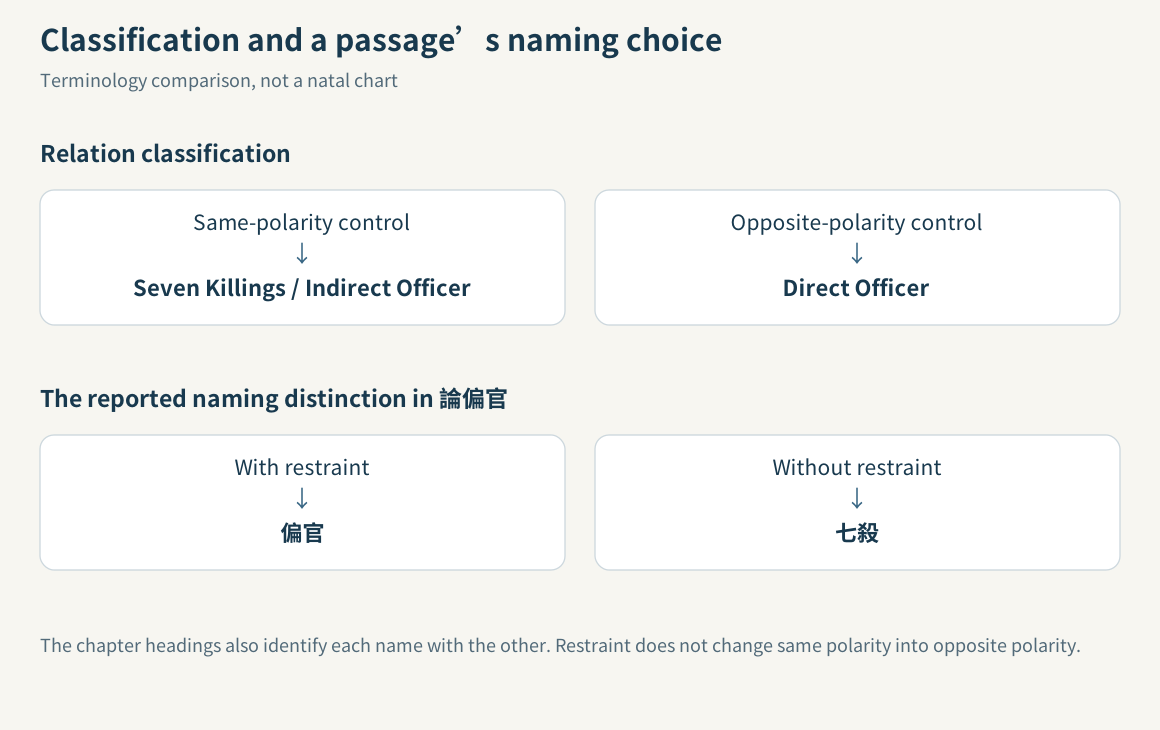
Scroll horizontally to read the figure; open the original for a full-size view. Open full-size figure · PNG
Figure 5.1. Fixed polarity classification and the passage’s additional naming distinction.
Read the second half of the sentence
“Favors restraint” is easily remembered. “Should not be excessive” is easily dropped. Removing the second half turns a conditional teaching into a rule for adding unlimited control.
Restraint is an operation with a target, an agent and a degree. In the following example, Metal can restrain Wood, but that Metal is Output generated by an Earth Day Master. It is not free. The day stem's support must be considered alongside the controlling Wood and the restraining Metal.
Partial structural exercise, not a complete validated natal chart. Use 戊, Yang Earth, as Day Master; 甲, Yang Wood, as Seven Killings; and 庚, Yang Metal, as Eating God, a same-polarity Output relation. Do not assign these symbols to birth positions. The unchanged arrows are 甲 controlling 戊, 戊 generating 庚, and 庚 controlling 甲.
Insufficient restraint. Stipulate strong seasonal and rooting support for 甲, little support for 戊, and ineffective 庚. Identifying 庚 as a potential restrainer is accurate. Declaring “Eating God restrains Seven Killings” as an accomplished configuration is premature. The analysis has not shown that Metal can perform the required function, or that Earth can sustain its Output demand. The next inquiry is about support and effectiveness, not a promised personal disaster.
Suitable restraint. Now stipulate supported 戊, substantial 甲, and effective 庚 that checks Wood without dominating the structure. This illustrates the relation intended by the phrase 喜制伏, “favors restraint.” The restraint has a stated task and support for performing it. “Suitable” means suitable to these premises; it does not establish a numerical balance, a named pattern or an assured career outcome.
Excessive restraint. Make 甲 slight while 庚's Output demand becomes substantial, with limited support for 戊. Metal can now exceed what is needed to check Wood, while drawing on the Day Master. The familiar “use Metal against Wood” remedy has outgrown its target. This is the counterexample contained in 不宜太過, “should not be excessive.” More of the proposed remedy is no longer the same solution.
Figure 5.2 shows the same nodes and arrows in each panel, with different written premises. Its captions evaluate a stipulated structural question, not three kinds of people.
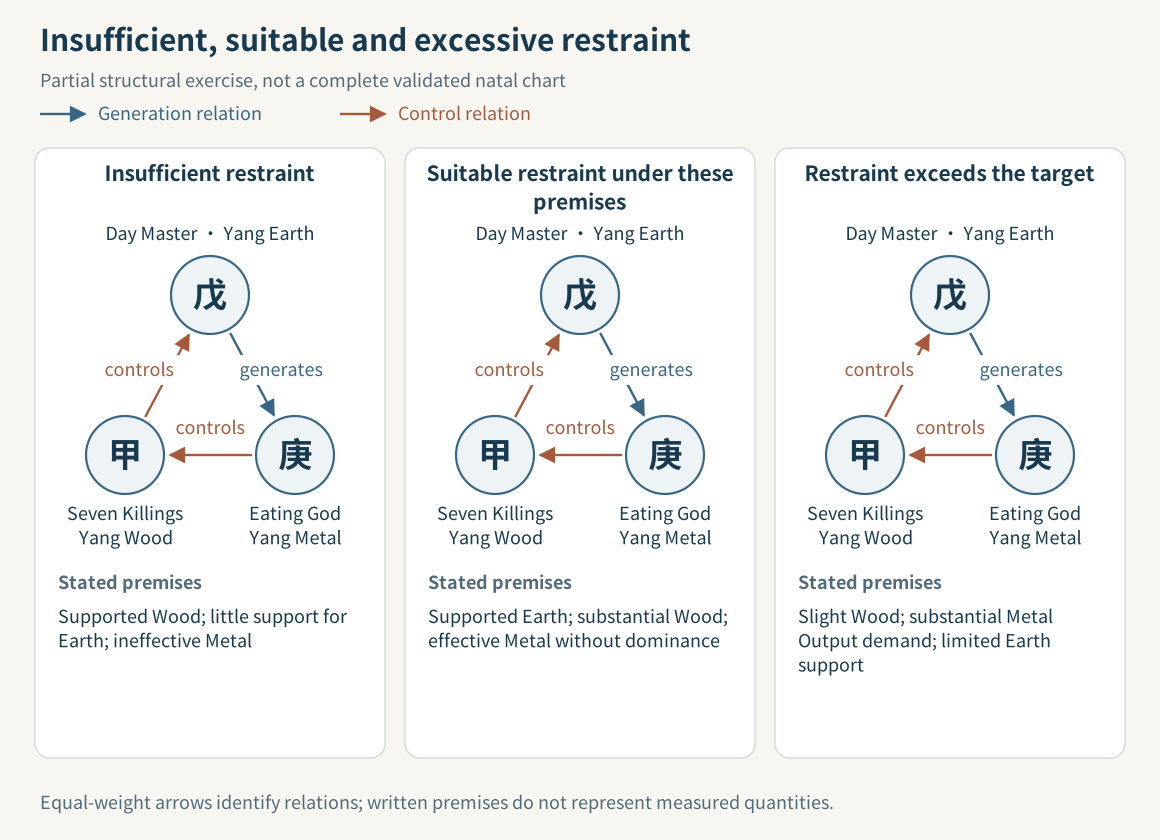
Scroll horizontally to read the figure; open the original for a full-size view. Open full-size figure · PNG
Figure 5.2. The unchanged relations under three explicit conditions. Partial structural exercise, not a complete validated natal chart.
Direct Officer is not automatically desirable in every amount
The Direct Officer chapter, continuing on scan image 11, cautions that numerous Direct Officers may fail to be beneficial. This qualification blocks the inference that a favorable-sounding name becomes better through simple multiplication. It does not justify declaring every instance of two Officers unfavorable.
For 戊, 乙, Yin Wood, is Direct Officer. Compare this with the previous 甲 case. Both control Earth, but the role label and the chapter's treatment differ. A reader cannot transfer the Seven Killings instruction “favors restraint” wholesale into a Direct Officer discussion and assume that attacking its controlling factor is always the right operation. First establish what the particular configuration is organized around and what the passage asks to preserve.
Position matters here as evidence, not as an invented universal weighting. A visible controlling stem associated with the month is not interchangeable with a branch-contained stem elsewhere. Write which layer actually contains the factor and whether its activity is supported. Two occurrences of a name do not automatically amount to two equally effective agents.
Separate the mechanism from the historical ethics
These chapters use the language of rank, authority and social hierarchy. That vocabulary helps explain why an ordered controlling relation could be praised. It also reflects a historical system of values, not a neutral measure of the reader's character.
We can preserve the technical question, “What checks what, and with what degree of support?”, without endorsing a hierarchy of respectable Officer people and disreputable Killings people. We should also resist translating the names straight into occupations. Direct Officer does not prove a civil-service career; Seven Killings does not prove military work, aggression or criminality. Those claims leap from a symbolic relation to an unseen biography.
A two-pass reading method
In the first pass, record the Day Master, the controlling element, its polarity, its actual stem or hidden-stem location, and the relevant month context. This gives a classification you can check.
In the second pass, read the chapter's verbs and qualifications. Is restraint required, already present, ineffective, or excessive? Is a term being used as a general synonym or as an evaluative name? What supports the restrainer, and what demand does it place on the Day Master? Write one condition that would reverse your provisional judgment.
Stop short of a configuration verdict when the effective support is unknown, the locations have not been distinguished, or the passage's conditions have not been checked. A lookup can name the relation while the more important question remains open.
The next article widens the diagram. Wealth can generate the controlling element while damaging Resource; Resource can support the Day Master while restraining Output. Judging one relation in isolation will then be even less adequate.
Source notes: ancient scan evidence
All quotations are checked against the 1634 witness; punctuation is editorial and translations are original.
Fascicle 2, scan image 10, left lower-band large text, 正官論; 同淵源 is its small-type heading note. Scan image
Fascicle 2, scan image 11, right lower-band large text, continuation of 正官論: numerous Direct Officers. The left chapter heading 論偏官 carries 即七殺 in small type. Scan image
Fascicle 2, scan image 3, left lower-band large verse, 繼善篇: restraint and its limit. Scan image
Fascicle 2, scan image 12, right lower-band large text, continuation of 論偏官: the restrained/unrestrained naming distinction. The left heading 論七殺 carries 即偏官 in small type. Scan image
Classical quotations use editorial punctuation and limited normalization of common character forms (such as 于/於 and 强/強). Uncertain readings are identified or avoided, not silently supplied. Ancient scan links are textual evidence; scholarly history and software reproduction have separate roles.
Evidence and source roles
These roles distinguish ancient text, older commentary, historical scholarship and tool reproduction. The numbered notes in the article retain the precise scan pages and explanations. Library and academic sources do not endorse predictive claims.