Water generates Wood. Metal controls Wood. Those two statements identify relations in the five-phase vocabulary. They do not yet tell us which relation matters most, whether a particular configuration can sustain it, or what the passage under discussion is trying to preserve. A useful reading of Yuanhai Ziping starts where the familiar circle diagram stops.
The previous article established the seasonal month context and distinguished visible stems from branch contents. We now put those distinctions to work. The question is not whether an arrow exists, but what it does within a specified structure. Generation can become excessive. Control can provide needed restraint. A combination can be recognized without establishing transformation. These are different judgments, requiring different evidence.
The book itself supplies a counterexample to beneficial generation
In the 1634 witness, fascicle 2, scan image 10, the lower-band large text says:
木從水養,水盛而木則漂流。 金賴土生,土厚而金遭埋沒。
Our translation: “Wood receives nourishment from Water; when Water is abundant, Wood instead drifts away. Metal depends on Earth for generation; when Earth is thick, Metal becomes buried.” Modern punctuation has been added.
The images of drifting and burial qualify generation from within the book's own language. They do not supply numerical thresholds, and we should not invent any. Their force is logical: a relation's direction does not settle its suitability. The amount and condition of what generates, and the capacity of what receives, change the reading.
This also explains why counting three Water symbols and one Wood symbol cannot by itself establish “excess Water.” The count omits season, rooting, other support, and competing demands. The passage offers a warning against indiscriminate addition, not an ancient scoring formula. Wood and Metal here are the book's symbolic phases, not laboratory measurements or diagnoses of people.
Four words that should not be collapsed
Generation, 生, names the phase relation by which one phase generates another. In a Day Master reading it may indicate support for the day stem, its production of Output, or a relation between other factors. “Support” describes a direction; “useful support” is a further judgment.
Control, 克, names another phase relation. Metal controls Wood whether the Metal is classified as Direct Officer or Seven Killings. Calling this relation “harm” before examining the structure discards the very distinction the next article needs.
Restraint, 制, asks a more particular question: what is being checked, by what, and to what extent? Fire controlling Metal may restrain Metal's control of Wood. But Fire is also generated by Wood. The proposed remedy therefore places a demand on the same Wood it is meant to protect.
Transformation, 化, requires the most care. Elemental transformation associated with a stem combination is not the same claim as a sequence of generation that redirects an apparent opposition. If Metal generates Water and Water generates Wood, our diagram can show an intermediary route. It has not shown Metal becoming Water, and it has not established a special transformation configuration. Name the operation instead of using “transformation” for every change in the picture.
A later analytical vocabulary may call an intermediary route tongguan, bridging. Here it is a modern diagramming aid, not a term silently inserted into the quoted passage.
One set of arrows, three different structural questions
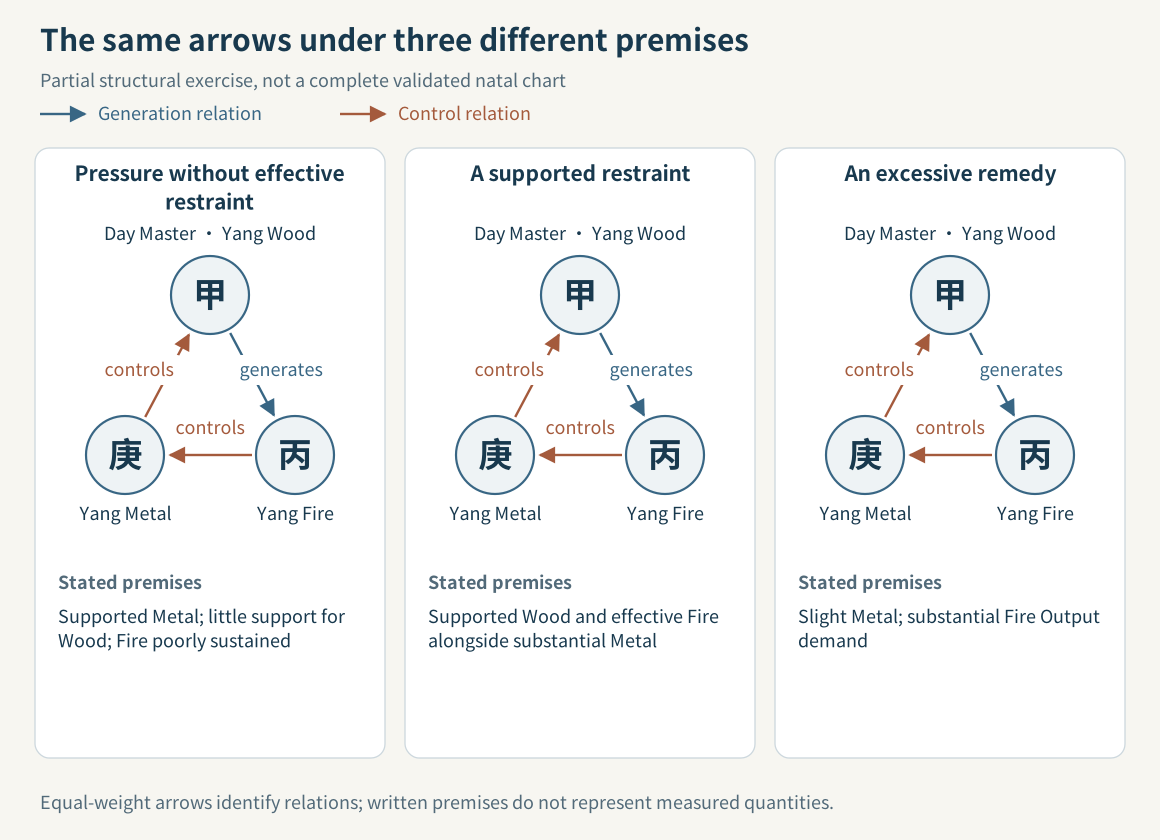
Partial structural exercise, not a complete validated natal chart. Take 甲, Yang Wood, as the Day Master and consider 庚, Yang Metal, and 丙, Yang Fire. These symbols are not assigned to four birth positions.
The relations remain constant: 庚 controls 甲; 甲 generates 丙; 丙 controls 庚. What changes below is explicitly stipulated evidence about their condition.
Case A: pressure without an effective restraint. Suppose the seasonal and rooting evidence supports 庚, while 甲 has little support and 丙 is poorly sustained. We can identify the Fire-to-Metal control relation, but cannot credit it with successfully restraining Metal merely because 丙 appears. The symbol is present; the proposed function is not yet established. The reader must investigate whether the Day Master can sustain the Output involved.
Case B: a supported restraint. Now stipulate supported 甲 and effective 丙 alongside substantial 庚. Fire's restraint of Metal is a plausible organizing relation. It answers a stated structural need rather than adding a universally “good” element. This still does not prove a named pattern: that requires the conditions of the particular chapter, including its treatment of the month and other factors.
Case C: an excessive remedy. Keep supported 甲, but make 庚 slight and Fire's demand substantial. “More Fire” no longer follows from the original problem. The restraint can outgrow its target while Output continues to draw on Wood. The same three arrows now require an inquiry into excessive restraint. We have changed the premises, not contradicted the five-phase relations.
Location is another evidence question. A visible 丙 and a 丙 stored in a branch occupy different layers; they cannot simply be credited with identical activity. Our nearby diagram nodes do not assert nearby birth positions. Record the actual locations and their support instead of letting graphic proximity decide effectiveness.
Figure 4.1 uses equal-weight arrows in all three panels. Its changing annotations identify stipulated support and demands, rather than quantities computed from a birth chart.
Scroll horizontally to read the figure; open the original for a full-size view. Open full-size figure · PNG
Figure 4.1. Identical relations, different support conditions. Partial structural exercise, not a complete validated natal chart.
An intermediary has to work on both sides
A second partial structural exercise, not a complete validated natal chart, uses 甲, 庚 and 壬, Yang Water. It retains 庚 controlling 甲 while adding 庚 generating 壬 and 壬 generating 甲.
This route is worth checking because it links a controlling factor to support for the controlled factor. But a connecting node is not automatically an effective intermediary. Unsupported Water does not become effective simply because the diagram needs a bridge. Conversely, strongly sustained Water should not be praised without checking the earlier warning about Water abundance and drifting Wood.
Write two separate questions: “Can the Metal-to-Water relation be significant here?” and “Can the Water-to-Wood relation provide suitable support here?” An affirmative answer to the first does not supply an affirmative answer to the second. Nor does drawing the route erase the direct Metal-to-Wood control relation. A responsible diagram shows both and leaves their relative significance conditional.
Recognizing a combination is not proving transformation
Fascicle 1, scan image 5, lists the five stem pairs under 論天干相合, “On combinations of the heavenly stems.” One is 甲與己合: “Jia combines with Ji.” This verifies the pair-recognition rule. It is not, by itself, a statement that every appearance of 甲 and 己 must be read as transformed Earth.
A stronger test appears in fascicle 3, scan image 15, under the “transformation image” section of 神趣八法, “Eight methods of interpreting configurations.” Its example begins with a 甲/己 day in a 辰, 戌, 丑 or 未 month and a visible 己 combining with 甲. It discusses Earth transformation, then adds:
如逢甲乙木生旺運,化不成,反為不吉。
Our translation: “If a cycle is encountered in which Jia or Yi Wood is flourishing, transformation does not succeed; it is instead considered unfavorable.” The unfavorable judgment belongs to this historical passage, not to a forecast we endorse.
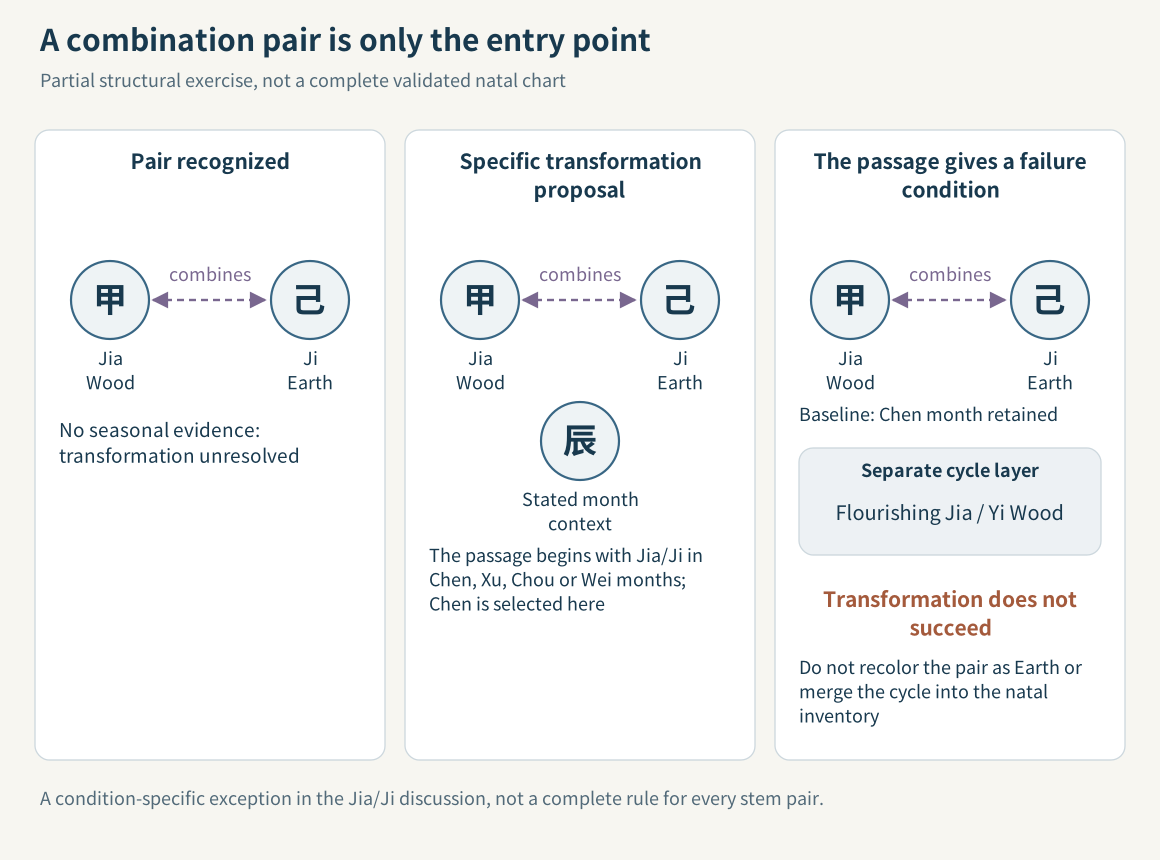
Partial structural exercise, not a complete validated natal chart. Use 甲 as the day stem, 辰 as the stated month context, and visible 己 as its combination partner. Mark “Earth-transformation proposal under this passage's conditions,” rather than immediately replacing both stems with Earth. In a separate time-layer panel, introduce the stipulated flourishing Wood cycle described by the text. The passage now says 化不成, “transformation does not succeed.” The combination pair has not ceased to be a recognized pair; the transformation reading has failed its additional condition. Keep the original symbolic identities available instead of mechanically recoloring everything as Earth.
This is a source-grounded combination-without-successful-transformation counterexample. It concerns the specific 甲己 discussion, not a universal rule for all five pairs. The cycle belongs in its own layer; it must not be smuggled into the natal inventory. With only 甲 and 己 and no other evidence, the stricter conclusion remains “combination identified; transformation unresolved.” Failure to prove transformation is not always proof of non-transformation.
Scroll horizontally to read the figure; open the original for a full-size view. Open full-size figure · PNG
Figure 4.2. Recognition, a conditional proposal and a separately displayed cycle exception. Partial structural exercise, not a complete validated natal chart.
A reading procedure you can use
For each relation, write down:
Its source and target, identifying whether each is a visible stem or a branch-contained stem
The relevant seasonal support, rooting and demands, rather than just the element count
The function being proposed: support, Output, restraint, an intermediary route, or elemental transformation
The textual condition that would justify that function, and the evidence still missing
A counterexample: what change would make the proposed addition excessive or ineffective?
The Jishan pian makes the month command the organizing thread and calls for a supported Day Master. These statements help explain why a free-floating arrow is incomplete evidence. They do not authorize a universal strength threshold or make every ordinary configuration follow one identical rule.
The next article tests this method against Direct Officer and Seven Killings. Both control the Day Master, but their naming and their treatment of restraint cannot be read from “control is bad.” We must ask how much restraint the particular structure requires, and when the remedy itself becomes the problem.
Source notes: ancient scan evidence
1634 Yu-family Shanchengtang witness, fascicle 2, scan image 10, lower-band large text: the Water/Wood and Earth/Metal generation counterexamples. Scan image
Same witness, fascicle 1, scan image 5, lower band, 論天干相合: stem-pair list. Scan image
Same witness, fascicle 2, scan image 2, lower-band large verse, 繼善篇: 月令 as 提綱 and 日主最宜健旺. Scan image
Same witness, fascicle 3, scan image 15, left lower-band large text, 神趣八法, 化象 section: the specific Jia/Ji Earth-transformation example and its flourishing-Wood-cycle exception. Scan image
The exercises and diagrams are original teaching constructions. They test conditional textual reasoning, not scientifically validated forecasts of a person's life.
Classical quotations use editorial punctuation and limited normalization of common character forms (such as 于/於 and 强/強). Uncertain readings are identified or avoided, not silently supplied. Ancient scan links are textual evidence; scholarly history and software reproduction have separate roles.
Evidence and source roles
These roles distinguish ancient text, older commentary, historical scholarship and tool reproduction. The numbered notes in the article retain the precise scan pages and explanations. Library and academic sources do not endorse predictive claims.
- E03 · Ancient text evidence: 論天干相合
- P01 · Ancient text evidence: 繼善篇
Text layer in the witness: 下欄大字正文 - P03 · Ancient text evidence: 繼善篇
Text layer in the witness: 下欄大字正文 - P04 · Ancient text evidence: 繼善篇
Text layer in the witness: 下欄大字正文 - P05 · Ancient text evidence: 繼善篇
Text layer in the witness: 下欄大字正文 - P23 · Ancient text evidence: 神趣八法·化象
Text layer in the witness: 下欄大字正文