Two symbolic arrangements can contain the same elements yet invite different traditional readings. A raw count cannot show whether Wood is being considered in spring or autumn, whether a stem has support in branch contents, or whether a proposed operative factor is exposed or only stored. The month-command instruction is a way into those differences.
It is also easy to overstate. “The month is the framework” does not mean “one branch settles the chart.” It means seasonal context should organize the investigation that follows.
A starting priority, followed by a demand for detail
Jishan pian begins its reading order with:
“欲知貴賤,先觀月令,乃提綱。”
Our translation: “To examine rank, first observe the month command: it is the organizing thread.” [1]
A little further on, the large-character verse says:
“取用憑於生月,當推究於淺深;發覺在於日時,要消詳於強弱。”
Our translation: “In identifying the operative factor, begin from the birth month and investigate its depth; examine its manifestation through day and hour, carefully considering strength and weakness.” [2]
“Depth” is not an invitation to count how many times the month branch appears. The old annotation discusses the stages within the seasonal month. Juan 1's Yue lü fenye zhi tu also divides the month into allotted intervals associated with stems. [3] These are the text's traditional schemes, not instrument readings of physical energy. Their importance for close reading is that the month is not being treated as a uniform label with no internal distinctions.
The second half matters just as much. The instruction moves from the month to other positions and from an initial selection to strength. A reader who stops after choosing a month label has omitted the work the verse itself requests.
What kind of month is under discussion?
The traditional branch-month framework is seasonal. It should not be casually replaced by a Gregorian month number or an ordinary lunar-month number. A date described as “April” does not, by that English word alone, establish 辰; a lunar calendar's third month is not a substitute for checking the relevant seasonal convention.
For a real calculator comparison, distinguish two questions:
Calculation: Which month pillar does the stated calendar and time convention produce?
Interpretation: Once that pillar is established, how does the text use its seasonal and contained-stem relations?
The ancient verse answers the second kind of question. It does not specify a modern time-zone database, a daylight-saving rule, or how software should align an overseas birth to an absolute solar-term instant. Those belong in the calculator's methodology, where uncertainty near a boundary must remain visible. [4]
A count-preserving structural comparison
Partial structural exercise, not a complete validated natal chart:
Suppose we retain the visible references 甲 and 辛 and the branch references 卯 and 酉, but exchange which branch occupies the month context. This is a deliberately restricted comparison, not two proposed birth charts.
| Exercise | Month context | Other branch reference | Inventory |
|---|---|---|---|
| A | 卯, spring Wood context | 酉 | The same two stems and two branches |
| B | 酉, autumn Metal context | 卯 | The same two stems and two branches |
In both exercises Xin Metal controls Jia Wood. The dictionary relationship stays the same. A traditional strength inquiry changes because the month role changes: A begins from a Wood-supporting seasonal context; B begins from a Metal-supporting one. The other branch still matters in each exercise. We cannot finish the inquiry without the omitted symbols, their locations, and other interactions.
This comparison proves a modest reading point: counts do not preserve seasonal organization. It does not prove that A or B is favorable, nor that either describes a real person's capacities.
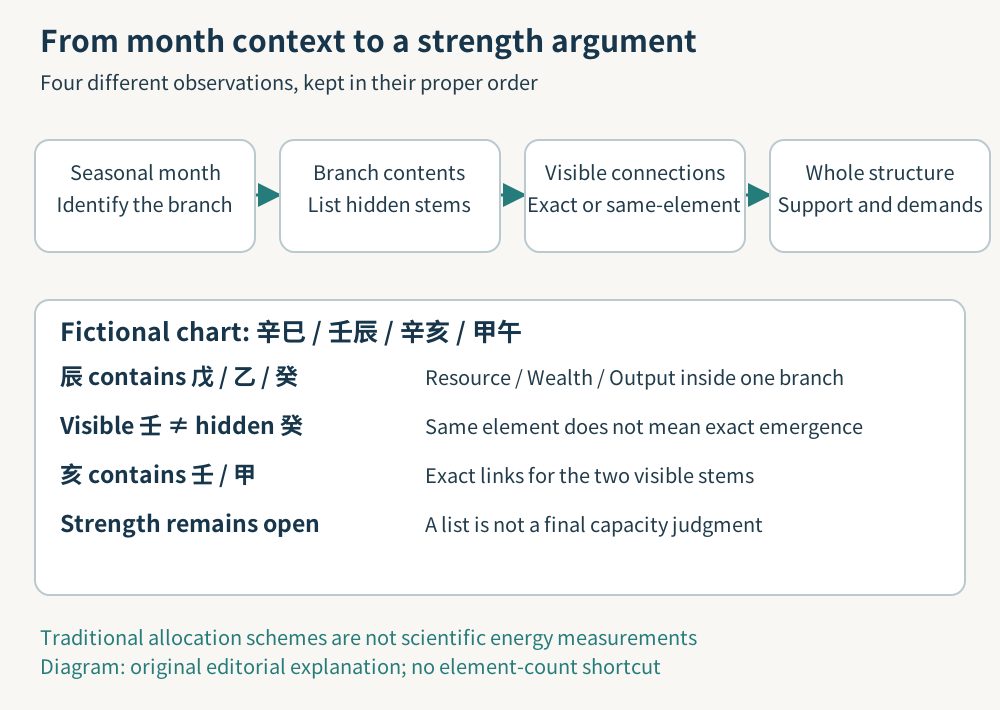
Scroll horizontally to read the figure; open the original for a full-size view. Open full-size figure · PNG
The diagram separates four tasks. A reader first identifies season, then opens the branch's contents, then checks actual visible connections, and only then weighs the whole structure. Skipping directly from the first box to “strong” loses the intervening evidence.
Hidden content, rooting, and emergence are different observations
Three expressions are often collapsed:
Hidden content: a branch contains a particular stem under the table being used
Rooting or branch support: a visible stem has support through branch contents; describe whether you mean the exact stem or same-element support
Visible emergence: a stem contained in a branch also appears among the visible stems
These observations answer different questions. The existence of hidden 癸 is not the visible emergence of 壬, even though both are Water. The existence of Earth Resource in a branch is not the same as a Resource stem appearing openly above the branches.
Terminology varies among later readers, especially over how broadly to use “root.” A transparent record is better than arguing from an undefined word: list the actual hidden stems and state exactly which link you mean.
Examine 辰 in the shared fictional example
Under the site's convention, the fictional chart is 辛巳 / 壬辰 / 辛亥 / 甲午. Its month branch is 辰. The hidden-stem inventory used here lists 戊, 乙, and 癸 in 辰. Relative to Xin, these are Direct Resource, Indirect Wealth, and Eating God. [4]
That gives a more informative record than “the month is Earth.” It also gives a set of careful distinctions:
| Observation | What it establishes | What it does not establish |
|---|---|---|
| 辰 contains 戊 | Earth Resource is present in the month branch | 戊 is a visible natal stem |
| 辰 contains 癸 while 壬 is visible | Both Water Output categories are present at different layers | 癸 itself has visibly emerged as 壬 |
| 亥 contains 壬 and 甲 | The visible 壬 and 甲 have exact contained-stem links there | Their final effectiveness or a completed pattern |
| 巳 contains 庚; no branch in this inventory contains 辛 | Metal support and exact Xin occurrence can be recorded separately | A one-word verdict that the day stem has no support |
The month is late-spring context with internal Earth, Wood, and Water relations in this table. It would be careless either to erase those distinctions or to assign precise percentages of ancient seasonal qi to this modern example without identifying and applying a particular allocation scheme.
Strength is a question of support and demands
Jishan pian's “財多身弱,正為富屋貧人” joins abundant Wealth with a weak day reference. Our translation is “Much Wealth with a weak self is like a poor person in a wealthy house.” [5] Its point for this lesson is relational: the presence of a named resource or object is different from the symbolic capacity to carry its demands.
To build a strength argument, examine at least four kinds of evidence:
Seasonal support or disadvantage at the month
Branch support and visible generating or same-element relations
The demands of Output, Wealth, and controlling relations
Interactions that alter the availability of the support or demands just identified
A good note says which evidence is decisive and which pulls the other way. “Wood occurs three times” is an inventory statement. “I treat this Wood reference as relatively supported because of the month and these branch links, but the visible Output and controlling relation complicate that support” is a structural argument. It may remain disputed, but it is at least inspectable.
Why a website score cannot finish this reading
A calculator may use declared weights to summarize an inventory. This site does. Such a display can help a reader notice relations to investigate, but its engineering categories do not become a formula from Yuanhai. Nor does a displayed “balanced” category decide the passage-specific 用神, the operative factor under discussion. [4]
Use the score to ask where its result came from, then keep the text's inquiry separate. The useful next step is not to add the missing element automatically. It is to ask what the proposed addition would generate, control, restrain, or displace in this structure. That is article 4's subject.
A short month-context audit
Before declaring a day reference strong or weak, check:
Have I established the month pillar under a stated calculation convention?
Have I distinguished its seasonal role from its hidden-stem contents?
When I say “root” or “emergence,” can I point to the actual stems?
Have I included both support and demands?
Can I state a changed condition that would weaken my conclusion?
If the last answer is no, the conclusion is probably a label rather than a reading.
Sources and reading notes: ancient scans, scholarship, and calculation
1634 Shanchengtang witness, juan 2, Jishan pian, fascicle 2 scan image 2, large-character verse. Month-command line.
Same witness, fascicle 2 scan image 3, right lower band. Birth month, depth, day/hour and strength. Quoted large text is distinguished from its small annotation; punctuation and translation are ours.
Same witness, juan 1, Yue lü fenye zhi tu, fascicle 1 scan image 13, right lower band. Month-allocation diagram. Used to identify the traditional distinction within months, not to claim scientifically measured seasonal quantities.
Site calculation methodology, checked against the current calendar and scoring implementation and the fictional input. Calculator outputs and editorial diagrams are distinct from the ancient text.
1634 witness, juan 2, Jishan pian, fascicle 2 scan image 4, right lower band. Wealth and capacity line.
Classical quotations use editorial punctuation and limited normalization of common character forms (such as 于/於 and 强/強). Uncertain readings are identified or avoided, not silently supplied. Ancient scan links are textual evidence; scholarly history and software reproduction have separate roles.
Evidence and source roles
These roles distinguish ancient text, older commentary, historical scholarship and tool reproduction. The numbered notes in the article retain the precise scan pages and explanations. Library and academic sources do not endorse predictive claims.
- P01 · Ancient text evidence: 繼善篇
Text layer in the witness: 下欄大字正文 - E13 · Historical diagram: 月律分野之圖
- P31 · Ancient text evidence: 繼善篇
Text layer in the witness: 下欄大字正文 - P03 · Ancient text evidence: 繼善篇
Text layer in the witness: 下欄大字正文 - P13 · Ancient text evidence: 繼善篇
Text layer in the witness: 下欄大字正文 - C01 · Site calculation reproduction: Fictional Los Angeles input under current site convention