The day stem supplies a reference point. It does not reduce the whole chart to a single element, and it does not authorize a personality description from that element's name. Its practical value is more precise: it makes relationships among different symbols comparable.
Once the reference is fixed, you can ask what generates it, what it generates, what it controls, and what controls it. The same stem can receive a different Ten God name when the reference changes. A chart reading therefore needs a map before it needs a verdict.
What “take the day stem as the principal reference” means
Juan 2's Jishan pian gives the instruction:
“次斷吉凶,專用日干為主本。”
Our translation: “Next, in distinguishing favorable and unfavorable configurations, take the day stem specifically as the principal reference.” [1]
“Reference” is the key to our explanation. The passage does not say to ignore the other seven visible characters. Its adjoining discussion connects the three layers with configurations and the four pillars. The month remains the seasonal framework, while the day stem answers the relational question: relative to which stem are Officer, Wealth, Resource, and Output being named?
This distinction resolves an apparent competition between the day and month. They perform different jobs. The day stem is the classification anchor; the seasonal month helps determine the conditions under which those classifications operate. Neither job can replace the other.
The three layers prevent a flattened reading
Juan 1's Lun sanyuan gives a compact example:
“假令甲子,以甲木為天元,子為地元,子中所藏癸水為人元。”
Our translation: “Take Jia-Zi as an example: Jia Wood is the stem layer, Zi is the branch layer, and the Gui Water stored in Zi is the hidden-stem layer.” [2]
This is a classification example, not a claim about a particular person's biography. It teaches the reader to keep a visible stem, a branch, and a stem contained in that branch distinct. The Jishan pian annotation likewise explains these three layers. [1]
If you write 子 simply as “Water” and discard 癸, you preserve the element but lose the polarity-bearing stem used in relational classification. If you count 子 and 癸 as two identical visible Water votes, you create a different error: branch contents have been flattened into extra characters of the same status.
The chart map should instead preserve containment. A branch box contains its hidden stems; a visible stem sits above it. A later step may discuss their strength and influence, but the inventory comes first.
A five-family map, followed by polarity
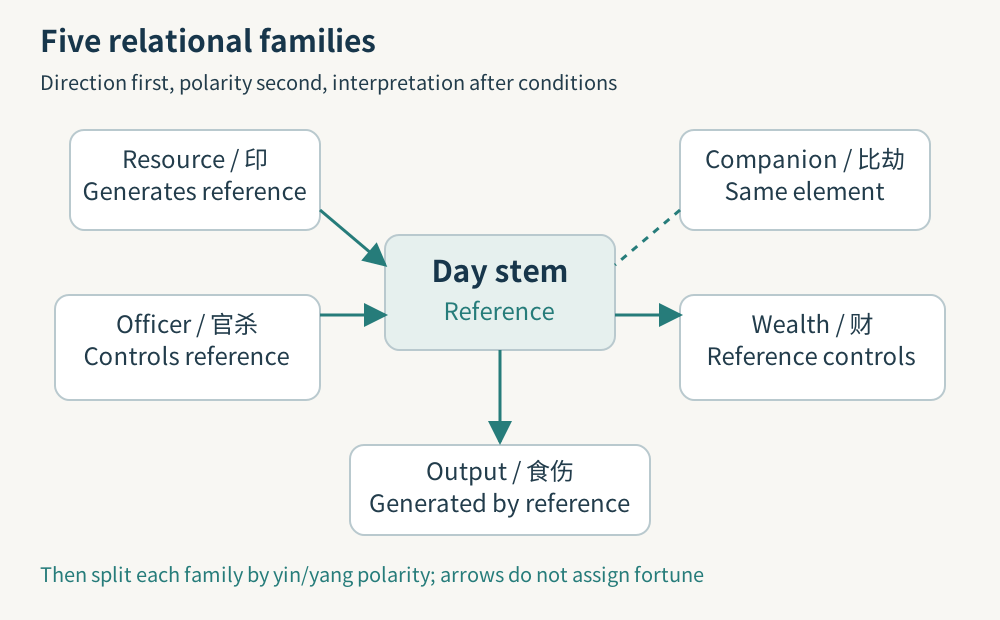
Scroll horizontally to read the figure; open the original for a full-size view. Open full-size figure · PNG
The diagram is our teaching map. It shows directions of relation; it does not assign benefit, harm, or measurable amounts.
| Relation to the day stem | Same polarity | Opposite polarity |
|---|---|---|
| Same element | Companion, 比肩 | Rob Wealth, 劫財 |
| Generated by the day stem | Eating God, 食神 | Hurting Officer, 傷官 |
| Controlled by the day stem | Indirect Wealth, 偏財 | Direct Wealth, 正財 |
| Controls the day stem | Seven Killings / Indirect Officer, 七殺/偏官 | Direct Officer, 正官 |
| Generates the day stem | Indirect Resource, 偏印 | Direct Resource, 正印 |
The book's stem tables provide the classifications; individual chapters explain their relations. The Direct Officer discussion starts with Jia seeing Xin. The Resource discussion defines it through “what generates me,” and the Hurting Officer discussion explains “I generate the other” with opposite polarity. [3]
The old names can be vivid or uncomfortable. “Rob Wealth” does not establish theft; “Hurting Officer” does not establish rebelliousness; “Resource” does not measure education. Their first task here is relational classification. More specific interpretation requires additional conditions.
Test whether you really kept the reference fixed
Partial structural exercise, not a complete validated natal chart:
| Reference | Stem being examined | Element relation | Polarity | Name |
|---|---|---|---|---|
| 甲 Jia, yang Wood | 辛 Xin, yin Metal | Metal controls Wood | Opposite | 正官 Direct Officer |
| 乙 Yi, yin Wood | 辛 Xin, yin Metal | Metal controls Wood | Same | 七殺 Seven Killings |
Xin has not changed element or polarity. The name changes because the reference changes. This gives a useful error check: if an interpretation says “Xin always represents Direct Officer,” it has forgotten the day stem.
A second check concerns arrow direction. For a Jia Wood reference, Water generates the reference and is Resource. Fire is generated by the reference and is Output. Reversing those arrows swaps two families. Before using an English label or a memorized association, state the relation in plain words.
Map a complete fictional chart without reading a life into it
We will use one fictional record throughout the later worked example: 18 April 2001, 12:18 local civil time, Los Angeles, with the site's male selection for the traditional cycle rule. Reproduction under the site's declared calculation convention gives 辛巳 / 壬辰 / 辛亥 / 甲午, with adjusted time 11:25. This is an auditable calculator example, not a historical chart from Yuanhai. [4]
The day stem is 辛, yin Metal. Begin with what is visible:
Year stem 辛: same element and polarity, Companion
Month stem 壬: Metal generates Water, opposite polarity, Hurting Officer
Day stem 辛: the reference itself, not another independent Companion to count
Hour stem 甲: Metal controls Wood, opposite polarity, Direct Wealth
Now open the branch boxes under the hidden-stem convention used in this example:
| Position | Branch contents | Names relative to 辛 |
|---|---|---|
| Year, 巳 | 丙 / 戊 / 庚 | Direct Officer / Direct Resource / Rob Wealth |
| Month, 辰 | 戊 / 乙 / 癸 | Direct Resource / Indirect Wealth / Eating God |
| Day, 亥 | 壬 / 甲 | Hurting Officer / Direct Wealth |
| Hour, 午 | 丁 / 己 | Seven Killings / Indirect Resource |
This inventory produces questions that a one-element personality story would miss. The visible 壬 also occurs inside 亥; the visible 甲 likewise occurs inside 亥. 丙 and 丁 are both present in branches, but neither is a visible natal stem. The month contains Resource, Wealth, and Output relations rather than a single homogeneous “Earth vote.”
Notice what the table does not decide. It does not prove that a Seven Killings configuration dominates because 丁 exists, or that the Resource relation is strong enough merely because 戊 appears twice. It records where the candidate relations are. Strength, seasonal context, interaction, and pattern conditions come next.
Do not lose position, but do not invent events from it
Two charts with the same list of stems can have different branch contents or arrangements. Preserve the year, month, day, and hour positions when you make your map. That lets you distinguish a visible monthly stem from a hidden yearly stem and follow a relation back to its actual location.
Preserving position is not permission to claim that a year-column symbol proves a family event or an hour-column symbol guarantees a future outcome. The map is a record of symbolic structure. Biographical claims would require a different kind of evidence, which this fictional exercise has deliberately not supplied.
A usable first-page worksheet
Before any interpretation, complete these steps:
Copy all four pillar pairs and the calculation convention
Mark the day stem as the reference
Classify the other visible stems by element relation, then polarity
List branch contents beneath each branch, without promoting them to visible stems
Mark repeated relations and actual locations; leave strength undecided
Write one question for each major relation instead of a life prediction
For the example, a good question is: “Does the seasonal setting and available support allow the visible Water Output to operate as the text's discussion assumes?” A premature answer is: “Hurting Officer means this person rejects authority.” The first opens an inquiry; the second hides the missing steps behind a label.
Article 3 supplies the next part of the map: why the month is an organizing context, how hidden stems matter, and why an element count is not a strength judgment.
Sources and reading notes: ancient scans, scholarship, and calculation
1634 Shanchengtang witness, juan 2, Jishan pian, fascicle 2 scan image 2. Verse and small annotation. The quoted sentence is large-character text; the three-layer explanation beside it is old small-character commentary.
Same witness, juan 1, Lun sanyuan, fascicle 1 scan image 16, left lower band. Jia-Zi example. Punctuation and English translation supplied here.
Same witness: stem classification tables, fascicle 1 images 13–14; Direct Officer, fascicle 2 image 10; Resource, images 13–14; Hurting Officer, image 18. Yin-stem table, Direct Officer, Resource, Hurting Officer.
Site calculation methodology, read with the current calculation source and a reproduced fictional input. The inventory here explains the resulting symbols; it is not copied from an ancient birth record.
Classical quotations use editorial punctuation and limited normalization of common character forms (such as 于/於 and 强/強). Uncertain readings are identified or avoided, not silently supplied. Ancient scan links are textual evidence; scholarly history and software reproduction have separate roles.
Evidence and source roles
These roles distinguish ancient text, older commentary, historical scholarship and tool reproduction. The numbered notes in the article retain the precise scan pages and explanations. Library and academic sources do not endorse predictive claims.
- P02 · Ancient text evidence: 繼善篇
Text layer in the witness: 下欄大字正文 - E08 · Older commentary evidence: 繼善篇
- P32 · Ancient text evidence: 論三元
Text layer in the witness: 下欄大字正文 - E12 · Historical classification table: 天干五陽通變/天干五陰通變
- P07 · Ancient text evidence: 正官論
Text layer in the witness: 下欄大字正文 - P14 · Ancient text evidence: 論印綬
Text layer in the witness: 下欄大字正文 - P15 · Ancient text evidence: 論印綬
Text layer in the witness: 下欄大字正文 - P18 · Ancient text evidence: 論傷官
Text layer in the witness: 下欄大字正文 - C01 · Site calculation reproduction: Fictional Los Angeles input under current site convention