Yuanhai Ziping is easiest to misuse when it is treated as a bag of quotations. A reader finds a sentence about an Officer, Wealth, or a clash, applies it to one character, and skips the conditions that make the sentence intelligible. A better first task is to identify the edition, separate its textual layers, and learn where a rule belongs in a larger reading.
This series reads the book as a historical work of Chinese fate-calculation. It explains how its symbolic reasoning operates, including places where that reasoning is conditional or internally varied. Understanding a traditional argument is different from establishing that it predicts real events.
Start with the book actually in front of you
Our working witness is the five-juan New Imprint of the Combined Official-Edition Yuanhai Ziping with Pronunciation, Meaning, and Commentary, issued by the Yu family's Shanchengtang in 1634. The National Library of China scan is available in five fascicles. In the first fascicle, scan image 4 contains both the end of a preface dated Chongzhen 7 and the opening of juan 1. Its attribution names “宋錢塘東齋徐升編” and “明清江竹亭楊淙增校”: Xu Sheng as compiler and Yang Cong as reviser. These are the witness's own attributions. They should not be silently replaced with “written by Xu Ziping.” [1]
The history is less tidy than a single-founder story. Chao Wei-pang's 1946 study discusses the Xu Dasheng attribution and judges the received Yuanhai likely to be an expansion and reworking of earlier materials. His conclusion is probabilistic, not a demonstration that every passage has one author. We therefore use the Xu Sheng/Xu Dasheng compilation tradition while identifying the Ming revision in the edition we actually read. [2]
An edition date is not the date when all its contents were composed. Likewise, the National Central Library's record for a 1926 combined Yuanhai Ziping / Ziping Zhenquan, volume 1, documents a particular later publication. It does not make the two works interchangeable or give later commentary authority over the wording of this 1634 witness. [3]
When comparing another copy, record its full title, attributed roles, imprint date, number of juan, and the chapter heading around your passage. “I found it online” is not an edition description.
Read the page's layers before reading its conclusion
The scan has a narrow upper commentary band and a larger lower band. In the lower band, large-character text may alternate with double-line small annotations. A modern transcription can run these into one continuous paragraph. That changes how a reader understands who is explaining what.
For example, juan 2's Jishan pian says in large characters:
“次斷吉凶,專用日干為主本。”
Our translation: “Next, in distinguishing favorable and unfavorable configurations, take the day stem specifically as the principal reference.” [4]
The nearby small commentary explains the stem, branch, and hidden-stem layers. That explanation helps unpack the verse, but it is an annotation in this witness. If a modern writer adds a diagram or a five-step checklist, that is a third layer again. Keeping these layers visible avoids claiming that a helpful modern teaching device is a sentence from the ancient book.
There are three useful labels for your reading notes:
Text: the wording of the large-character passage, including its immediate context
Edition commentary: the smaller annotation that explains or qualifies it
Your interpretation: what you infer, diagram, or leave unresolved
These labels concern textual evidence, not which layer is automatically correct.
A reading route that builds the needed tools
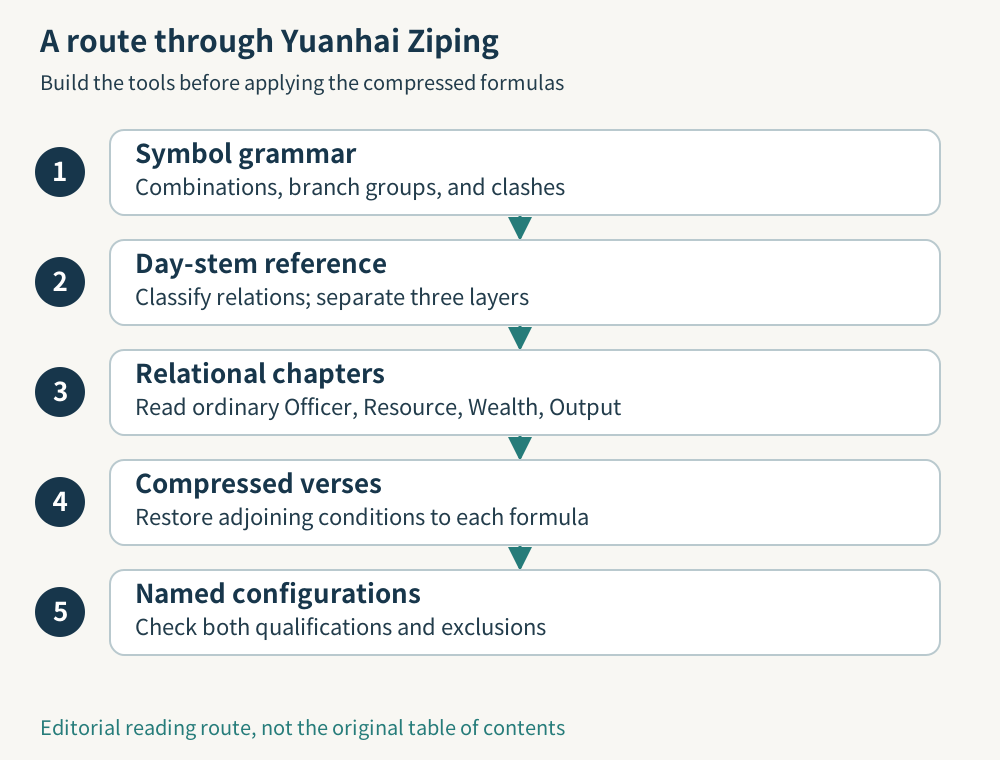
Scroll horizontally to read the figure; open the original for a full-size view. Open full-size figure · PNG
The figure is our reading route, not the book's original table of contents. Its purpose is to prevent advanced labels arriving before the concepts needed to evaluate them.
Learn the stem-and-branch grammar. Juan 1's sections on stem combinations and branch combinations, trines, and clashes give the relational vocabulary. Recognizing 甲己 as a combination pair is an identification step; it does not yet prove transformation into Earth in a complete chart. [5]
Establish the day-stem reference and the three layers. Learn to classify another stem by its element and polarity relative to the day stem. Keep a visible stem distinct from a stem stored in a branch.
Read the ordinary relational discussions. The Officer, Seven Killings, Resource, and Wealth discussions in juan 2 are easier to follow once you can identify the relation without guessing at a person's character.
Return to the compressed verses. Jishan pian is useful as a network of reminders. Read adjoining qualifications, not just the most memorable line.
Approach named and exceptional configurations with their exclusions in view. A striking pattern name is the beginning of an inquiry into conditions, not the end of one.
This route is deliberately not cover-to-cover. It is a way to make later reading less dependent on memorized verdicts. The following nine articles follow the same conceptual progression while returning to different passages and problems.
Turn a formula into a question
Consider another large-character line in Jishan pian:
“欲知貴賤,先觀月令,乃提綱。”
Our translation: “To examine rank, first observe the month command: it is the organizing thread.” [4]
The words “rank” and “high or low” belong to the book's hierarchical social setting. Our use of the passage is to investigate its order of reasoning, not to classify a modern person's worth.
There are at least three different readings of this line:
| Reading | What it does | What remains missing |
|---|---|---|
| “The month decides everything” | Elevates one factor into a complete verdict | Other stems and branches, seasonal depth, supporting and obstructing relations |
| “The month is one equal vote among eight characters” | Treats all symbols as interchangeable counts | The organizing priority expressly given to the month |
| “Begin with seasonal context, then examine its relations” | Preserves the stated order without ending the inquiry | The next steps still have to be carried out |
The third is the reading method developed here. It is an interpretation supported by the passage's priority and by the book's subsequent relational discussion. It is not a numerical formula hidden inside the word “thread.”
This exercise reveals an important habit: distinguish the instruction to start somewhere from permission to stop there.
Use a passage record instead of a quotation collection
For a first close reading, write a short record with six entries:
Location: edition, juan, heading, scan-image number, and textual layer
Literal relation: which symbol generates, controls, combines with, or is classified relative to which other symbol?
Subject: is the passage discussing the day stem, a pattern, a year, a decade, or an auxiliary marker?
Conditions: what must be present, absent, sufficiently strong, or protected?
Counterexample: what nearby sentence or changed condition would alter the reading?
Limit: what does the passage not establish about an actual person's life?
Try this on the month-command line. The location is juan 2, Jishan pian, fascicle 2 image 2, large-character verse. Its subject is the opening order of analysis. Its priority is seasonal month context. It does not identify the final operative factor in every possible chart. The countercheck is the adjoining instruction to use the day stem as the principal reference. Both instructions can hold because they answer different questions: “relative to what?” and “under which seasonal conditions?”
What to do with uncomfortable historical claims
The book also contains statements about gender, status, morality, illness, and lifespan. Removing all traces of these would misrepresent its historical character. Repeating them as present-day judgments would be equally irresponsible.
A careful reader can identify the old claim, examine the symbolic argument beneath it, and decline to carry its social ranking or medical certainty into the conclusion. A Wealth label is not a bank balance; Seven Killings is not a diagnosis of violence; an old illness verse is not medical evidence. Keeping that distinction explicit allows real textual study without making the book a source of authority over someone's health, finances, or relationships.
Before moving on, you should be able to answer three questions: Which edition am I reading? Is this sentence text, old annotation, or modern explanation? What conditions would make my interpretation change? If you can answer them, you are ready for article 2's chart map.
Sources and reading notes: ancient scans, scholarship, and calculation
1634 Shanchengtang witness, juan 1 opening and preface, fascicle 1 scan images 3–4. Attribution and dated preface, image 4. Images are a mechanical scan of the public-domain original; scan-image numbers are not traditional folio numbers.
Chao Wei-pang, “The Chinese Science of Fate-Calculation,” Asian Ethnology 5(1), 1946, pp.279–315, especially printed p.288. Scholarly article. Used for a concise historical qualification, not as evidence of predictive validity.
National Central Library Taiwan eBook, 1926 combined publication, volume 1, Qin Shen'an as collator. Library record. Bibliographic comparison only; not the base text for these quotations.
1634 witness, juan 2, Jishan pian, fascicle 2 scan image 2. Passage image. Quotations are the large-character verse; translations and punctuation are ours.
1634 witness, juan 1, stem combinations and branch relations, fascicle 1 scan images 5–6. Stem combinations, image 5, branch relations, image 6.
Classical quotations use editorial punctuation and limited normalization of common character forms (such as 于/於 and 强/強). Uncertain readings are identified or avoided, not silently supplied. Ancient scan links are textual evidence; scholarly history and software reproduction have separate roles.
Evidence and source roles
These roles distinguish ancient text, older commentary, historical scholarship and tool reproduction. The numbered notes in the article retain the precise scan pages and explanations. Library and academic sources do not endorse predictive claims.
- E01 · Historical edition evidence: Compiler/reviser attribution and dated preface
- E02 · Historical preface evidence: Preface
- E03 · Ancient text evidence: 論天干相合
- E04 · Ancient text evidence: 論十二支六合/論十二支三合/論十二相冲
- P01 · Ancient text evidence: 繼善篇
Text layer in the witness: 下欄大字正文 - P02 · Ancient text evidence: 繼善篇
Text layer in the witness: 下欄大字正文 - E09 · English historical scholarship: Chao Wei-pang, The Chinese Science of Fate-Calculation
- E10 · Library catalogue record: Yuanhai Ziping / Ziping Zhenquan,1926 combined edition,volume1