Added explanation can be distinguished if the passage is first matched and restatement, addition and the reader's analysis remain separate. Here only a fourteen-character core is aligned: repeated flourishing, required Geng Metal and the hewing-to-form-beams image in Waseda's spring-Jia discussion, against large type in the same stem/season discussion of a commentary witness actually dated January 1937. Two exceptionally short small-type phrases then let us test what the commentary adds.[1,2,5]
Waseda's printing year is unresolved, so its physical copy is not declared earlier than 1937. Nor does the dated commentary prove first publication or identity of the entire texts. The comparison concerns located historical wording and an actual near-modern commentary layer, rather than an unverified edition genealogy.[6,7]
Reach the actual text before filling comparison results
The publicly readable NLC48608 scan has Donghai Lewu's commentary and Qianqian Shushe on title page scan 2; scan 276 explicitly gives January of Republican year twenty-six, with commentary and issuing responsibilities.[5] This differs from the previously located August 1955 catalogue. No 1955 body text was acquired, so the 1937 words are not presented as quotations from a 1955 page.[8]
At scan 14, printed five, volume one's Spring Jia General Discussion separately credits Yu Chuntai's original compilation and Lewu's commentary. Large-type text and small-type explanation are distinguishable.[2] Layout and responsibilities together support the layers; an impression that a sentence sounds modern cannot assign its author.
The Waseda location is scan 8, left half, printed one, volume one, with a slightly different spring-Jia heading.[1] Both locations belong to their first volume; their title difference remains recorded. Matching fourteen characters does not make the entire paragraphs identical or establish that the 1937 large type was unedited. The unit stays at the genuinely matched core.
The base sentence already contains a condition
The shared core begins with repeated flourishing, then requires Geng, then explains through a hewing-and-beams image. Repeated is consequential: it qualifies the requirement. “Spring Jia must use Geng” expands the scope and cannot be retroactively called the old sentence's full meaning.
Beams are its craft image, not someone's independently authenticated occupation. Required use and possible formation have distinct force: one emphasizes selection within the branch, the other supplies an image of forming material. Studying their arrangement does not promise modern rank or achievement.
Before identifying an annotation's additions, therefore, mark conditions already in the base wording. Otherwise an explicit explanatory connection may be misremembered as a completely new rule supplied by the commentator.
A limiting phrase makes an existing boundary explicit
The small type uses the phrase “limited to repeated flourishing” for Geng's use.[3] Its Chinese wording, 以重見生旺為限, makes the applicability boundary explicit. It guards against extending the requirement to every Jia context, but does not invent the condition already at the core's beginning.
Separate two changes: whether the content relation is added, and whether an explanatory step becomes clearer. In this selected phrase, the scope can be compared with the base sentence. Explicit explanation does not establish an originally conditionless text, or historical first invention by Xu.
A reading card may place repeated flourishing under already written in the base, the explicit restriction under stated in the annotation, and the reason for retaining the premise under my interpretation. All three fields can be useful; valuing commentary does not require emptying the first.
A grade assessment is a different addition
A later short phrase is 非上格也, “not a superior pattern.”[4] It cannot become a verdict on every Geng arrangement. Between the Geng restriction and this closing assessment, the small-type paragraph also discusses Wu Earth; the assessment concerns those two kinds of arrangement. The two quoted phrases are separated by intervening text, not joined into one continuous sentence.
Relative to the aligned fourteen-character core, the grade statement adds an evaluative layer. The core gives a condition, Geng selection and a craft image; the selected commentary further positions the arrangements by grade. This permits identifying an assessment added here, without claiming the entire historical text never assesses grades or converting superior pattern into a modern income or ability score.
The object of assessment especially matters. Attaching the phrase to every person with Geng leaves the annotation's two-object scope and converts a book-internal grade into a judgment of human worth. That extension requires evidence the selected passage does not supply.
| Comparison field | Matched historical core | Selected annotation and interpretation |
|---|---|---|
| Applicable scope | Repeated flourishing | Makes that existing boundary explicit |
| Discussed object | Required Geng; hewing into beams | Does not extend the excerpt to all Jia or Geng arrangements |
| Assessment layer | The fourteen-character core lacks this grade phrase | Commentary assesses Geng/Wu arrangements locally |
| Research conclusion | Only the finite wording established | Separate restatement/addition without first-invention or whole-text claims |
Added explanation need not mean modern examples
This selection establishes explicit scope and grade assessment. It does not authenticate a new real-person case, modern everyday illustration or statistical validation. The planned question about steps, examples or modernized understanding asks what is found; it does not require every field to be filled. The supported fields receive results; the others remain unestablished.
The three-field card is this article's analytical tool, with its own attribution. It asks where a sentence comes from, which step it changes and whether its objects survive. It is not claimed as a table printed on the 1937 page. Original analysis should make its responsibility visible rather than hide new interpretation inside an apparent source layer.
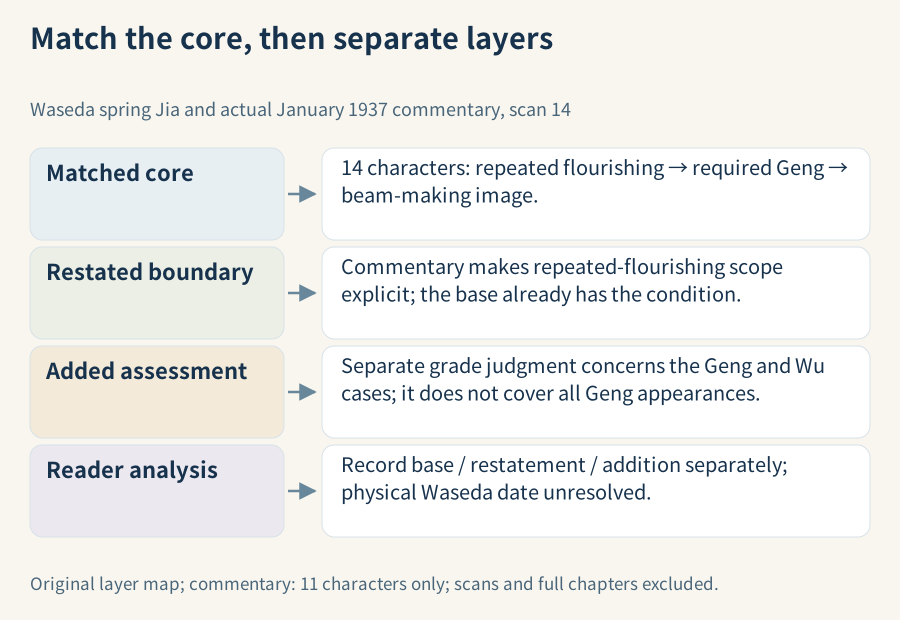
The complete figure is shown below. Select it to enlarge the labels. Open full-size figure · PNG
Readable access and unrestricted reproduction have separate limits
Public access to this dated print makes the finite comparison checkable. It does not automatically authorize worldwide reproduction of the entire commentary or institutional scans. The article uses necessary short quotations, explicit duties and locators, direct source links, and original analysis. The two commentary selections total eleven Chinese characters. The PDF, page images, copyright page and research crops are excluded from the author package.
A year alone does not settle rights. The historical imprint also states copyright and a prohibition on reprinting. That establishes what the imprint said then, not every territory's 2026 term or scan-use conditions. Expanded chapter reproduction or image republication would require a separate permission assessment.
Finish the book's finite reading scope
The thirteen questions in three collections move from witness and month labels through selected seasonal stem comparisons to conditional branches, cross-book language and commentary layers. The outcome is a reading method with retrievable evidence and visible unknowns. It is not a critical edition of all 108 Waseda images or the complete 1937 commentary.
Return to the third collection, or the first edition question for responsibilities and bibliography. The answer is limited to one real alignment: commentary may explicitly restate an existing condition and add an assessment requiring its own object. Who wrote each step and how far the evidence reaches should remain visible.
Sources and further reading
三春甲木論, scan 8, left half, printed 一. Waseda University Library classical-text page
三春甲木總論:大字核心, scan 14, printed 五. Dated edition base-text page
三春甲木總論, scan 14, printed 五. Dated commentary page
三春甲木總論, scan 14, printed 五. Dated commentary page
Actual title/imprint and selected base/commentary responsibilities, scan 276, numbered printed page unresolved or inapplicable. Imprint/responsibility page Separate positions: 2, 14
Printed titles and responsibilities, separately located, scan 8, printed 一. Waseda University Library classical-text page Separate positions: 1, 2, 4, 49
Historical-witness catalogue, historical-witness catalogue; scan/old printed page inapplicable. Historical-witness catalogue
窮通寶鑑評註:1955書目, commentary-edition catalogue; scan/old printed page inapplicable. Commentary-edition catalogue
Punctuation, translation, analysis and diagrams are original. Physical Wang/catalogued Gang, actual 1926/1936/1937 witnesses and commentary layers remain distinct; scan 12 region glyph unresolved. Institutional scans, complete modern commentary chapters and research materials excluded. Finite interpretation, not whole-book collation or validated life prediction.
Evidence and source roles
These roles distinguish ancient text, older commentary, historical scholarship and tool reproduction. The numbered notes in the article retain the precise scan pages and explanations. Library and academic sources do not endorse predictive claims.
- QT3-E04-BASE14 · Ancient text evidence: 三春甲木論
Text layer in the witness: Historical printed text in the identified Waseda witness; punctuation is editorial; handwritten margins and modern explanation excluded. - QT3-E04-MODERN-BASE14 · Historical-edition base text: 三春甲木總論:大字核心
Text layer in the historical-edition base text: Large-type historical base text in the actual 1937 commentary edition; distinct from its small-type commentary. - QT3-E04-COMMENT-LIMIT · Historical commentary text: 三春甲木總論
Text layer in the historical commentary: Actual 1937 small-type commentary, separately credited to Donghai Lewu by the page/title/imprint. Necessary limited quotation; not Waseda base text or unrestricted republication. - QT3-E04-COMMENT-RANK · Historical commentary text: 三春甲木總論
Text layer in the historical commentary: Actual 1937 small-type commentary, separately credited to Donghai Lewu by the page/title/imprint. Necessary limited quotation; not Waseda base text or unrestricted republication. - QT3-E00-XU1937 · Historical-edition imprint: Actual title/imprint and selected base/commentary responsibilities
Text layer in the imprint: Actual 1937 title/imprint and separately located page 14 responsibilities; not catalogue-as-body or unrestricted copyright authorization. - QT3-E00-WASEDA · Ancient text evidence: Printed titles and responsibilities, separately located
Text layer in the witness: Physical title and separately located duties; not one continuous quote or modern commentary. - QT3-E00-CATALOGUE · Historical-witness library catalogue: Historical-witness catalogue
Text layer in the catalogue: Modern catalogue of a historical witness; not its original title, date-bearing imprint or commentary body. - QT3-E00-XU1955-CATALOGUE · Modern-edition catalogue: 窮通寶鑑評註:1955書目
Text layer in the catalogue: Modern commentary catalogue only; no copyright page or actual1955 body acquired.