All three books discuss cold and warmth, but the selected passages do not ask equally sized questions. Qiong Tong Bao Jian's Jia spring discussion distinguishes early/late spring states and Fire/Water functions. Zi Ping Zhen Quan makes climate interact with selection from the Month Command. Di Tian Sui Ji Yao begins with cold/warm and dry/damp principles, then qualifies their operation in its explanations. Comparing these arguments shows how shared vocabulary enters different routes, and which rules cannot simply be transferred.
The comparison concerns finite passages in three identified witnesses: Waseda Bunko19 F0111, NLC46443 with its actual January 1926 imprint, and Ji Yao's printed Cold/Warm Discussion. Waseda's physical Wang, 網, remains distinct from catalogued Gang, 綱, with printing year unresolved. The Shen-text volume's publishing responsibilities and Ji Yao's raised opening statements and same-size explanations retain separate layers.[10,11,12] This does not establish original manuscripts, individual authorship of every explanation or direct borrowing.
Compare sentences and their jobs first
“Qiong Tong means climate, Zi Ping means patterns, Di Tian means strength” turns books into exclusive labels. The selected texts are less tidy: Zi Ping explicitly uses tiaohou, seasonal adjustment; Ji Yao contains a named pattern and ordering words; Qiong Tong distinguishes position, absence and extra qualifications. Labels may aid searching, but cannot answer what an actual sentence is doing.
Ask four common questions: where does the argument enter, which objects remain, what inference does seasonal language change, and how does the text limit extension? The unit of comparison is thus an argument with premises, rather than a whole-book score or hierarchy.
Printed wording also needs care. Ji Yao uses 煖, while the planned article title uses modern 暖. Recording this difference enables retrieval; the character variant alone does not establish two different climate theories. Objects and qualifications determine the substantive difference.
Qiong Tong branches a spring discussion by state and function
Scan8, left half, printed one, in the spring-Jia discussion says early spring still has residual cold and Fire should warm it.[1] The literal Chinese retains printed 温 rather than normalizing it to 溫. Jia comes from the chapter scope, with early spring and residual cold before the warming function; the short selection does not name Bing or Ding.
Elsewhere in that discussion, late-spring strengthening yang and thirsty Wood lead to welcomed Water support.[2] Intervening text separates the two selections; they are not concatenated. Late spring, strengthening yang, thirst and support form a different branch, despite the shared Jia subject.
Thus the Qiong Tong climate label here describes this article's seasonal reading. These short sentences do not print a comprehensive definition of tiaohou. A shared seasonal concern does not make Fire's warming and Water's support two answers to one strength score.
Its comparison column retains subject, position within spring, condition and discussed function. A generic flourishing spring-Wood label cannot swallow residual cold and thirst; should and welcomed cannot be interchanged. Seasonal branching is one checkable job in this comparison.
Zi Ping joins climate to an existing selection argument
NLC46443 scan 31, printed eighteen, opens: the discussion primarily uses yongshen from the Month Command, but must also combine climate with it in mutual consideration.[3] Primarily identifies the entry; must also makes the added check consequential; mutual consideration joins them. Neither converting all yongshen into climate factors nor treating climate as decorative preserves this sentence.
The subsequent general Officer/Seal assessment is restricted when Wood encounters winter Water: even with Officer disclosed, the claimed noble result is difficult to ensure.[4] Seasonal language limits whether an existing structural assessment can be carried forward. “Difficult to ensure” must not become either guaranteed success or guaranteed failure.
Another passage first requires flourishing self and Seal with Food Spirit disclosed, then applies the relation to winter Wood and gives the discussed Fire both discharge and seasonal-adjustment functions.[5] One factor receives two jobs. Keeping only Fire's climate function loses the structural qualifications; keeping only discharge loses the explicitly added explanation.
The two examples show a checkable relation: climate can restrict an inference or add an explanation without replacing Month Command selection. Fire/Water functions from the Qiong Tong column cannot simply be substituted here, making every Fire Food Spirit or every Water Seal regardless of the subject.
Ji Yao states limits before qualifying operation
At scan 32, printed twenty-seven, the raised statements say cold/warm must not go too far and dry/damp must not become one-sided.[6,7] Their traditional heaven/earth/human frame supplies limits before specifying a Jia month. No measuring units or numerical thresholds are provided.
The same-size explanation then says that cold with attained qi meets warmth and develops, while warmth with attained qi meets cold and forms.[8] Both directions carry the attained-qi premise. Keeping only cold meeting warmth removes that qualification and the reverse branch. Yin/Yang branches and the Metal/Water versus Wood/Fire classification participate in the explanation; classification alone does not settle every case.
Scan 33, printed twenty-eight, gives Fire/Earth arrangements suited to dryness with Earth before Fire, and Metal/Water arrangements suited to dampness with Metal before Water.[9] Suitability qualifies each branch before afterward states an order. The explanation can therefore reach particular relationships without supplying a universal Earth-before-Fire formula. Its ordering words cannot be lent to the selected Qiong Tong spring clauses as if that print contained them.
A comparison table should retain differences
| Selected position | Entry to judgment | Job of seasonal language | Qualifications to preserve |
|---|---|---|---|
| Qiong Tong spring-Jia clauses | Subject and position within spring | Branch warming/support by seasonal state | Early/late spring; should/welcomed; warming/support |
| Zi Ping climate chapter | Month Command yongshen primarily | Restrict assessment or add a climate function | Officer/Seal with winter Water; flourishing self/Seal, disclosed Food, winter Wood |
| Ji Yao Cold/Warm statements and explanation | Limits of excess and one-sidedness | Qualify operation through attained qi and suitability | Both attained-qi directions; suitability before the specified orders |
Shared cold language makes the comparison possible; different entries and jobs are results to preserve. Forcing every column into “replace what is missing” requires deleting actual fields. The resulting tidiness comes from rewriting, not discovery in the selected text.
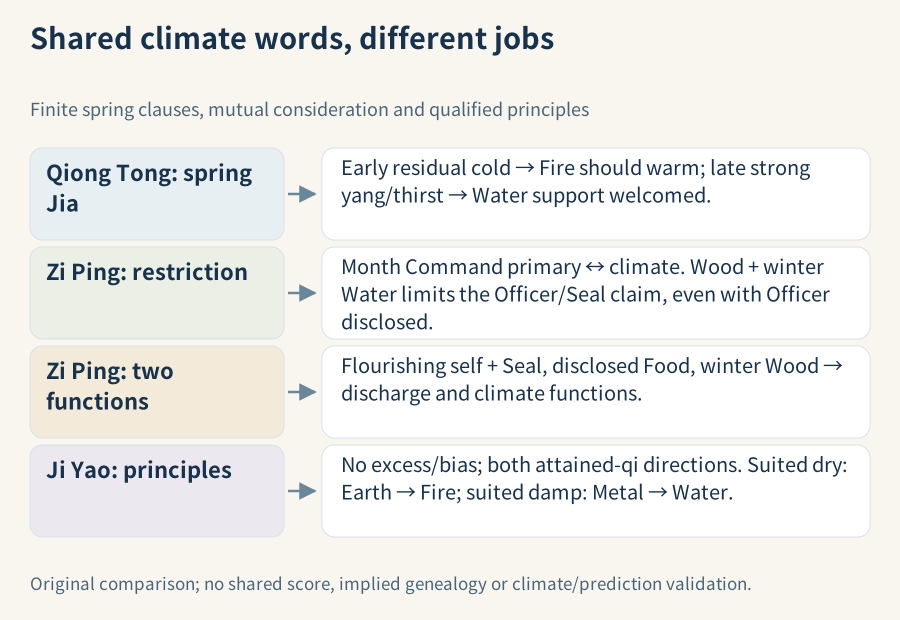
The complete figure is shown below. Select it to enlarge the labels. Open full-size figure · PNG
Test a modern abstract with the common questions
Consider “All three say winter Wood with Fire guarantees high status.” The Qiong Tong selections distinguish early and late spring, not a silently substituted winter entry. Zi Ping's winter-Wood example retains flourishing self and Seal with Food disclosed. Ji Yao's attained-qi statement retains both directions. The abstract drops month, structural qualifications and direction, so these three finite selections cannot support it.
A better abstract can say that seasonal language enters judgment in all three witnesses, while the selected spring discussion, mutual-consideration chapter and principle/explanation use different conditions to determine its task. This identifies a shared concern while preserving evidence limits. Historical transmission or changes between editions require separate dating, citation and textual evidence; similar words do not establish them.
See the individual close readings of Zi Ping's climate chapter and Di Tian's cold/warm chapter. This article supplies the three-way comparison. An explanation inside a historical model is not meteorological validation, bodily diagnosis or demonstrated modern life prediction.
Sources and further reading
三春甲木論, scan 8, left half, printed 一. Waseda University Library classical-text page
三春甲木論, scan 8, left half, printed 一. Waseda University Library classical-text page
論用神配氣候得失, scan 31, printed 一八. Identified witness page
論用神配氣候得失, scan 31, printed 一八. Identified witness page
論用神配氣候得失, scan 31, printed 一八. Identified witness page
寒煖論, scan 32, printed 二七. Identified witness page
寒煖論, scan 32, printed 二七. Identified witness page
寒煖論, scan 32, printed 二七. Identified witness page
寒煖論, scan 33, printed 二八. Identified witness page
Printed titles and responsibilities, separately located, scan 8, printed 一. Waseda University Library classical-text page Separate positions: 1, 2, 4, 49
Actual publication/issue imprint and separate Shen-text responsibilities, scan 74, numbered printed page unresolved or inapplicable. Imprint/responsibility page Separate positions: 14
Actual imprint and separate compilation/check-printing responsibilities, scan 64, numbered printed page unresolved or inapplicable. Imprint/responsibility page Separate positions: 1
Punctuation, translation, analysis and diagrams are original. Physical Wang/catalogued Gang, actual 1926/1936/1937 witnesses and commentary layers remain distinct; scan 12 region glyph unresolved. Institutional scans, complete modern commentary chapters and research materials excluded. Finite interpretation, not whole-book collation or validated life prediction.
Evidence and source roles
These roles distinguish ancient text, older commentary, historical scholarship and tool reproduction. The numbered notes in the article retain the precise scan pages and explanations. Library and academic sources do not endorse predictive claims.
- QT3-E03-QT-EARLY · Ancient text evidence: 三春甲木論
Text layer in the witness: Historical printed text in the identified Waseda witness; punctuation is editorial; handwritten margins and modern explanation excluded. - QT3-E03-QT-LATE · Ancient text evidence: 三春甲木論
Text layer in the witness: Historical printed text in the identified Waseda witness; punctuation is editorial; handwritten margins and modern explanation excluded. - QT3-X-ZP01 · Ancient text evidence: 論用神配氣候得失
Text layer in the witness: Shen-text single-line discussion as printed in the identified 1926 issue; not modern Xu commentary. - QT3-X-ZP02 · Ancient text evidence: 論用神配氣候得失
Text layer in the witness: Shen-text single-line discussion as printed in the identified 1926 issue; not modern Xu commentary. - QT3-X-ZP03 · Ancient text evidence: 論用神配氣候得失
Text layer in the witness: Shen-text single-line discussion as printed in the identified 1926 issue; not modern Xu commentary. - QT3-X-DT01 · Ancient text evidence: 寒煖論
Text layer in the witness: Raised short statement in this Ji Yao print; not an individually credited explanation. - QT3-X-DT04 · Ancient text evidence: 寒煖論
Text layer in the witness: Raised short statement in this Ji Yao print; not an individually credited explanation. - QT3-X-DT02 · Ancient text evidence: 寒煖論
Text layer in the witness: Same-size explanation recorded in this Ji Yao print; this passage has no individual commentator credit. - QT3-X-DT05 · Ancient text evidence: 寒煖論
Text layer in the witness: Same-size explanation recorded in this Ji Yao print; this passage has no individual commentator credit. - QT3-E00-WASEDA · Ancient text evidence: Printed titles and responsibilities, separately located
Text layer in the witness: Physical title and separately located duties; not one continuous quote or modern commentary. - QT3-E00-ZP · Historical-edition imprint: Actual publication/issue imprint and separate Shen-text responsibilities
Text layer in the imprint: Actual 1926 imprint; separate earlier prefaces/main-text responsibilities are not all one date or author. - QT3-E00-DT · Historical-edition imprint: Actual imprint and separate compilation/check-printing responsibilities
Text layer in the imprint: Actual 1936 Ji Yao imprint; not the date of an authenticated earliest Di Tian manuscript.