This comparison has two identifiable textual objects: Jiyao cold/warm and dry/damp principles with their explanation, and one local first-month Jia-Wood passage in an old Waseda-held print. Both use seasonal language, but make judgments at different levels of scope. Preserving their objects, states and connecting words shows how the explanation works and prevents a month-specific fragment from becoming a prescription for every pattern.
The actual Jiyao heading is 寒煖論, scans 32–33, printed pages 27–28. The Chinese article title uses the common modern 暖 spelling; quotations retain the printed 煖.[7] Waseda catalogues the comparison witness as Qiongtong baojian Lanjiang gang (欄江綱); the inspected title and preface fields print 欄江網, Lanjiang wang. Its printing year remains unestablished here. This article uses no modern Xu Lewu commentary and does not claim the later Qiongtong series is already complete.[8]
A cosmological principle followed by qi qualifications
The raised sentence says the way of Heaven has cold and warmth, develops the myriad things, and that the human way obtains this without excess.[1] Cold and warmth belong to a traditional Heaven/Earth/human correspondence. “Without excess” limits the claim’s application. This selection supplies no temperature units, measurements or procedure for obtaining observed weather from birth data.
The explanation first classifies yin/yang branches and Metal/Water versus Wood/Fire as cold/warm. It then requires cold with obtained qi to encounter warmth and develop, and warmth with obtained qi to encounter cold and become established.[2] Both relationships retain 得氣, obtained qi, and their directions differ. Copying only the classifications would detach them from the qualifications that immediately follow. Leaving only “cold needs warmth” would also delete the reverse branch.
The same page discusses yang among the Five Phases encountering Zi month, and yin encountering Wu month. It uses one yang or yin followed by the myriad things conceiving or being stored, then gives direction language for yang occupying yang and yin occupying yin.[3] These are traditional qi-transformation accounts in this witness, not modern meteorological or embryological evidence. Retain the named Zi/Wu months instead of substituting any day a reader considers cold or hot.
The dry/damp entrance does state an order
A second raised sentence gives dryness and dampness to the way of Earth, the production of categories of things, and warns the human way against one-sidedness.[4] This parallels the cold/warm restriction but requires its own explanatory objects. It is not permission to merge both distinctions into a single numerical scale.
The scan 33 explanation first names Metal/Water Hurting Officer requiring dryness. It then gives Fire/Earth situations suitable for dryness, using Earth and afterward Fire, and Metal/Water situations suitable for dampness, using Metal and afterward Water.[5] Hurting Officer supplies a particular relationship term; suitability for dryness or dampness qualifies the relevant branch. “Afterward” is genuinely printed, so the order can be recorded when that branch applies.
The passage does not say every occurrence of Fire/Earth calls for Earth/Fire, or every occurrence of Metal/Water calls for Metal/Water. It gives no doses or numerical thresholds for these factors either. Keeping the operation’s object and its suitability condition is more faithful than producing an unconditional element-order chart.
Identify the comparison print by its own title
The Waseda witness has Qiongtong baojian on its cover, both Qiongtong baojian and 欄江網 (Lanjiang wang) on its title page, and the combined printed name in its first body-volume title. The inspected character is 網 (糹 plus 罔); the library catalogue’s title is 欄江綱. Keep those two evidence layers separately. It credits Yu Xingtang with appraisal, Yu Chuntai with editing and Zeng Jichan with checking. Its preface also prints 欄江網 when describing the manuscript copy it edited.[8]
These are the witness’s credits and its own account. They identify the source of this seasonal passage without establishing the full genealogy of earlier copies or word-for-word identity with any modern annotated edition. The inspected identity pages and official catalogue do not resolve its printing year. A date from the separate 1936 Jiyao cannot be transferred to this other book.
The selection is the first local first-month Jia-Wood condition group, body juan1, printed page1, scan9 right half. It ends at the ordinary-person judgment, before the next branch beginning with a group of Geng/Xin factors. Handwritten marginal notes visible on the image are excluded; the comparison uses printed body text.[6]
The Jia-Wood passage distinguishes disclosure and concealment
This passage begins with first-month Jia Wood and early spring retaining residual cold. Obtaining disclosed Bing and Gui receives a wealth-and-rank judgment. Concealed Gui with disclosed Bing is called cold Wood facing the sun and also receives a strong status judgment. It then qualifies the result if fengshui is insufficient, while preserving a refined scholarly outcome; absence of Bing/Gui receives an ordinary-person judgment.[6] The punctuation is editorial; stem, month, disclosure/concealment and negation words follow the print.
| Supplied qualification | What it distinguishes | Rule not supplied by this selection |
|---|---|---|
| First-month Jia Wood, early-spring residual cold | Stem/month and seasonal premise | Every Jia or every cold pattern |
| Obtaining disclosed Bing/Gui | Two named stems and their disclosed state | Either generic Fire or Water |
| Concealed Gui, disclosed Bing | Different states of the two factors | Both disclosed, both concealed, or state irrelevant |
| If fengshui is insufficient | A further condition acknowledged by the source | Listed elements exhaust every determinant |
| If Bing/Gui are absent | A negative branch | Treating absence as presence |
Wealth, rank, scholarly refinement and ordinary status are the book’s social evaluations. We record their connection to conditions without promising a modern occupation, income or personal worth. The fengshui qualification particularly shows that this paragraph does not close every result around the listed stems alone.
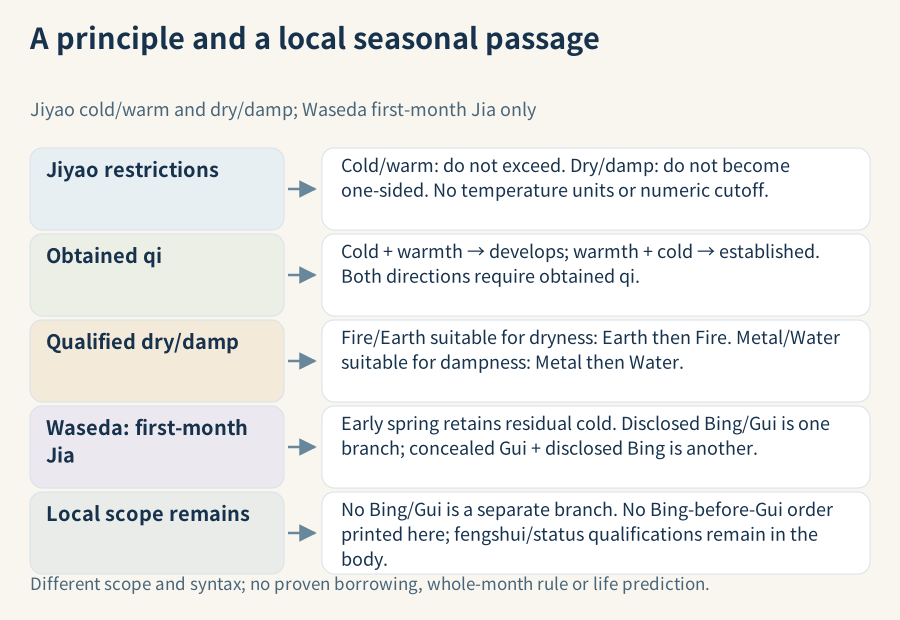
The complete figure is shown below. Select it to enlarge the labels. Open full-size figure · PNG
The diagram expands selected conditions only. The Waseda passage’s fengshui qualification and social judgments remain in the body. Unquoted later branches of the same month are not declared nonexistent, and row order supplies no priority between Bing and Gui.
How far this comparison reaches
The Jiyao selection begins with cosmological categories and restrictions, then adds obtained qi, Zi/Wu and particular dry/damp structures. The Waseda selection begins directly with Jia, first month and residual early-spring cold, before differentiating Bing/Gui states and absence. “Afterward” is printed in the former’s dry/damp branches. The latter’s selected 51 unpunctuated characters contain no “first,” “after,” “also use” or “must.” One passage’s order word cannot speak for the other.
This establishes a scope-and-syntax comparison between the selected passages. It does not establish direct historical borrowing or reduce every stem and month in Qiongtong to one rule. The later planned comparison will need broader evidence from that book; the present article supplies one identified starting point.
Use the Ten Gods basics page to recognize terms such as Hurting Officer, and the third-collection directory for the other readings. These traditional conditions are objects of textual analysis; the passages supply neither actual weather measurements nor a modern life-outcome test.
Sources and further reading
寒煖論, printed 27, scans 32. Source page 1
寒煖論, printed 27, scans 32. Source page 1
寒煖論, printed 27, scans 32. Source page 1
寒煖論, printed 27, scans 32. Source page 1
寒煖論, printed 28, scans 33. Source page 1
三春甲木論 · 正月甲木开头第一组局部条件, printed 一;scan9右半叶, scans 9. Waseda University Library page 1
扉頁、自序、目錄、刊記, separately located identity fields; scans 1/2/4/5/64. Source page 1 Source page 2 Source page 3 Source page 4 Source page 5
封面、扉页、序、卷题与题署, separately located identity fields; scans 1/2/3/4/8. Waseda University Library page 1 Waseda University Library page 2 Waseda University Library page 3 Waseda University Library page 4 Waseda University Library page 5
Punctuation, translation, analysis and diagrams are original. Source facsimiles, modern commercial commentary and inspection materials are excluded. The 1936 Jiyao, 1947 Chanwei, undated Waseda witness and historical transcription keep their distinct identities and layers. Return to Cycles, Commentators and Comparison, or consult the Ten Gods guide.
Evidence and source roles
These roles distinguish ancient text, older commentary, historical scholarship and tool reproduction. The numbered notes in the article retain the precise scan pages and explanations. Library and academic sources do not endorse predictive claims.
- DT3-E02-01 · Ancient text evidence: 寒煖論
Text layer in the witness: Raised opening short-text column in this Jiyao witness - DT3-E02-02 · Ancient text evidence: 寒煖論
Text layer in the witness: Explanation recorded in this Jiyao; largely same-size columns, not individually signed - DT3-E02-03 · Ancient text evidence: 寒煖論
Text layer in the witness: Explanation recorded in this Jiyao; largely same-size columns, not individually signed - DT3-E02-04 · Ancient text evidence: 寒煖論
Text layer in the witness: Raised opening short-text column in this Jiyao witness - DT3-E02-05 · Ancient text evidence: 寒煖論
Text layer in the witness: Explanation recorded in this Jiyao; largely same-size columns, not individually signed - DT3-E02-06 · Ancient text evidence: 三春甲木論 · 正月甲木开头第一组局部条件
Text layer in the witness: Printed body text in the Waseda witness; handwritten margins excluded - DT3-E00-01 · Ancient text evidence: 扉頁、自序、目錄、刊記
Text layer in the witness: Separately located identity and responsibility fields, not one continuous passage - DT3-E00-03 · Ancient text evidence: 封面、扉页、序、卷题与题署
Text layer in the witness: Separately located identity and responsibility fields, not one continuous passage命理窮通寶鑑欄江網卷之一。
Actual title/prelude/body-volume fields on scans2/3/4/8 print 欄江網, with 網 (糹+罔). The official catalogue records 欄江綱; this catalogue title is retained as a separate layer, never substituted into a quotation of the print. Appraisal/editing/checking duties remain unchanged. The preface’s manuscript-editing statement is not a proved genealogy; printing year/place/publisher remain unestablished.