The cycle-and-year discussion brings time into relationships already established in the original pattern. It first asks how the Day Master combines with the other seven characters, how their weights differ, and which cycle is desired. Incoming characters then act on that arrangement. A pair of incoming factors can therefore lead into different conditional branches. The reader needs the original preference, direction of action and any stated assistance together.
This article reads only the 1936 Di tian sui jiyao chapter printed as 歲運論, on scans 25–27, printed pages 20–22. Its raised short text, largely same-size explanation and parenthetical notes retain separate responsibilities. The compilation and correction credits of Chen Su’an and Lewu do not assign every unsigned explanation to an individually established author.[7] Favorable and adverse outcomes here are the traditional text’s judgments. These passages supply no independently verified births, events or advance prediction records.
What work the metaphors distribute
The raised text links favorable or adverse outcomes to the cycle, especially the year, then asks in clash and conflict which party yields, and in harmonious relations which connection is closer.[1] Those latter questions contain objects and directions. Taking only the priority of the year would leave a supposed weighting table detached from the relationship the verse asks the reader to examine.
The explanation distributes four images: the Day Master resembles oneself; factors in the original arrangement resemble boats, horses and attendants; the major cycle resembles the places traversed; the year factor resembles people encountered. It consequently emphasizes branches for the cycle, but adds 未嘗無天干, never without stems. It emphasizes stems for the year, but adds 未嘗無地支, never without branches. Only then does it require first understanding one Day Master in combination with the seven other characters, their relative weight, and which cycle is desired.[2]
An emphasis establishes a preferred entrance; it does not delete the other dimension. Reducing every cycle to its branch and every year to its stem would remove the explanation’s explicit qualifications. The original seven-character arrangement is also a prior task. An incoming character is not yet favorable or adverse merely because its name has been recognized. The images of a body, a route and encountered people organize an interpretation; they are not documented journeys or interpersonal events.
Reversing the attacking direction changes the row
The explanation calls a Bing cycle with a Geng year 運伐歲, the cycle attacking the year. A Geng cycle with a Bing year is 歲伐運, the year attacking the cycle. The printed character is 伐, attacking, not 代, replacing.[3][4] These labels establish who acts on whom. They do not by themselves establish the original pattern’s preference.
For Bing-cycle/Geng-year, one branch begins with the Day Master preferring Geng and requiring Bing to yield. It then links its favorable judgment to the printed 得戊得壬 qualification. Another branch begins with the Day Master preferring Bing: the year will not yield, and obtaining Wu/Ji to harmonize the relation is termed excellent.[3] This article keeps the printed Wu/Ren expression without forcing an unstated conjunction into an automatic “either” or “both” rule. What is explicit is that the preferred object changes, the desired yielding or harmonizing task changes, and named further characters qualify the judgment.
Geng-cycle/Bing-year receives a separate statement: if the Day Master prefers Geng, obtaining Wu/Ji to harmonize Bing is termed favorable. Immediately before it, a Geng-seated-on-Yin-year branch gives Bing greater force and says the year has to yield. A parenthetical note adds that when momentum is great, the year has no authority.[4] That local qualification prevents the opening priority of the year from becoming permanent supremacy over the cycle. Swapping the incoming cycle and year characters while copying the earlier conclusion would discard the new conditions. Nor should these fragments be completed into invented natal charts. The book gives local relationship examples.
Parties, stem-level help and negations in the clash examples
The Zi-cycle/Wu-year and Wu-cycle/Zi-year discussion continues past the label “clash.” It distinguishes the desired side, the number of allies and which side the stems assist or do not assist.[5]
| Printed branch | Conditions to retain | Judgment stated by the book |
|---|---|---|
| Zi cycle/Wu year, Day Master prefers Zi | Assist Zi; also obtain a year stem controlling Wu | “Still more excellent” |
| Following branch with greater Wu-side force | Many Wu allies, or Bing/Wu/Jia at stem level | “Necessarily adverse” |
| Wu cycle/Zi year, Day Stem prefers Wu | Many Zi allies; stems also assist Zi | “Necessarily adverse” |
| Branch with Day Stem preferring Zi | Few Wu allies; stems also do not assist Wu | “Necessarily favorable” |
| Final separate “if” clause | Wu weighty, Zi light | Year does not yield; nevertheless no harm |
These strong favorable/adverse terms belong to the source’s assertions. The table does not turn them into demonstrated probabilities. “Do not assist Wu” cannot become “assist Wu”; “few allies” cannot vanish. The last clause should also remain a separate printed qualification. It does not restate a Day Master preference there, so the table does not supply one on its behalf. Its following parenthetical note says the momentum is already formed and the year’s force cannot cause harm. That remains a separate explanatory layer rather than an omitted reminder. Keeping the conditions visible is the purpose of this record.
After combination, return to the original preference
For Yi-cycle/Geng-year and Geng-cycle/Yi-year, the explanation first calls the relation beneficial. It then distinguishes a Day Master preferring Metal, termed favorable, from one preferring Wood, termed unfavorable. Zi-cycle/Chou-year and the reverse are also initially termed beneficial, before a distinction between preferring Earth and preferring Water.[6]
A local beneficial relationship is therefore insufficient to establish a favorable whole-life verdict. The first statement identifies a connection; the next returns that connection to the original preference. This passage also supplies no permission to assume that every combination automatically transforms into Metal or Earth. We interpret its stated examples, while the full qualifications of following and transformation remain the separate question examined in collection two.
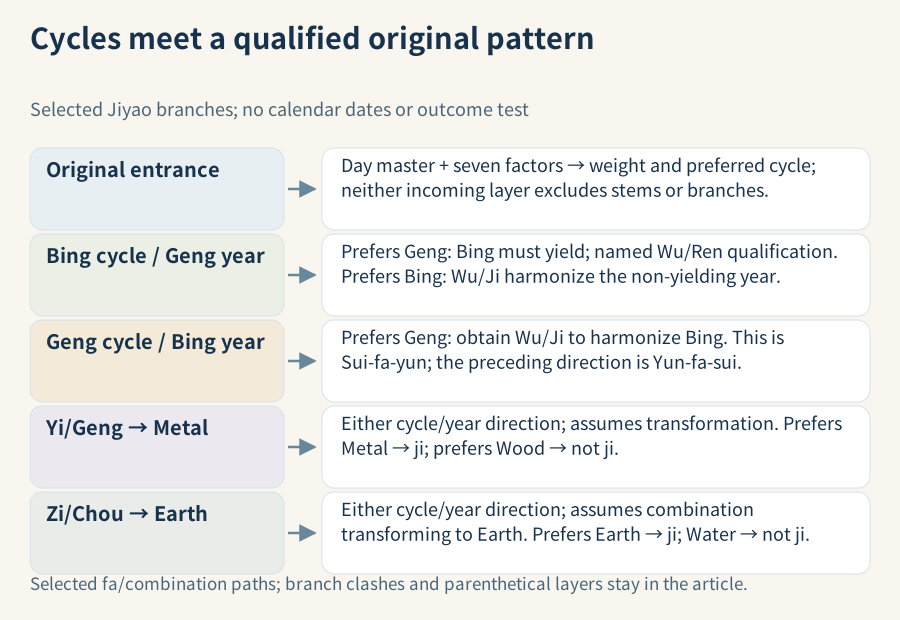
The complete figure is shown below. Select it to enlarge the labels. Open full-size figure · PNG
The diagram expands selected attacking and combination branches. The table separately retains the clash discussion’s allies and stem-level conditions. Neither replaces every branch in the chapter or supplies calendar dates and real events.
Recording structure and time in the same ledger
A useful reading row has five fields: the original preference, incoming cycle character, incoming year character, operation and prerequisites for the judgment. “Bing cycle/Geng year” alone is an unfinished row. Continue with whether Geng or Bing is desired, which side should yield, and whether the explanation’s named harmonizing or assisting factors are obtained. Leave unknown fields blank instead of completing a supposed event from the label.
This ledger also separates two kinds of time information. Cycle and year are temporal entrances in a traditional model. A person’s actual birth date and the date of a documented event are factual records requiring independent sources. These short examples do not supply both. Understanding their conditional reasoning explains how the passage organizes relationships. Testing a successful prediction would additionally need identifiable events and records made before those events. The fifth article examines that distinction using an actually located Chanwei case.
Use the Ten Gods basics page to refresh the relationship names, and the third-collection directory for the other questions. Recognizing the names helps locate the factors; this chapter’s decision routes still depend on its own stated qualifications.
Sources and further reading
歲運論, printed 20, scans 25. Source page 1
歲運論, printed 20, scans 25. Source page 1
歲運論, printed 21, scans 26. Source page 1
歲運論, printed 21, scans 26. Source page 1
歲運論, printed 21, scans 26. Source page 1
歲運論, printed 22, scans 27. Source page 1
扉頁、自序、目錄、刊記, separately located identity fields; scans 1/2/4/5/64. Source page 1 Source page 2 Source page 3 Source page 4 Source page 5
Punctuation, translation, analysis and diagrams are original. Source facsimiles, modern commercial commentary and inspection materials are excluded. The 1936 Jiyao, 1947 Chanwei, undated Waseda witness and historical transcription keep their distinct identities and layers. Return to Cycles, Commentators and Comparison, or consult the Ten Gods guide.
Evidence and source roles
These roles distinguish ancient text, older commentary, historical scholarship and tool reproduction. The numbered notes in the article retain the precise scan pages and explanations. Library and academic sources do not endorse predictive claims.
- DT3-E01-01 · Ancient text evidence: 歲運論
Text layer in the witness: Raised opening short-text column in this Jiyao witness - DT3-E01-02 · Ancient text evidence: 歲運論
Text layer in the witness: Explanation recorded in this Jiyao; largely same-size columns, not individually signed - DT3-E01-03 · Ancient text evidence: 歲運論
Text layer in the witness: Explanation recorded in this Jiyao; largely same-size columns, not individually signed; parentheses separately located - DT3-E01-04 · Ancient text evidence: 歲運論
Text layer in the witness: Explanation recorded in this Jiyao; largely same-size columns, not individually signed; parentheses separately located - DT3-E01-05 · Ancient text evidence: 歲運論
Text layer in the witness: Explanation recorded in this Jiyao; largely same-size columns, not individually signed; parentheses separately located - DT3-E01-06 · Ancient text evidence: 歲運論
Text layer in the witness: Explanation recorded in this Jiyao; largely same-size columns, not individually signed; parentheses separately located - DT3-E00-01 · Ancient text evidence: 扉頁、自序、目錄、刊記
Text layer in the witness: Separately located identity and responsibility fields, not one continuous passage