Firmness/softness and accordance/opposition both concern relationships, but the word cannot in their openings does not make them one rule that all strong factors should be followed and all weak ones assisted. The selected Firmness and Softness passage asks whether assistance attains the factor’s disposition or strengthens it in the opposite direction. Accordance and Opposition turns to the object that cannot be opposed and its established momentum. We compare those actual entrances with their limits intact.
In the 1936 Jiyao, Firmness and Softness occupies scan 31, printed page 26. Accordance and Opposition is headed there, with its selected opening and explanation at scan 32, printed page 27, before Cold and Warm. Disposition, might, fierceness, sharpness and authority are historical images here, not tests of real personality, gender or political value.
What cannot be controlled qualifies the object
The opening says firmness and softness differ, and that what cannot be controlled should have its disposition led through.[1] The latter clause concerns a qualified object. It does not prohibit control in every firmness/softness relationship or let the name firm remove the need to distinguish.
Leading its disposition is the response offered. Keep the strict cannot rather than quietly weakening it to somewhat difficult. At the same time, the old assertion is not a verified physical property. The following explanation uses specific factors to discuss failing to attain the relationship and instead assisting firmness.
Apparent complementarity does not complete the function
The recorded explanation first mentions mutual assistance of firm and soft, then says that helping firmness with softness without attaining its disposition instead assists its firmness.[2] Instead distinguishes the apparent response from its stated effect. A complementary pair of names cannot establish that the task has been achieved.
The reverse direction also appears: assisting softness with firmness without attaining the disposition instead increases softness.[5] Comparing both directions adds information about who acts on what and whether the function is appropriate; degree labels alone are insufficient.
This does not permit inventing an explanation for any outcome. Each branch still needs its object and failure-to-attain qualification. Return to the recorded example for the described effect rather than using firm and soft retrospectively to explain real events.
Keep the Geng/Xin seventh-month example specific
The example expressly concerns Geng/Xin born in the traditional seventh month. Ding Fire arouses might, Yi Wood assists fierceness, Ji Earth fulfills intention and Gui Water increases sharpness. It then proposes Ren Water as the stated firm-within-soft factor.[3] These verbs are the book’s personifying images, not assessments of anyone’s aggression or danger.
Month, Geng/Xin and the distinct stem functions cannot be reduced to a tally of Fire, Wood, Earth and Water. Gui and Ren both belong to Water, yet perform different tasks here. The explanation says Ren can lead through Geng’s disposition.[4] It does not extend that relationship to every Metal with every Water.
Keep seventh month as the traditional wording rather than civil-calendar July or one locality’s fixed dates. The example does not supply time-zone, longitude or modern term-boundary algorithms. Applying it to a new birthday would need separate data and conventions not provided by this excerpt.
| Factor in the old example | Recorded function | Example scope retained |
|---|---|---|
| Ding Fire | Arouses might | Geng/Xin born in the seventh month |
| Yi Wood | Assists fierceness | Not a moral or personality judgment about anyone |
| Ji Earth | Fulfills intention | Not every Earth occurrence in every position |
| Gui Water | Increases sharpness | Cannot be exchanged indiscriminately with Ren |
| Ren Water | Leads through Geng’s disposition | The specific Geng/Ren relationship explained below |
Accordance/opposition asks about momentum that cannot be opposed
Its opening states that accordance and opposition differ; what cannot be opposed should have its qi momentum followed.[6] Both differ and the qualified cannot-be-opposed object matter. This cannot become “following is always good,” or an instruction to obey someone in a real social setting.
The recorded explanation lists the way of firmness/softness, a distant source and long stream, and momentum already formed, each with may be followed and cannot be opposed.[7] We keep both the strong restriction and the specified objects. We neither soften it into a general suggestion nor claim to prove modern factual irreversibility.
Long source/stream and formed momentum shift attention from how one factor assists another to an established overall tendency. The entrance can relate to firmness/softness without turning every factor-description there into a definition of accordance/opposition. The questions and scope remain different.
Read social images as historical social images
The same passage includes authority concentrated in one person and two people of one mind, again attached to the following/opposition formulation.[8] These are old social images explaining concentrated or concerted momentum. Record their argumentative role without deriving modern political obedience or interpersonal obligations from them.
This also prevents claiming the old explanation is wholly without social images or evaluative color simply because our article makes no real-person judgment. The words exist. We identify their historical voice and scope without upgrading them into this site’s commands for actual people.
Compare entrances rather than merge them through one word
The first collection’s li/qi, accordance and advance/retreat analysis had its own passage and example boundaries. A shared word does not establish that this section repeats every earlier meaning. The two direct checks here can be arranged as follows:
| Selected entrance | Actual question | Restriction retained |
|---|---|---|
| Firm/soft assistance | Does it attain the disposition or assist/increase in the opposite direction? | Cannot-be-controlled object; particular month, stems and functions |
| Accordance/opposition momentum | Which stated tendency has formed, and can it be opposed? | Cannot-be-opposed object; long source/stream, formed momentum and related examples |
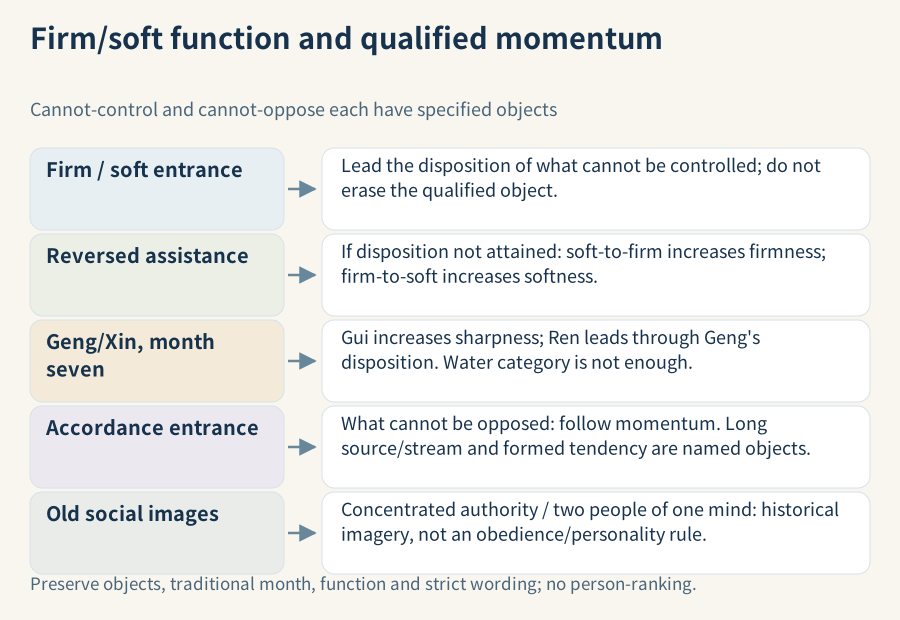
The complete figure is shown below. Select it to enlarge the labels. Open full-size figure · PNG
Restore the omitted subject and qualification
Compare “Water assists Metal” with the seventh-month example. It removes month, the Ren/Gui difference and the following explanation of leading through Geng’s disposition. Compare “one should comply” with the cannot-be-opposed object: it removes the local qualification and jumps from an old model into real behavior.
These paraphrase problems can be checked by restoring subject, object, month and limiting words. No new person or birth chart is needed. Describing a factor, comparing its function and discussing established momentum perform distinct tasks; a single favorable score or personality diagram cannot replace them.
Sources and further reading
剛柔論, printed 26, scans 31. Source page 1
剛柔論, printed 26, scans 31. Source page 1
剛柔論, printed 26, scans 31. Source page 1
剛柔論, printed 26, scans 31. Source page 1
剛柔論, printed 26, scans 31. Source page 1
順逆論, printed 27, scans 32. Source page 1
順逆論, printed 27, scans 32. Source page 1
順逆論, printed 27, scans 32. Source page 1
扉页与刊记, title/imprint without a body-page number, scans 1/64. Source page 1 Source page 2
Punctuation, translation, analysis and diagrams are original. Source facsimiles, modern commercial commentary and research/inspection materials are excluded. The final source item separately identifies the 1936 imprint and responsibilities. Return to Relations and Structural Distinctions, or consult the Ten Gods guide.
Evidence and source roles
These roles distinguish ancient text, older commentary, historical scholarship and tool reproduction. The numbered notes in the article retain the precise scan pages and explanations. Library and academic sources do not endorse predictive claims.
- DT2-E06-01 · Ancient text evidence: 剛柔論
Text layer in the witness: Raised opening short-text column in this Jiyao witness - DT2-E06-02 · Ancient text evidence: 剛柔論
Text layer in the witness: Explanation recorded in this Jiyao; largely same-size single columns, not individually signed by commentator - DT2-E06-03 · Ancient text evidence: 剛柔論
Text layer in the witness: Explanation recorded in this Jiyao; largely same-size single columns, not individually signed by commentator - DT2-E06-04 · Ancient text evidence: 剛柔論
Text layer in the witness: Explanation recorded in this Jiyao; largely same-size single columns, not individually signed by commentator - DT2-E06-05 · Ancient text evidence: 剛柔論
Text layer in the witness: Explanation recorded in this Jiyao; largely same-size single columns, not individually signed by commentator - DT2-E06-06 · Ancient text evidence: 順逆論
Text layer in the witness: Raised opening short-text column in this Jiyao witness - DT2-E06-07 · Ancient text evidence: 順逆論
Text layer in the witness: Explanation recorded in this Jiyao; largely same-size single columns, not individually signed by commentator - DT2-E06-08 · Ancient text evidence: 順逆論
Text layer in the witness: Explanation recorded in this Jiyao; largely same-size single columns, not individually signed by commentator - DT2-E00-01 · Ancient text evidence: 扉页与刊记
Text layer in the witness: Separately located printed title/imprint/responsibility fields; reused verified identity