Ruler/minister and mother/child roles change with the explanatory entrance in this witness. The Day Master can be ruler or minister, mother or child. First establish which factor occupies each role in the current passage; then read its relative strength and the assigned adjustment. That preserves the work performed by the image.
This article selects 君臣論 and 母子論 in the 1936 Di tian sui jiyao, scans 44–46, printed pages 39–41. Raised short texts and largely same-size explanations are located separately; compilation or correction credits do not identify every explanation’s individual composer.[9] These passages also employ historical ideals of political order, maternal care, filial service and abundant descendants. Explaining factor roles should not sanitize their language into something entirely free of value judgments.
First ruler/minister entrance: Day Master and Wealth
The first short statement warns against the ruler becoming excessive and praises diminishing the upper to benefit the lower.[1] The explanation then defines the Day Master as ruler and Wealth as minister. Its local example has Jia/Yi as Day Master, a configuration full of Wood, and only one or two points of Earth. It calls this ruler flourishing, minister declining, and asks for assistance to the minister: Fire generates it, Earth makes it substantial, Metal guards it. The assistance’s momentum is also required to be substantial.[2]
Role, distribution and operation are different fields. Day Master and Wealth establish who occupies the ruler/minister roles. Full Wood and little Earth establish this example’s relative situation. Generation, making substantial and guarding are the specified operations. After Metal’s guarding, a parenthetical note explains Officer controlling Robbery to guard Wealth; retain that explanatory layer. Taking only “Wealth is minister” would omit why this example calls for assistance; taking only favorable Fire or Metal would omit the object they are assisting.
Nor should momentum silently become a fixed character-count threshold. The passage describes one or two points and a full configuration, but provides no score universally applicable to other patterns. Its imagery of the upper remaining whole and the lower secure expresses an ideal of historical political order. We can explain that image’s reasoning function without using it to assess whether readers should govern or obey other people.
The next entrance places the Day Master below
The next raised statement warns against the minister exceeding its position and praises diminishing the lower to benefit the upper.[3] The explanation now makes the Day Master minister and the Officer ruler. Jia/Yi and full Wood remain, but the few points are Metal instead of Earth; this is minister flourishing and ruler declining.[4] The same Day Master name does not permanently occupy the upper role.
This explanation initially requires powerful Earth/Metal before assistance to the ruler becomes possible. It specifies Fire accompanied by Earth to discharge Wood, and Earth accompanied by Water to generate Metal.[4] “Accompanied by Earth” and “accompanied by Water” cannot be removed in favor of any Fire or any Earth. The discharged Wood and generated Metal must remain visible too. A further branch begins with excessive Wood/Fire: preserving the ruler’s child becomes necessary, Water qi is used, and proceeding along Water cycles is said to bring prosperity. Metal was the ruler here, and the continuation explicitly names Water; the ruler’s child is not supplied as a real heir’s biography.
The two entrances therefore need separate rows. One assists the few Earth/Wealth factors. The next initially assists the few Metal/Officer factors and retains the further branch stated by the book. Combining them into a permanent Day-Master-ruler mapping would invert the second paragraph’s grammar.
Mother/child also reverses the Day Master’s place
The first maternal short text links understanding a caring mother’s care for a solitary child to rejoicing in abundant descendants.[5] Its explanation begins with the Day Master as mother and what it generates as child. Jia/Yi amid full Wood with one or two points of Fire is mother flourishing, child solitary. It calls for helping the child and proceeding through Fire cycles, then supplies the descendants judgment.[6]
The generated factor occupies an explanatory role, with Food/Injury separately specified in a parenthetical note. Fire cycles are the adjustment entrance explicitly named here. “Help the child” is not permission to add any generating factor. Nor should solitary become a diagnosis of a real child’s loneliness, bereavement or need for intervention. The source does indeed promise a celebration of descendants; that is its traditional judgment rather than a verified family fact supplied by our reading.
The next short text praises a filial child’s service to the parent and harmonious order.[7] The Day Master is now child, and what generates it is mother, with Seal separately specified by a parenthetical note. Jia/Yi with full Wood and few Water factors becomes many children with a declining mother. The explanation calls for securing the mother, naming Metal generating Water and Earth generating Metal. It then adds an explicit alternative: if there is no Metal, Water’s disposition depends on Wood, and flourishing Wood/Fire places are also usable.[8]
Earth generating Metal and Metal generating Water are a path actually given by this passage. The no-Metal alternative also matters. Omitting it would turn the account into a single supposed remedy whenever Water is scarce. Conversely, extracting “Wood/Fire is also usable” would omit the preceding absence of Metal and dependence on Wood.
How the same images assign different tasks
| Explanatory entrance | Factors in this example | Stated relative condition | Operations requiring further reading |
|---|---|---|---|
| Day Master as ruler | Jia/Yi Wood and Earth/Wealth | Full Wood, little Earth | Fire generates; Earth makes substantial; Metal guards; assistance’s momentum |
| Day Master as minister | Jia/Yi Wood and Metal/Officer | Full Wood, little Metal | Strong Earth/Metal; qualified Fire and Earth; further Water branch when excessive |
| Day Master as mother | Jia/Yi Wood and generated Fire | Mother flourishing, child solitary | Assist child; Fire cycles |
| Day Master as child | Jia/Yi Wood and generating Water | Many children, declining mother | Metal generates Water; Earth generates Metal; no-Metal alternative |
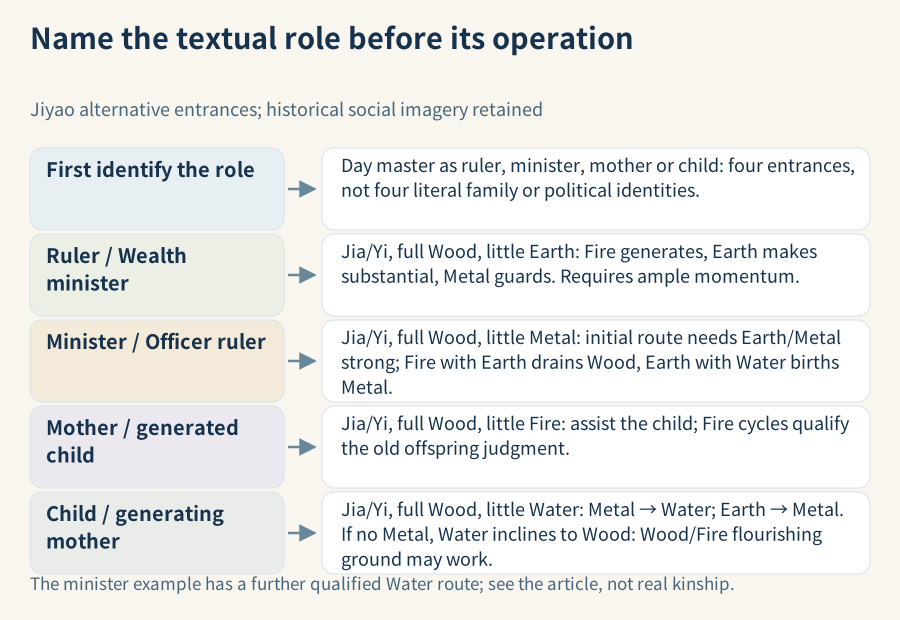
The complete figure is shown below. Select it to enlarge the labels. Open full-size figure · PNG
The minister row shows the initial Earth/Metal route; the excessive Wood/Fire condition leading to Water is discussed in the body. This is not a chart assigning roles to real relatives or proving the book’s promised descendants, prosperity or political outcomes.
Translating roles while retaining their historical values
An explanatory translation can first establish what ruler and minister refer to, then retain the task of diminishing the upper or lower. For mother and child, record who generates whom and whether the Day Master occupies the mother or child entrance. Readers need not guess the direction from modern family identities.
Care, filial service, secure hierarchy and rejoicing in descendants are nevertheless part of the printed account. They show how the model borrows ideals of political and lineage-based family order. We can identify that historical value language and its connection to factor definitions. It does not establish a particular family’s morality, relationship quality or number of children. Those actual questions would require appropriate people-and-event evidence; this selection supplies traditional role configurations and judgments.
A reusable reading ledger records grammatical subject, role object, relative condition and specific operation. Give the source’s praised or promised result its own final field. The first four fields keep the factor reasoning inspectable; the last preserves the historical evaluation rather than hiding it. Keeping both prevents an image from becoming invented real-world data.
Refresh the names on the Ten Gods basics page, and find the other questions in the third-collection directory. This reading distinguishes roles within two selected chapters; it assigns readers no family or political position.
Sources and further reading
君臣論, printed 39, scans 44. Source page 1
君臣論, printed 40, scans 45. Source page 1
君臣論, printed 40, scans 45. Source page 1
君臣論, printed 40, scans 45. Source page 1
母子論, printed 40, scans 45. Source page 1
母子論, printed 40、41, scans 45/46. Source page 1 Source page 2
母子論, printed 41, scans 46. Source page 1
母子論, printed 41, scans 46. Source page 1
扉頁、自序、目錄、刊記, separately located identity fields; scans 1/2/4/5/64. Source page 1 Source page 2 Source page 3 Source page 4 Source page 5
Punctuation, translation, analysis and diagrams are original. Source facsimiles, modern commercial commentary and inspection materials are excluded. The 1936 Jiyao, 1947 Chanwei, undated Waseda witness and historical transcription keep their distinct identities and layers. Return to Cycles, Commentators and Comparison, or consult the Ten Gods guide.
Evidence and source roles
These roles distinguish ancient text, older commentary, historical scholarship and tool reproduction. The numbered notes in the article retain the precise scan pages and explanations. Library and academic sources do not endorse predictive claims.
- DT3-E03-01 · Ancient text evidence: 君臣論
Text layer in the witness: Raised opening short-text column in this Jiyao witness - DT3-E03-02 · Ancient text evidence: 君臣論
Text layer in the witness: Explanation recorded in this Jiyao; largely same-size columns, not individually signed; parentheses separately located - DT3-E03-03 · Ancient text evidence: 君臣論
Text layer in the witness: Raised opening short-text column in this Jiyao witness - DT3-E03-04 · Ancient text evidence: 君臣論
Text layer in the witness: Explanation recorded in this Jiyao; largely same-size columns, not individually signed; parentheses separately located - DT3-E03-05 · Ancient text evidence: 母子論
Text layer in the witness: Raised opening short-text column in this Jiyao witness - DT3-E03-06 · Ancient text evidence: 母子論
Text layer in the witness: Explanation recorded in this Jiyao; largely same-size columns, not individually signed; parentheses separately located - DT3-E03-07 · Ancient text evidence: 母子論
Text layer in the witness: Raised opening short-text column in this Jiyao witness - DT3-E03-08 · Ancient text evidence: 母子論
Text layer in the witness: Explanation recorded in this Jiyao; largely same-size columns, not individually signed; parentheses separately located - DT3-E00-01 · Ancient text evidence: 扉頁、自序、目錄、刊記
Text layer in the witness: Separately located identity and responsibility fields, not one continuous passage