Benefit/grievance and conflict/combination name relationship effects in this witness. Understanding them requires continuing to who communicates, who interferes, and who receives assistance or becomes bound. The same combining pair can perform opposite functions when the currently desired object changes. A label suggesting harmony is insufficient to identify the relationship being discussed.
This article selects 恩怨論, scan 39/printed 34, and 戰合論, scans 40–42/printed 35–37, in the 1936 Di tian sui jiyao. They are separated by 順反論 in the print. Their comparison here does not turn them into one originally continuous passage.[8] Short texts and largely same-size explanations retain distinct layers, and strong historical assertions retain their actual scope.
What mediation and interference modify
The en/yuan verse begins with two inclinations communicating through a mediator. It describes pursuit across distance, interference in an affectionate connection, and grievance leaving something lifeless as ash.[1] The explanation connects this imagery to a desired factor, a combining factor and the further phrase 引用神生化, likened to mediation. Separated factors can still harmonize. If an undesired factor interferes, combination cannot be obtained or harm results, the beneficial relationship reverses into grievance.[2]
This supplies three positions for a reading ledger: the factors originally communicating, the mediating generation/transformation function, and the unwanted factor intervening. Retaining the printed functional phrase avoids inventing a portable rule that any factor named yongshen restores every connection. Reversal also retains interference, failed combination or harm as conditions. Grievance alone supplies no assessment of a person’s emotional state.
The explanation continues with disliked factors better kept distant, loved factors especially close, chance encounters and privately entangled connections. It even describes a branch in which removing such a connection can be welcome.[2] Emotional and interpersonal value language is genuinely present. We explain its work in the factor model without using it to judge actual romance, loyalty, resentment or personality.
Heavenly and earthly conflict have different limiting clauses
The raised conflict sentence says heavenly conflict may still be manageable, while earthly conflict is urgent like fire.[3] The explanation names Jia/Geng/Yi/Xin stems as heavenly conflict, but immediately qualifies it with obtaining an orderly, quiet earthly side and no harm. Yin/Shen/Mao/You branches are called earthly conflict; it says stems cannot provide force there and the tendency becomes adverse rapidly. It explains the distinction through Heaven moving and Earth being still.[4]
The orderly/quiet earthly qualification cannot disappear from the heavenly-conflict row. The earthly row also does not establish a modern severity scale for war. Motion/stillness belong to this witness’s Heaven/Earth and stem/branch explanatory framework, not a supplied dataset of physical movement or social conflict.
The same paragraph names patterns of the printed Geng-Shen/Jia-Yin/Yi-Mao/Xin-You kind, where all are present, as simultaneous heavenly/earthly conflict. It asserts necessary adversity without doubt, then adds cycle/year combination and gathering, consideration of victory/defeat, and possibilities of preservation or advancement.[4] Retain both stages: the full-presence scope and strong judgment, followed by the added cycle/year relations. One opposed pair alone cannot inherit the whole judgment; the later clause does not guarantee that every conflict can be rescued by any combination.
A combination’s subject determines whom it assists
Another short sentence explicitly says combinations can be suitable or unsuitable, and many combinations are not extraordinary.[5] Its next four examples deserve separate rows because either end of the same pair can occupy the current role.[6][7]
| Role specified in this example | Combining factor and stated transformation | Effect recorded by the explanation |
|---|---|---|
| Geng is desired | Obtain Yi combination, explained through Metal transformation | Assist Geng |
| Jia is adverse | Obtain Ji combination, explained through Earth transformation | Remove Jia |
| Ji is adverse | Jia combines, explained through Earth transformation | Assist Ji |
| Yi is desired | Geng combines, explained through Metal transformation | Bind Yi |
For Jia/Ji, adverse Jia is explained as removed, while adverse Ji is explained as assisted. For Yi/Geng, desired Geng is assisted, while desired Yi is bound. Giving a pair a permanently good or bad label before identifying the current subject would overwrite the example’s grammar. Assistance, removal and binding are also different operations whose objects must remain visible.
Metal/Earth transformation is the explanation’s stated premise for these local examples. It does not authenticate genuine transformation whenever Yi/Geng or Jia/Ji occurs elsewhere. The second collection’s following/transformation qualifications retain their own conditions and exceptions. Four short examples here do not erase those distinctions.
To read the two Yi/Geng rows back, put “Geng desired” first, followed by incoming Yi, the Metal-transformation explanation and assistance to Geng. When reading “Yi desired,” restart with incoming Geng and binding Yi. Changing the first field while keeping the earlier assistance-to-Geng conclusion would misassign the object. This checks grammar without inventing a complete case.
The four combination examples also supply no complete month-command, seated-branch, quantity or position fields for each case. They begin with factors already designated desired or adverse and explain what combination does to them. They do not exhaust how that designation was established. Separate supplied roles from missing formation data instead of treating four rows as all qualification decisions.
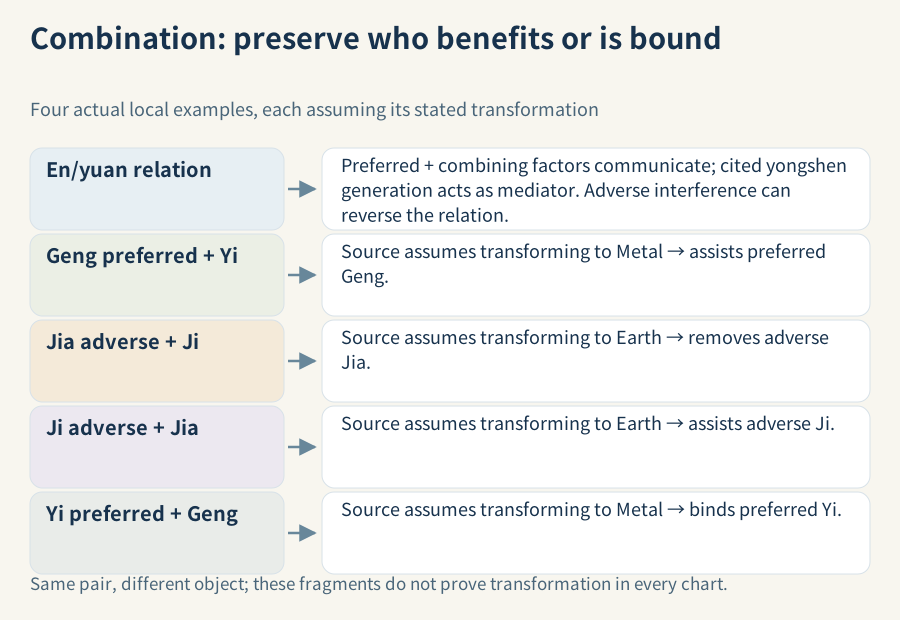
The complete figure is shown below. Select it to enlarge the labels. Open full-size figure · PNG
The diagram principally expands the four combination-object branches. The body separately retains heavenly/earthly conflict, full presence and cycle/year qualifications. Arrows record the passage’s explanatory direction; they calculate no actual interpersonal relationship or life score.
Retain emotional words’ provenance and operations’ objects
A two-layer notebook helps distinguish these tasks. First retain mediation, inclination, benefit, grievance, conflict and harmony, recording the historical emotional or social imagery they borrow. Then record the current desired, adverse or combining factor, stem or branch, and the specific object of generation/transformation, assistance, removal or binding. Neither layer should silently replace the other.
For example, welcoming the removal of a connection is the paragraph’s evaluation of a particular private-entanglement image, not general approval of ending relationships. Binding a desired factor does not document a real person’s emotional confinement. Modern psychological or interpersonal judgments would need appropriate evidence about those people. The evidence obtained here concerns how an old text names factor relationships.
This method also preserves reversal conditions. Communication requires attention to mediation and interference; heavenly conflict requires attention to the earthly side; combination requires identifying whom it assists or binds. A row containing current role, incoming factor, stated transformation and operation object makes the four examples comparable without inventing an automatic scoring system.
Refresh the names on the Ten Gods basics page, and use the third-collection directory for the other routes. A name is an entrance; the actual subjects, objects, directions and limiting clauses establish the explanatory boundary.
Sources and further reading
恩怨論, printed 34, scans 39. Source page 1
恩怨論, printed 34, scans 39. Source page 1
戰合論, printed 36, scans 41. Source page 1
戰合論, printed 36, scans 41. Source page 1
戰合論, printed 36, scans 41. Source page 1
戰合論, printed 36, scans 41. Source page 1
戰合論, printed 36、37, scans 41/42. Source page 1 Source page 2
扉頁、自序、目錄、刊記, separately located identity fields; scans 1/2/4/5/64. Source page 1 Source page 2 Source page 3 Source page 4 Source page 5
Punctuation, translation, analysis and diagrams are original. Source facsimiles, modern commercial commentary and inspection materials are excluded. The 1936 Jiyao, 1947 Chanwei, undated Waseda witness and historical transcription keep their distinct identities and layers. Return to Cycles, Commentators and Comparison, or consult the Ten Gods guide.
Evidence and source roles
These roles distinguish ancient text, older commentary, historical scholarship and tool reproduction. The numbered notes in the article retain the precise scan pages and explanations. Library and academic sources do not endorse predictive claims.
- DT3-E04-01 · Ancient text evidence: 恩怨論
Text layer in the witness: Raised opening short-text column in this Jiyao witness - DT3-E04-02 · Ancient text evidence: 恩怨論
Text layer in the witness: Explanation recorded in this Jiyao; largely same-size columns, not individually signed - DT3-E04-03 · Ancient text evidence: 戰合論
Text layer in the witness: Raised opening short-text column in this Jiyao witness - DT3-E04-04 · Ancient text evidence: 戰合論
Text layer in the witness: Explanation recorded in this Jiyao; largely same-size columns, not individually signed - DT3-E04-05 · Ancient text evidence: 戰合論
Text layer in the witness: Raised opening short-text column in this Jiyao witness - DT3-E04-06 · Ancient text evidence: 戰合論
Text layer in the witness: Explanation recorded in this Jiyao; largely same-size columns, not individually signed - DT3-E04-07 · Ancient text evidence: 戰合論
Text layer in the witness: Explanation recorded in this Jiyao; largely same-size columns, not individually signed - DT3-E00-01 · Ancient text evidence: 扉頁、自序、目錄、刊記
Text layer in the witness: Separately located identity and responsibility fields, not one continuous passage