This case supplies a printed heading, arranged stem/branch data, a paired cycle table and an explanation. A separate history also supplies a recorded birthday. Each item has its own provenance; together they have not become an independently authenticated complete birth, event and advance-prediction record. Keeping separate fields shows what this Chanwei page contributes and which judgments remain textual interpretation.
The witness has an actual April 1947 first-edition colophon, recording Li Yutian’s correction and publication duties. The separate Yuan preface describes Ren Tieqiao’s expanded annotation; that is the preface’s attribution, rather than a Ren credit on the colophon. The prefixed beginner’s shortcut is not excerpted here.[7] 1947 dates this print, not the person’s birth or the first composition of every passage.
Why this case belongs to the continuing Ren-tagged layer
In juan1, 通神論·知命 begins on scan 54/printed 4 with body text and an “original gloss” layer, followed by a distinct 任氏曰 opening. Scan55 continues that discussion. Scan56/printed 6 presents the first case, titled 高宗純皇帝御造, an imperial chart labeled Gaozong Chunhuangdi. The case does not repeat the Ren tag or introduce a different commentator label beforehand.[1][2]
The continuous layout supports assigning the case to the continuing Ren-tagged layer; it does not mean every line is individually signed by Ren. The selected case ends with the same page’s “all under Heaven peaceful” wording. A differently headed next case is excluded.[4] Layer attribution establishes an entry into textual responsibility, not autograph authorship, an authenticated imperial chart or its earliest source.
State who supplied the data-table labels
The four displayed pillars read right to left as Xin-Mao, Ding-You, Geng-Wu and Bing-Zi. The original does not print year/month/day/hour beside each pillar. The following column labels are editorial arrangement of those positions, not independent fields already printed on the page.[2]
| Editorial position | Displayed pair | Limit of this record |
|---|---|---|
| Year pillar | Xin-Mao | No Gregorian birth year supplied from the cycle name |
| Month pillar | Ding-You | No independently sourced numerical birthday added |
| Day pillar | Geng-Wu | No calendar-date conversion performed |
| Hour pillar | Bing-Zi | No clock time, time standard or birthplace supplied |
Below are two rows of eight paired columns. Read right to left, they give Bing-Shen, Yi-Wei, Jia-Wu, Gui-Si, Ren-Chen, Xin-Mao, Geng-Yin and Ji-Chou. The original adds no separate “major cycle” heading, starting age or absolute years and age intervals.[2] The paired table can be recorded as the book’s cycle arrangement; eight pairs cannot become eight authenticated dated periods. The imperial title is not an independent sex or birth register either.
Three negations the explanation cannot lose
The selected continuous excerpt has 102 Chinese characters including editorial punctuation. It interprets Geng/Xin/Bing/Ding through Fire refining autumn Metal, and Zi/Wu/Mao/You through Kan/Li/Zhen/Dui, the four cardinal positions and eight directions. It then states no Earth among the Five Phases and, despite birth in the autumn command, not treating the arrangement as flourishing.[3] No Earth and despite autumn are its premises; “not treating as flourishing” is its judgment. You month must not automatically overwrite that sentence with a flourishing label.
The no-Earth claim also remains at this explanation’s stated level. It is not permission to silently rewrite every hidden-stem or other computational count. No independent Earth stem/branch appears in the displayed characters, but that does not establish the book’s Earth definition at every interpretive level.
The next two clash explanations have different objects:
| Printed relationship | Stated operation | Result object that must remain |
|---|---|---|
| Zi/Wu clash | Water controls Fire | Wu Fire does not damage You Metal; supports the master |
| Mao/You clash | Metal controls Wood | Mao Wood does not assist Wu Fire; restraint appropriately obtained |
The Chinese quotation retains the witness’s different 剋/克 forms. Wu Fire not damaging You Metal cannot become damaging it. Mao Wood not assisting Wu Fire is not a universal assertion that Wood does not generate Fire. These are operations in this case, with “making,” “then” and appropriateness connecting their objects. One page cannot establish every clash as favorable or adverse.
What the separate historical birthday adds
The opening of the public transcription of Qingshigao, juan10, Gaozong biography, records birth at the residence of Prince Yong on Kangxi 50, eighth month, thirteenth day.[5] The biography’s heading and extended imperial title contain Gaozong and Chunhuangdi, corresponding to the chart’s title. That supports a finite historical cross-reference to the similarly titled figure.
The sentence supplies the history’s recorded regnal year, month, day and residence. It does not give Xin-Mao, Ding-You, Geng-Wu, Bing-Zi or an hour. What was inspected is a modern public transcription of a Republican-period draft history: scan and printed-page fields remain empty. It is not a contemporaneous Kangxi birth register or an original printed page inspected here. No Gregorian conversion is performed, and Bing-Zi is not copied backward from the case into the history.
We can therefore add the field “the history records this birthday,” while keeping the complete chart, authentic imperial birth, hour and actual achievements unverified. Corresponding titles do not make every field in the two records warrant the other. Absence of an hour in this sentence also establishes only what the obtained sentence lacks, not absence from every possible source.
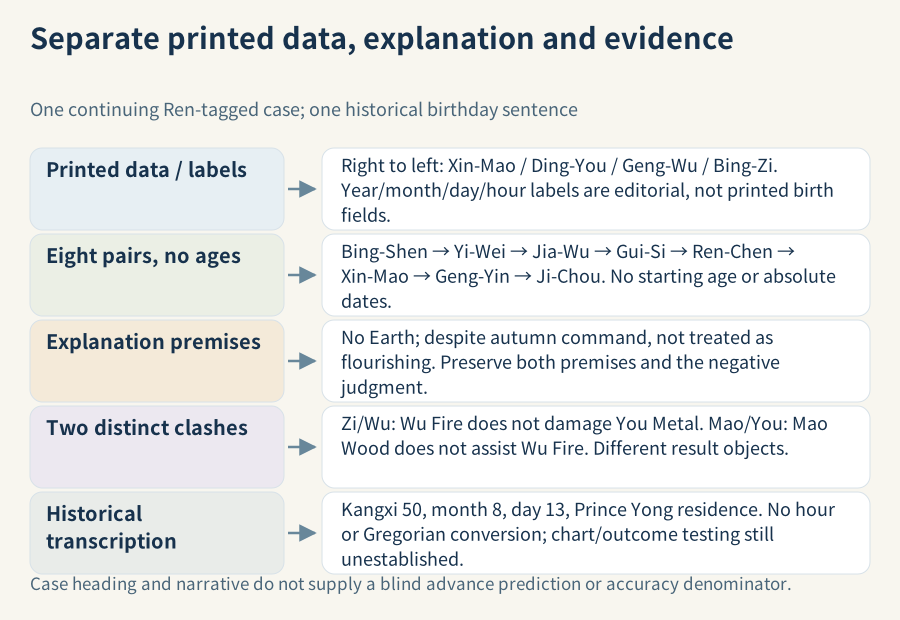
The complete figure is shown below. Select it to enlarge the labels. Open full-size figure · PNG
The diagram links evidence and the selected explanation. It invents no birth chart or starting age and turns neither imperial heading nor historical birthday into authentication of the actual chart.
From commentary to achievement, and from records to testing
The continuation connects Mao/You and Zi/Wu to trigram imagery and established Water/Fire relations, then moves into praise of imperial achievements and a peaceful realm.[4] Preserve that genre shift. Imagery and praise are not independently checked policies, dates or causal effects. The reader has already encountered the imperial heading and its claimed status before the factor explanation.
This presentation shows how a commentator explains a case already labeled with a status. It does not exhibit a dated, falsifiable prediction made without knowing the outcome. Predictive testing would additionally need independently sourced birth and event records, a judgment fixed before the event, a defined target and time range, and sampling records including cases that failed the judgment. Counting this single successful narrative supplies no denominator for an accuracy rate.
A historical birthday does not replace those further fields. It first adds a source for data. Only when data, judgment and events have inspectable connections can a prediction’s test be assessed. No percentage is calculated here, and imperial status supplies no scientific certification of the method.
Closing the seventeen-question interpretive scope
The original plan gives three collections, 17 questions and 34 Chinese/English manuscripts. Collection one’s six questions distinguish witnesses, commentary, imagery and positions. Collection two’s six distinguish functions, degrees, paths and genuine/apparent qualifications. This collection’s five distinguish cycles, seasonal passages, social imagery, operation direction and case evidence. The author package’s seventeen-question scope index returns each selected reading, route and source-card ID to its article; the Di Tian Sui reading directory provides the article entrances.
That index does not establish complete collation of all 42 Jiyao chapters or translation of all 516 Chanwei scans. Full original-text checking is a separate task not completed by these readings.[6][7] Witness limits and missing evidence remain attached to the indexed questions.
Use the Ten Gods basics page for the relationship names, and the third-collection directory for this collection. The useful result of a case reading is placing text, data provenance, interpretation and testing requirements into fields that can each be inspected.
Sources and further reading
通神論 · 知命, printed 四、五、六, scans 54/55/56. Source page 1 Source page 2 Source page 3
通神論 · 知命第一例:高宗純皇帝御造, printed 六, scans 56. Source page 1
通神論 · 知命第一例:高宗純皇帝御造, printed 六, scans 56. Source page 1
通神論 · 知命第一例后续叙述, printed 六, scans 56. Source page 1
本紀十 高宗本紀一 · 起首生日句, historical-source transcription; original printed page and scan not obtained. Historical transcription 1 Historical transcription 2
扉頁、自序、目錄、刊記, separately located identity fields; scans 1/2/4/5/64. Source page 1 Source page 2 Source page 3 Source page 4 Source page 5
Colophon / Yuan preface, separately located identity fields; scans 3/4. Source page 1 Source page 2
Punctuation, translation, analysis and diagrams are original. Source facsimiles, modern commercial commentary and inspection materials are excluded. The 1936 Jiyao, 1947 Chanwei, undated Waseda witness and historical transcription keep their distinct identities and layers. Return to Cycles, Commentators and Comparison, or consult the Ten Gods guide.
Evidence and source roles
These roles distinguish ancient text, older commentary, historical scholarship and tool reproduction. The numbered notes in the article retain the precise scan pages and explanations. Library and academic sources do not endorse predictive claims.
- DT3-E05-01 · Ancient text evidence: 通神論 · 知命
Text layer in the witness: Continuing Ren-tagged case layer: selected heading, layout or explanation, not every line individually signed - DT3-E05-02 · Ancient text evidence: 通神論 · 知命第一例:高宗純皇帝御造
Text layer in the witness: Continuing Ren-tagged case layer: selected heading, layout or explanation, not every line individually signed - DT3-E05-03 · Ancient text evidence: 通神論 · 知命第一例:高宗純皇帝御造
Text layer in the witness: Continuing Ren-tagged case layer: selected heading, layout or explanation, not every line individually signed - DT3-E05-04 · Ancient text evidence: 通神論 · 知命第一例后续叙述
Text layer in the witness: Continuing Ren-tagged case layer: selected heading, layout or explanation, not every line individually signed - DT3-E05-05 · Historical text transcription: 本紀十 高宗本紀一 · 起首生日句
Text layer in the transcription: Historical-source transcription of a Republican-period draft history; no original scan inspected - DT3-E00-01 · Ancient text evidence: 扉頁、自序、目錄、刊記
Text layer in the witness: Separately located identity and responsibility fields, not one continuous passage - DT3-E00-02 · Ancient text evidence: 刊記、袁序
Text layer in the witness: Separately located colophon (scan3) and Yuan preface (scan4); preface attribution is not a same-page colophon credit or autograph authentication