The first job is to establish which evidence a name belongs to. This Waseda-held print, its institutional catalogue and the catalogue of a modern commentary edition supply different fields. A printed title identifies what is visible on a particular page; a preface supplies that preface’s account of editing; a modern catalogue describes another bibliographic object. None of those fields should silently acquire the authority of all the others.
The planned question retains the familiar name Lanjiang gang. Waseda’s catalogue also records 欄江綱. The inspected title page, preface and volume-title positions instead print 欄江網, Lanjiang wang: 網 has the thread radical and 罔 on the right. The catalogue’s 綱 and the print’s 網 are recorded separately.[1][2][3] This difference establishes a finite character reading, not the reason for the catalogue’s wording or the original manuscript’s title.
One object has several title positions
The cover says 窮通寶鑑. The title page displays both 窮通寶鑑 and 欄江網, with an attached 月談賦 indicated. The first body-volume title reads 命理窮通寶鑑欄江網卷之一. The inspected second-volume opening likewise retains the combined title with 卷之二.[1][4] These positions identify the witness more securely than a detached electronic text headed only “Qiongtong.”
Keeping both titles also prevents an unjustified shortcut. A common search name can lead to this object without becoming a literal transcription of its title page. Conversely, the observed 網 does not require changing every library catalogue or asserting that every edition prints that character. The exact planned article title remains a route into the problem; quoted printed fields keep their witnessed characters.
Waseda identifies the object as Bunko19 F0111 in the 風陵 collection. Its catalogue describes two juan, a preliminary juan and an attached supplement. The official image index contains 108 full-image links.[2] That is an image inventory, not 108 numbered text pages or proof that every image contains a separate chapter. Scans, printed folios and section headings need their own locator fields.
A responsibility field is a role, not an origin story
The inspected responsibilities say Yu Xingtang 鑒定, Yu Chuntai 編輯 and Zeng Jichan 校閱. We translate these here as appraisal, editing and checking.[1] The different verbs matter. Listing the three names as interchangeable original authors would discard precisely the information the print supplies.
Nor does a printed duty certify an autograph, explain every intervention or establish the earliest composition. The field tells us how this witness presents a person’s responsibility. To know whether a particular passage was newly composed, revised or inherited would require corresponding textual evidence from other witnesses. A responsibility list alone does not contain that comparison.
This distinction is useful when naming layers. “The passage in the Yu Chuntai-edited witness” places a paragraph in an identified object. “Yu Chuntai personally wrote every word” adds a historical conclusion. The first claim can be tied to the printed role; the second needs evidence not obtained in this finite reading.
Read the preface as an account with a speaker
The preface refers to a 欄江網繕本, a manuscript copy, and 細加編輯, careful editing. Its continuation says the name was changed to 窮通寶鑑 and ends with 春臺氏序并書.[3] Those phrases explain how this preface presents the compilation. The retained double title on the title page and body opening should be reported alongside that account rather than erased to make a simpler story.
An account of receiving and editing a manuscript is not independent identification of that manuscript’s earliest author or date. The obtained pages also do not establish a genealogy connecting every Lanjiang text, Zaohua yuanyao or modern Qiongtong edition. No missing manuscript or first-edition date is supplied on their behalf.
The distinction between account and verification applies even where the speaker’s words are clear. We can quote what the preface says and locate it. Establishing that the entire process occurred exactly as narrated is a further historical question. Clear transcription does not remove that difference in evidential scope.
Map the organization actually inspected
The preliminary pages and inspected juan junction do not supply a separate traditional contents page. This is a bounded observation about those positions, not a declaration that no contents page exists anywhere among the 108 images. We therefore report visible organization instead of manufacturing a standardized table of contents.[4]
| Inspected locator | Printed label | What that sample establishes |
|---|---|---|
| Scan 4 | 五行總論 | A general Five-Phase entrance |
| Scan 6, right half | 論木 | A Wood discussion |
| Scan 8, left half | 三春甲木論 | A seasonal Jia-Wood entrance |
| Scans9–12, selected positions | 正月甲木, 二月甲木, 三月甲木, 五六月甲木 | Numbered-month labels and a combined-month heading |
| Scan 48 ending and scan 49 opening | Juan1 ending, juan2 and 論土 | A visible volume junction and Earth entrance |
| Scan 96, left half | 增補月談賦 | An attached supplement, distinct from preceding body discussion |
The samples show several organizing levels: general discussion, an element discussion, stem/season or stem/month labels, volume divisions and an appendix. They do not provide a fully transcribed ten-stem/month inventory. Even the combined fifth/sixth-month heading matters: it would be misleading to pretend every month is uniformly headed as a separate chapter.
Keep the printing date and publisher fields open
The catalogue records publication place and publisher as unknown. The identified print’s year remains unestablished here.[2] A Qing attribution in an author field does not date the physical impression. Dates from the separate 1936 Jiyao or 1947 Chanwei used in the preceding book cannot be transferred to this object.
The catalogue notes 集賢堂 at the second volume’s block centre. A current inspection of scan 88’s left block centre confirms those three characters.[5] That is useful physical evidence, but a block-centre mark does not alone establish the publisher, printing place or year. It adds a field to the record rather than closing every bibliographic question.
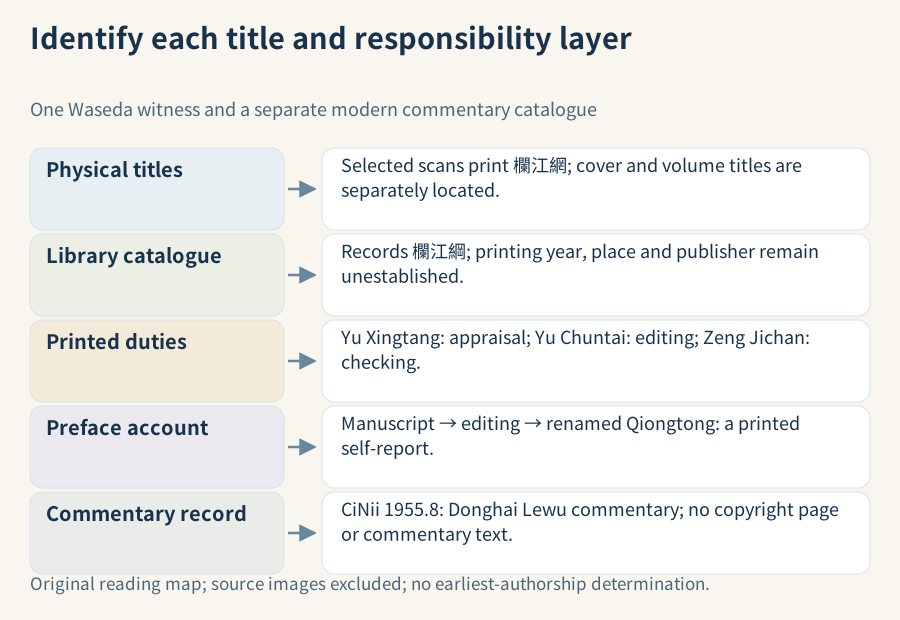
The complete figure is shown below. Select it to enlarge the labels. Open full-size figure · PNG
The diagram assigns each claim to its evidence layer. It represents no complete edition genealogy and reproduces no institutional scan.
The 1955 commentary record belongs in another row
CiNii Books records 窮通寶鑑評註, with the responsibility statement 東海樂吾評註, an author-index entry for Xu Lewu, and Hong Kong Shixue Bookstore, 1955.8. Its physical description is 4, 273 pages and 19cm.[6] These are the catalogue’s fields for that item. They do not date the Waseda impression, prove 1955 was the first composition or establish the original copyright page.
The source obtained here is a catalogue, with scan and printed-page fields empty. No passage of that commentary was retrieved or copied. Consequently, the record can help separate the later commentary object from the old print, but cannot yet support a sentence-by-sentence account of what the commentator added. A 1937 date appearing in the plan remains a research lead rather than a verified imprint here.
A useful edition ledger therefore separates object identifier, title as catalogued, title as printed, responsibilities, preface claims, date/place/publisher evidence, selected passage and commentary access. Unknown cells remain unknown. Once those fields are inspectable, the remaining questions can read real seasonal paragraphs without turning a familiar title into a universal text.
Continue through the first-collection directory. The next question keeps month labels, seasonal wording and modern calendar conventions in separate fields; Ten Gods basics supplies relationship terminology. The present article establishes a finite witness and a reading route, with full-text collation remaining a separate unfinished task.
Sources and further reading
Cover, title page, volume titles and responsibility lines, scan 8, folio unresolved or identity fields separately located. Waseda University Library classical-text database Separate positions: 1, 2, 4, 49
Waseda catalogue record, bibliographic record; original scan and printed page not supplied. Official catalogue
Preface self-report: manuscript, editing and renaming, scan 3, right half, folio unresolved or identity fields separately located. Waseda University Library classical-text database Separate positions: 4
Selected organizational headings and volume boundary, scan 8, left half, folio unresolved or identity fields separately located. Waseda University Library classical-text database Separate positions: 4, 6, 9, 10, 11, 12, 14, 19, 20, 48, 49, 60, 64, 72, 88, 96
Volume-two block-centre inscription, scan 88, left block-centre, folio unresolved or identity fields separately located. Waseda University Library classical-text database
CiNii Books BA61461510 commentary catalogue, bibliographic record; original scan and printed page not supplied. Official catalogue
Punctuation, translation, analysis and diagrams are original. Printed Wang and catalogued Gang, preface self-report, responsibility lines and modern bibliography retain their distinct layers. Institutional images, modern commercial commentary and research materials are excluded. Return to the first-collection directory, or consult the Ten Gods guide.
Evidence and source roles
These roles distinguish ancient text, older commentary, historical scholarship and tool reproduction. The numbered notes in the article retain the precise scan pages and explanations. Library and academic sources do not endorse predictive claims.
- QT1-E01-IDENTITY · Ancient text evidence: Cover, title page, volume titles and responsibility lines
Text layer in the witness: Separately located physical title and responsibility fields, not one continuous quotation - QT1-E01-CATALOGUE · Modern library catalogue: Waseda catalogue record
Text layer in the catalogue: Modern institutional bibliographic record of an old witness; not an original printed page - QT1-E01-PREFACE · Ancient text evidence: Preface self-report: manuscript, editing and renaming
Text layer in the witness: Preface self-report; separately located snippets, not a continuous combined quotation - QT1-E01-ORGANIZATION · Ancient text evidence: Selected organizational headings and volume boundary
Text layer in the witness: Separate printed headings and volume boundary samples, not continuous body text - QT1-E01-PRINTERMARK · Ancient text evidence: Volume-two block-centre inscription
Text layer in the witness: Printed block-centre inscription; responsibility/date not established - QT1-E01-MODERN · Modern-edition catalogue: CiNii Books BA61461510 commentary catalogue
Text layer in the catalogue: Modern commentary-edition bibliographic record; no original copyright page or commentary text inspected