The book’s month labels first locate paragraphs. Their neighboring seasonal words then qualify the discussion within those paragraphs. A modern calendar date is another kind of field, requiring a declared calendar and time standard. These layers can be connected, but the connection must be stated rather than hidden in the translation of “month.”
This article reads four finite positions in the identified Waseda print, keeping the title-glyph and unknown-imprint boundaries established in the first question.[7] It does not construct a complete calendar from all 108 images. The modern astronomical references below belong to their own source layer and establish no predictive validity for the old book.
Keep the subject next to the month label
Scan 9, right half, printed folio 1, begins 正月甲木,初春尚有餘寒: first-month Jia Wood, early spring still having residual cold.[1] The phrase contains a named stem, a month label and a seasonal state. Translating only the numeral would drop the other two fields. Changing “first month” into “January” would add a Gregorian correspondence that this obtained phrase does not print.
The same fragment also does not print Yin. A reader familiar with a stem/branch month convention may wish to relate it to Yin, but that relation must remain an explicitly stated convention rather than a character supposedly found in this short quotation. The distinction protects both the old wording and whatever modern calculation is actually being used.
“Residual cold” is likewise a condition in the paragraph, not a measured Celsius threshold. The text qualifies early spring instead of providing a weather station, coordinates or individual observation. The next questions investigate how such conditions connect to the source’s named factors without converting imagery into temperature data.
A seasonal heading is not a single numerical month
At scan 14, left half, printed 7, the heading 三秋甲木 gives an autumn-season Jia-Wood entrance.[2] A heading organizes material; it is not the complete argument of every paragraph under it. The present selection proves the visible heading, not an exhaustive reading of all the autumn conditions.
This also shows why the book should not be flattened into 120 identical cells before its organization is checked. A stem/season heading, an individual month opening and the fifth/sixth-month combined heading are different scopes. A reader can use an index to find them, while still preserving their differences in the reading notes. The first question’s organization samples supply that starting map, not a completed ten-stem/month database.
A cold word within the sixth-month passage needs its own context
Scan 12, left half, in 五六月甲木, has 六月三伏生寒,丁火退氣: sixth month, sanfu giving rise to cold, Ding Fire’s qi retreating.[3] The printed folio on this half is unresolved and remains empty; scan, side and actual heading locate the passage. A folio from the other half must not be copied into that empty field.
The wording is important precisely because a modern reader may find “cold” surprising alongside sanfu. The next phrase concerns Ding Fire’s qi. We therefore preserve the source’s formulation and its local relation context. We do not silently replace cold with heat to make a weather expectation, or claim that every place experiences low temperatures in Gregorian June.
The word sanfu also does not supply this paragraph with a tabulated solar-term instant or a Gregorian month boundary. It is a temporal/seasonal expression printed in the old argument. The fourth question reads the following actual priority and exception clauses. Those clauses stay tied to their fifth- or sixth-month branches rather than to an independently assumed civil date.
The twelfth-month clause is another local premise
Scan 19, left half, printed 12, is retained as 十二月甲木,天氣寒〔疑字:東形〕: twelfth-month Jia Wood and cold weather, followed by an unresolved glyph resembling 東.[4] The available ink does not settle 東 or 凍, so the translation adds no freezing meaning and makes no printing-error claim. The readable cold-weather wording still is not a measured climate series or an observation of a particular reader’s surroundings.
Early-spring residual cold and the readable twelfth-month cold wording give two textual premises to compare, with the latter’s following glyph still unresolved. Their subjects remain Jia Wood, while month and description change. These are useful fields for locating a discussion, but the selected openings alone do not establish every subsequent choice or an actual person’s strength, health or prospects.
| Printed field | Locator | What remains separate |
|---|---|---|
| 正月甲木 + 初春尚有餘寒 | Scan 9 right, printed 1 | Gregorian January or an unprinted Yin character |
| 三秋甲木 | Scan 14 left, printed 7 | Complete autumn argument or a uniform one-month scope |
| 六月三伏生寒 + 丁火退氣 | Scan 12 left, folio unresolved | A modern June interval, temperature report or term instant |
| 十二月甲木 + 天氣寒〔疑字:東形〕 | Scan 19 left, printed 12 | Gregorian December or an individual weather measurement |
Modern astronomy adds a different kind of reference
The Hong Kong Observatory explains the 24 solar terms through solar longitude: 24 divisions, separated by 15 degrees.[5] This astronomical definition differs from numbering a Gregorian month. Its discussion also treats the Agricultural Calendar’s lunar months separately. Neither mechanism is supplied merely by encountering a month numeral in the old paragraph.
The Observatory’s solar-term time page explicitly specifies Hong Kong Time, eight hours ahead of UTC.[6] That makes the standard of a published instant inspectable. A comparison involving an instant needs a common time standard; a numeral such as “first month” provides no time-zone instruction on its own. These modern documents clarify calendar fields without becoming evidence that the old divination judgments are scientifically verified.
State the bridge before applying a paragraph
A modern input ledger needs at least the entered calendar, year/month/day, clock time if relevant, time zone and any daylight-saving treatment. If a method derives month pillars using specified solar-term boundaries, it also needs the actual boundary policy, its time source and the handling of a birth exactly at a boundary. These are modern implementation choices to document, not extra words inserted into the Waseda quotation.
A lunar birthday and a Gregorian date can both contain the numeral 1 while belonging to different calendar fields. A seasonal heading supplies yet another scope. The check is therefore not “do the month numbers look equal?” It is whether the field’s calendar and conversion have been established, and whether the chosen paragraph’s stem, month and remaining premises actually match the interpretation being proposed.
No individual birth or boundary calculation is invented here. The obtained old passages do not specify coordinates, time zones, instantaneous solar longitude or a complete conversion algorithm. Leaving those absent fields visible is more useful than silently selecting a preferred modern rule and claiming it was already printed.
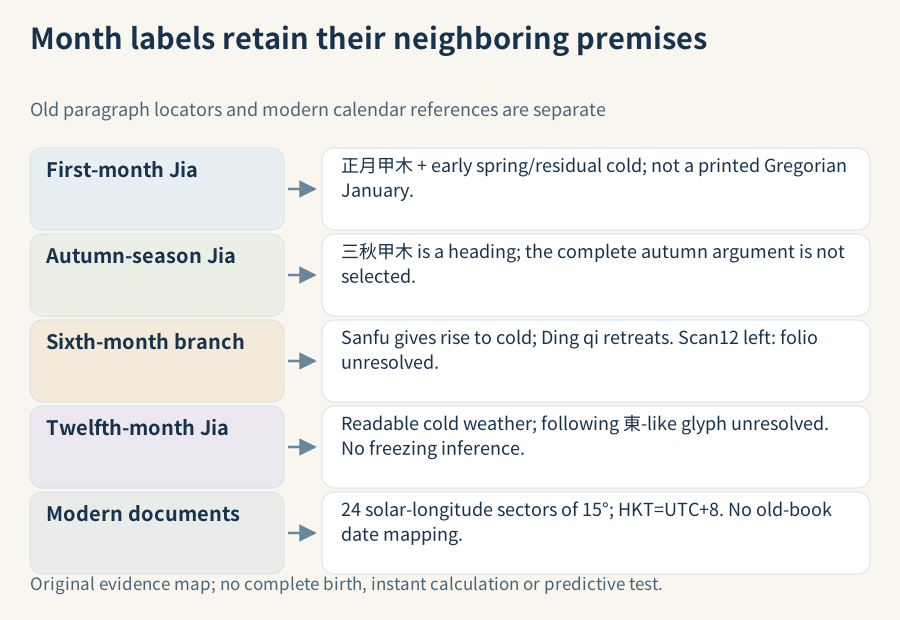
The complete figure is shown below. Select it to enlarge the labels. Open full-size figure · PNG
The diagram connects categories of evidence, not a lookup table turning every old month label into a modern date. Its modern-reference row cannot supply the other old clauses’ omitted conditions.
Return from the calendar to the whole paragraph
Even after a calendar bridge is stated, finding the correct label completes only the location step. A seasonal paragraph may distinguish disclosed or concealed factors, named objects, combinations, absences, order and cycles. The third and fourth questions recover actual examples of those qualifications. A matched month must not erase them.
Use the first-collection directory to keep the readings together, and Ten Gods basics for the relation names. The useful result is a ledger in which printed month wording, seasonal premise, modern input and conversion policy can each be inspected. A calendar supplies a date framework; the passage’s additional interpretation still has its own evidence and limits.
Sources and further reading
正月甲木, scan 9, right half, printed 一. Waseda University Library classical-text database
三秋甲木, scan 14, left half, printed 七. Waseda University Library classical-text database
五六月甲木, scan 12, left half, folio unresolved or identity fields separately located. Waseda University Library classical-text database
十二月甲木, scan 19, left half, printed 十二. Waseda University Library classical-text database
The 24 Solar Terms, modern calendar documentation; ancient scan and printed page inapplicable. Hong Kong Observatory documentation
Date and Time of the 24 Solar Terms, modern calendar documentation; ancient scan and printed page inapplicable. Hong Kong Observatory documentation
Cover, title page, volume titles and responsibility lines, scan 8, folio unresolved or identity fields separately located. Waseda University Library classical-text database Separate positions: 1, 2, 4, 49
Punctuation, translation, analysis and diagrams are original. Printed Wang and catalogued Gang, preface self-report, responsibility lines and modern bibliography retain their distinct layers. Institutional images, modern commercial commentary and research materials are excluded. Return to the first-collection directory, or consult the Ten Gods guide.
Evidence and source roles
These roles distinguish ancient text, older commentary, historical scholarship and tool reproduction. The numbered notes in the article retain the precise scan pages and explanations. Library and academic sources do not endorse predictive claims.
- QT1-E02-SPRING · Ancient text evidence: 正月甲木
Text layer in the witness: Printed text in the identified Waseda witness; editorial punctuation; handwritten margins and modern commercial commentary excluded - QT1-E02-AUTUMN · Ancient text evidence: 三秋甲木
Text layer in the witness: Printed text in the identified Waseda witness; editorial punctuation; handwritten margins and modern commercial commentary excluded - QT1-E02-MIDYEAR · Ancient text evidence: 五六月甲木
Text layer in the witness: Printed text in the identified Waseda witness; editorial punctuation; handwritten margins and modern commercial commentary excluded - QT1-E02-WINTER · Ancient text evidence: 十二月甲木
Text layer in the witness: Printed text in the identified Waseda witness; editorial punctuation; handwritten margins and modern commercial commentary excluded - QT1-MCAL-01 · Modern calendar documentation: The 24 Solar Terms
Text layer in the modern calendar documentation: Modern astronomical/calendar documentation; original ancient scan and printed-page fields inapplicable - QT1-MCAL-02 · Modern calendar documentation: Date and Time of the 24 Solar Terms
Text layer in the modern calendar documentation: Modern astronomical/calendar documentation; original ancient scan and printed-page fields inapplicable - QT1-E01-IDENTITY · Ancient text evidence: Cover, title page, volume titles and responsibility lines
Text layer in the witness: Separately located physical title and responsibility fields, not one continuous quotation