The spring-Jia paragraph asks more than one question. Its repeated-flourishing branch names Geng Metal; its late-spring thirst branch names Water support. Reading both branches keeps their premises visible. Replacing them with a single “strong or weak” label would lose the distinction the passage actually makes.
This article uses a finite paragraph in the Waseda witness, whose physical title has 網 while its library catalogue has 綱. The printing year remains unestablished.[3] The discussion is an analysis of the book's traditional language, not a temperature model, health diagnosis or claim about anyone's future.
Start with the paragraph's subject and its two branches
Under 三春甲木論, scan 8, left half, printed folio 1, a continuous selected passage reads: 重見生旺,必用庚金,斫鑿可成棟樑。春末陽壯,木渴,喜水資扶,則花繁葉茂.[1] Editorial punctuation separates the phrases; the named objects and qualification words remain those of the print.
An original translation is: “When flourishing states are repeatedly encountered, Geng Metal must be used; cutting and chiselling can make beams and pillars. At spring's end, yang is vigorous and Wood thirsty; it favors Water for support, then flowers abound and leaves flourish.” “Must” belongs to the first branch's repeated-flourishing premise. “Favors” belongs to the second branch's late-spring and thirst premises. Neither verb has been made into a rule for every Jia-Wood paragraph.
The continuous passage gives us a reliable comparison within one printed location. It does not give a complete birth chart, an empirical trial or the numerical extent of flourishing or thirst. Its timber and flowering imagery supplies the author's explanatory pictures. Those pictures are not measurements of a person's body, occupation or finances.
Repeated flourishing has a named relation response
重見生旺 does not simply say “it is spring.” It adds repeated encounter with shengwang, the text's vital/flourishing state language. The article preserves that qualification rather than inferring an automatic score from the season heading. The clause then names 庚金, Geng Metal, not an interchangeable category of any Metal.
The following 斫鑿可成棟樑 pictures Wood being worked into useful timber. In the paragraph, cutting is part of a qualified constructive account. A reader who translates every restraining relation as inherently harmful would have difficulty preserving that account. Conversely, the image does not establish that a real person should seek hardship or physical injury. Its use here is to explain a textual relation.
“Must use” is stronger than “may also use,” and a faithful translation should retain the difference. But retaining a strong local verb is not permission to remove its antecedent. A card containing only 必用庚金 would leave the reader unable to see what the text says must first be encountered.
Late-spring thirst introduces another premise
The next branch specifies 春末, the end of spring, then 陽壯 and 木渴. Time within the season and the description of Wood both enter the sentence. The response 喜水資扶 is attached to that description. Turning it into “weak Wood always needs Water” would substitute a general strength diagnosis for the actual seasonal premise.
This does not make the two branches unrelated. They share the Jia-Wood chapter and the vocabulary of support and use. But a shared subject is not enough to make their antecedents identical. The paragraph can consider how Wood is fashioned under repeated flourishing and how it is supported under late-spring thirst, without supplying a single arithmetic scale that orders those conditions.
The ending 花繁葉茂 continues the plant image. It helps explain the kind of support pictured by the sentence; it does not independently authenticate success in a life. The passage contains no observed outcomes or stated temperature and humidity thresholds against which such a claim could be tested.
The early-spring clause also retains its own time
The same paragraph has the separately selected words 初春猶有餘寒,當以火温暖: “At the beginning of spring there is still residual cold; Fire should provide warmth.”[2] This short selection is not joined to the main quotation as though no intervening words existed. Its early-spring timing also differs from the main passage's end-of-spring timing.
The juxtaposition gives a useful reading exercise. “Spring” alone cannot tell us whether the selected clause is describing residual cold or later thirst. Nor can an element's relation label replace the stated purpose of warmth. We first keep the actual location and words, then ask what condition the proposed use is addressing.
An adjacent phrase in the print has 水 where a familiar transcription might lead a reader to expect 木. That phrase is not used to establish this article's argument. Limiting the selection protects a clear claim without silently normalizing the witness or pretending that the whole paragraph has been fully collated.
Make two columns of questions before making a judgment
| Question asked of the selected text | Actual words | Response and remaining limit |
|---|---|---|
| What relation or state qualification is added? | 重見生旺 | 必用庚金 remains conditional on that premise |
| What local seasonal condition is described? | 春末陽壯,木渴 | 喜水資扶 remains attached to late spring and thirst |
| What earlier-season condition is described elsewhere in the paragraph? | 初春猶有餘寒 | 當以火温暖 retains early spring and residual cold |
| What would a numerical or individual conclusion require? | No scale or complete birth supplied | Do not invent a score, measured climate or verified life outcome |
The two columns are an editorial aid to reading. They do not claim that the old author formalized two independent mathematical axes. Seasonal language and relation language can interact within the same argument. The aid simply prevents one kind of description from being erased by another.
A useful annotation therefore writes the whole local condition before the response: “Repeated flourishing → Geng,” “late spring, yang vigorous, Wood thirsty → Water support,” and “early spring, residual cold → Fire warmth.” None of these abbreviated annotations replaces the quotation or the rest of the chapter.
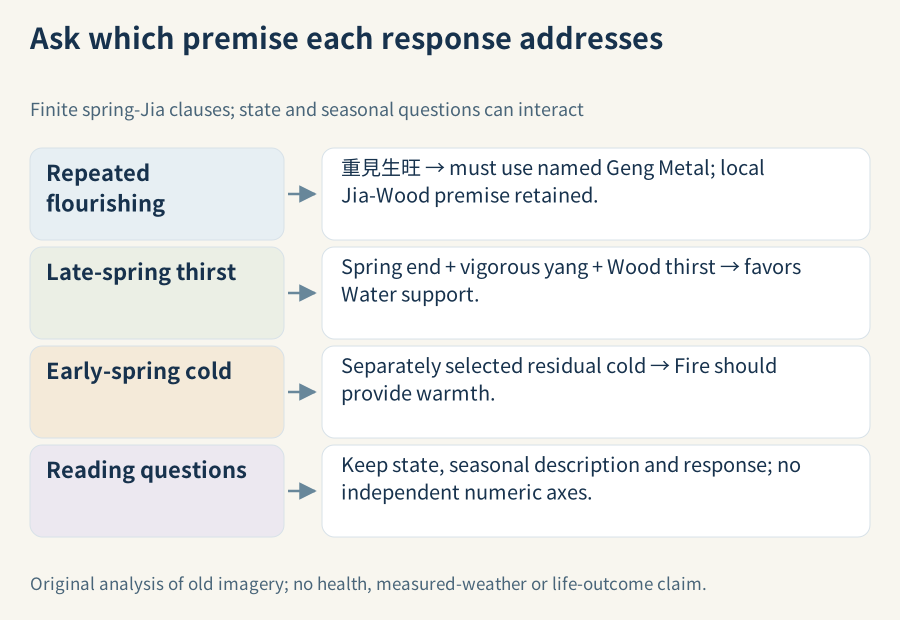
The complete figure is shown below. Select it to enlarge the labels. Open full-size figure · PNG
Check what was lost in a simplified rule
Consider an editorial paraphrase such as “Jia Wood is strong in spring, so Metal is always needed.” The selected text supplies the spring-Jia context, but the paraphrase drops 重見 and turns a local 必 into “always.” It also leaves no place for the late-spring thirst branch. The problem can be identified directly from the words without calculating an invented chart.
A second paraphrase, “Water is helpful because Wood is weak,” loses a different premise. The quoted branch says 木渴, not that this entire chart is weak. To substitute weakness would require another argument and its own evidence. We can describe the Water response's role in this clause without making that unsupported substitution.
The correction is to restore the missing terms, not to pronounce strength irrelevant. In the first branch, shengwang is expressly present. In the second, the seasonal description directs attention elsewhere. A good reading can retain both and ask how the wider paragraph relates them.
Carry the distinctions into the next question
The fourth question examines actual first/next orders and exceptions in third-, fifth- and sixth-month Jia passages. It tests the same habit at a finer level: a named object, a priority word and an exception each need their own premise. The current paragraph has not supplied a universal order for every month or stem.
Return to the first-collection directory for the edition and calendar boundaries, and consult Ten Gods basics for relation names. The working result is a reading note in which state, seasonal description, proposed response and evidential limit remain inspectable together.
Sources and further reading
三春甲木論, scan 8, left half, printed 一. Waseda University Library classical-text database
三春甲木論, scan 8, left half, printed 一. Waseda University Library classical-text database
Cover, title page, volume titles and responsibility lines, scan 8, folio unresolved or identity fields separately located. Waseda University Library classical-text database Separate positions: 1, 2, 4, 49
Punctuation, translation, analysis and diagrams are original. Printed Wang and catalogued Gang, preface self-report, responsibility lines and modern bibliography retain their distinct layers. Institutional images, modern commercial commentary and research materials are excluded. Return to the first-collection directory, or consult the Ten Gods guide.
Evidence and source roles
These roles distinguish ancient text, older commentary, historical scholarship and tool reproduction. The numbered notes in the article retain the precise scan pages and explanations. Library and academic sources do not endorse predictive claims.
- QT1-E03-SPRING-JIA · Ancient text evidence: 三春甲木論
Text layer in the witness: Printed text in the identified Waseda witness; editorial punctuation; handwritten margins and modern commercial commentary excluded - QT1-E03-EARLY-SPRING · Ancient text evidence: 三春甲木論
Text layer in the witness: Printed text in the identified Waseda witness; editorial punctuation; handwritten margins and modern commercial commentary excluded - QT1-E01-IDENTITY · Ancient text evidence: Cover, title page, volume titles and responsibility lines
Text layer in the witness: Separately located physical title and responsibility fields, not one continuous quotation