First and next specify an order inside a qualified passage. An exception opens another branch with its own premises. In the selected Jia-Wood paragraphs, third-month Geng/Ren, fifth-month Gui/Ding and sixth-month Ding/Geng are different orders. They cannot be made into one reusable recipe by deleting the month or the exception.
This article reads two sections of the identified Waseda print: third-month Jia and the combined fifth/sixth-month Jia section.[4] The third-month excerpts are separately located, with intervening material left unquoted. The fifth/sixth-month selection is one continuous passage. Neither selection is a complete collation of the book or a verified rule for actual life outcomes.
Read a local order with its heading
In 三月甲木, scan 11 right half, printed folio 3, the safe selected words are 先取庚金,次用壬水: “Take Geng Metal first; use Ren Water next.”[1] The title's third month and Jia Wood remain part of the scope. An annotation containing only “Geng first, Ren next” would be incomplete without that heading.
The pair also preserves particular stems. Geng is not every possible Metal, and Ren is not every possible Water. “First” and “next” are the printed order of consideration here; they do not tell us a person's first and second life events. Nor does this small selection specify dosage, the number of occurrences or a complete chart in which both have already been found.
The preceding wording in this witness includes a glyph different from a familiar modern transcription. The present argument needs only the clearly read priority clause, so it does not silently replace that glyph or build an interpretation on it. Limiting an excerpt is different from claiming the entire heading's paragraph has been critically settled.
Keep the Metal-formation exception and its denial together
Later in the same section, scan 11 left half, printed 4, reads: 或支成金局,方可用丁,不然三月無用丁之法。惟有先庚後壬取用.[2] An original translation is: “If the branches form a Metal formation, only then may Ding be used; otherwise, in the third month there is no method of using Ding. Only taking Geng first and Ren afterward remains.”
The opening 或 introduces a branch. 方可 attaches permission to that branch. 不然 and 無 deny the use outside it, while the closing sentence restates the local Geng-before-Ren route. Extracting only “no method of using Ding” would omit the permission that immediately qualifies it. Extracting only “Ding may be used” would omit the condition just as seriously.
The selected words say 支成金局 but do not enumerate the formation's constituent branches. We therefore retain the expression rather than adding an unquoted combination formula. The source can support this exception's structure without supporting every detail a modern reader might supply from elsewhere.
There is also a physical gap between this passage and the earlier priority clause. It contains further disclosure/concealment, case and other qualifications that this article does not exhaust. The two excerpts may be compared, but they must not be joined into a fabricated continuous quotation or treated as a complete summary of all third-month outcomes.
A combined heading does not erase differences between its months
The section 五六月甲木, scan 12 left half, begins a continuous selection: 五六月甲木,一理共推,木性虛焦。五月先癸後丁,庚金次之。六月三伏生寒,丁火退氣,先丁後庚,無癸亦可成。五月乏癸,用丁亦可,要運行水地為佳.[3] The printed folio on this half is unresolved; the scan, side and heading are supplied instead of an inferred number.
The first sentence groups the fifth and sixth months for a shared discussion. The following sentences then distinguish them. For the fifth month, the text says Gui first, Ding afterward, with Geng Metal next. For the sixth, sanfu/cold and Ding's retreating qi precede Ding first and Geng afterward. A shared heading is therefore not evidence that the two months have an identical order.
The sixth-month clause also permits formation without Gui: 無癸亦可成. Its subject remains the sixth-month branch just described. It cannot be moved backward to mean that the earlier fifth-month Gui priority has vanished, or outward to mean that Gui is unnecessary in every Jia-Wood passage.
The fifth-month fallback still has a cycle qualification
The final sentence returns explicitly to 五月. It grants 用丁亦可 when Gui is lacking, but continues 要運行水地為佳. An original translation is: “In the fifth month, lacking Gui, using Ding is also possible; it requires the cycle to go through Water ground for the preferable condition.” The cycle phrase belongs to the fallback and must remain beside it.
“Also possible” is not the same as “equivalent in all respects.” The named missing factor, replacement and cycle setting distinguish this branch from the first fifth-month order. The text has provided no numerical weight that would let us price the substitution, or an independently verified outcome proving that it succeeds for an actual birth.
The sixth-month “without Gui” branch and the fifth-month “lacking Gui” fallback share a negative Gui condition, yet their surrounding premises differ. The former follows sixth-month sanfu and Ding retreat; the latter names the fifth month and adds Water-ground cycles. A note based only on the words “no Gui” would lose precisely the differences the continuous paragraph preserves.
| Local entrance | Printed order or permission | Qualification that must travel with it |
|---|---|---|
| Third-month Jia | Geng first, Ren next | This stem/month section; no universal order |
| Third-month Jia, branches form Metal | Only then Ding permitted | Otherwise Ding denied in the local clause; Geng/Ren restated |
| Fifth-month Jia | Gui first, Ding afterward, Geng next | Fifth month, within the combined fifth/sixth section |
| Sixth-month Jia | Ding first, Geng afterward; without Gui may also form | Sanfu/cold and Ding retreat in the sixth-month clause |
| Fifth-month Jia lacking Gui | Ding also possible | Water-ground cycle condition retained |
Read the grammar before turning it into a diagram
The useful words are not just the stems. First, next and afterward mark order; only then marks qualified permission; otherwise and no mark denial; also possible marks an admitted branch; requires marks a further qualification. Reading these words is how the selection avoids becoming a list of supposedly helpful factors.
A diagram can shorten the wording only if it carries the same month, object and qualification. Its fifth-month fallback row must retain the Water-ground cycle condition, and its third-month Ding row must retain the Metal-formation premise. Space saved by dropping either premise would change the argument rather than merely its presentation.
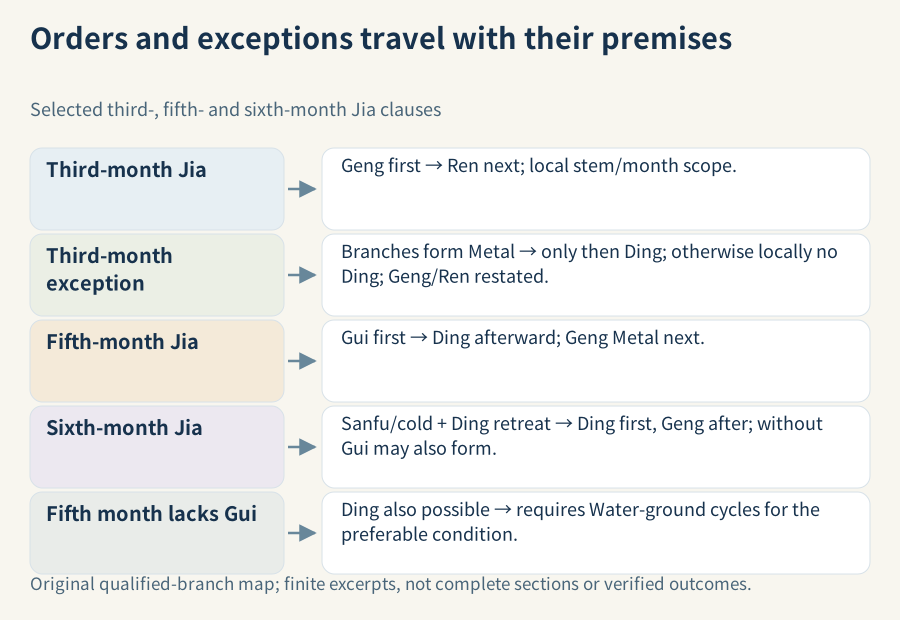
The complete figure is shown below. Select it to enlarge the labels. Open full-size figure · PNG
Test an interpretation by changing only what the text allows
A reader can compare two excerpts without inventing births. Remove “third month” from the first row and its scope becomes too broad. Remove “only then” from the Ding exception and a conditional permission becomes unrestricted. Remove the cycle condition from the fifth-month fallback and a qualified alternative appears to be an equal replacement. These are editorial losses visible in the source wording itself.
This check does not establish that the old judgments predict reality. It establishes whether a proposed account faithfully preserves their conditions. The distinction matters when an old paragraph uses confident success language: even accurately quoted confidence remains the book's claim, not an empirical result supplied by the article.
Finish the first collection with a usable reading note
The edition question identifies the witness and separates its preface from a modern commentary catalogue. The calendar question keeps month labels distinct from modern inputs. The third question separates repeated flourishing from seasonal thirst. The current question then preserves actual orders and their exceptions. Together they make the next collection's selected seasonal paragraphs easier to locate and question.
Return to the first-collection directory, or consult Ten Gods basics for relation names. A useful note records heading, exact qualified clause, named objects, exception, locator and remaining uncertainty. It supports further reading while leaving the book's unselected material and untested life claims visible.
Sources and further reading
三月甲木, scan 11, right half, printed 三. Waseda University Library classical-text database
三月甲木续条, scan 11, left half, printed 四. Waseda University Library classical-text database
五六月甲木, scan 12, left half, folio unresolved or identity fields separately located. Waseda University Library classical-text database
Cover, title page, volume titles and responsibility lines, scan 8, folio unresolved or identity fields separately located. Waseda University Library classical-text database Separate positions: 1, 2, 4, 49
Punctuation, translation, analysis and diagrams are original. Printed Wang and catalogued Gang, preface self-report, responsibility lines and modern bibliography retain their distinct layers. Institutional images, modern commercial commentary and research materials are excluded. Return to the first-collection directory, or consult the Ten Gods guide.
Evidence and source roles
These roles distinguish ancient text, older commentary, historical scholarship and tool reproduction. The numbered notes in the article retain the precise scan pages and explanations. Library and academic sources do not endorse predictive claims.
- QT1-E04-MARCH-ORDER · Ancient text evidence: 三月甲木
Text layer in the witness: Printed text in the identified Waseda witness; editorial punctuation; handwritten margins and modern commercial commentary excluded - QT1-E04-MARCH-EXCEPTION · Ancient text evidence: 三月甲木续条
Text layer in the witness: Printed text in the identified Waseda witness; editorial punctuation; handwritten margins and modern commercial commentary excluded - QT1-E04-MAY-JUNE · Ancient text evidence: 五六月甲木
Text layer in the witness: Printed text in the identified Waseda witness; editorial punctuation; handwritten margins and modern commercial commentary excluded - QT1-E01-IDENTITY · Ancient text evidence: Cover, title page, volume titles and responsibility lines
Text layer in the witness: Separately located physical title and responsibility fields, not one continuous quotation