Jianlu, Yang Blade, Quzhi and Yanshang occur in pattern discussions, but do not thereby become one row of equivalent checkboxes. We compare only two types of entry: day/month or flourishing positions with their control conditions, and the day-stem, branch-formation and qualification requirements of Quzhi and Yanshang. Different entries can overlap in a record; they need not be assumed mutually exclusive.
The Qin Shen'an/Wenming witness is catalogued as 1926. Juan 5 has 論建祿 at scan 120, printed page 61. The Yang Blade entry actually prints 論陽刀 at scan 114, printed page 55; our qualification excerpt is on scan 118, printed page 59. Juan 6, scan 153, printed page 32 contains 曲直 and 炎上. [1][2][3][4] Order, characters and locators belong to this witness rather than being transferred from a circulating contents list.
The first entry type asks about day/month or flourishing position
Jianlu begins 建祿者,乃甲日寅月、乙日卯月,五行臨官之位是也. Our translation: “Jianlu refers to Jia day in Yin month or Yi day in Mao month, the Five Phases' Linguan position.” [1] It enters through day stem and month, then discusses Jia's Wealth and Officer in Yin and excessive personal strength. Linguan is a technical position, not receipt of a modern job or salary.
The passage evaluates absence of usable Wealth or Officer together with competing factors through old poverty language. Later on the same page, however, it adds 如八字內外元有財官,引旺得地,官星有助,運臨官星有氣之地,亦貴. Our translation: “If Wealth and Officer already occur within or beyond the configuration, are led to flourishing and well situated, Officer has support and the cycle reaches a domain where Officer has qi, distinction is also possible.” [1]
We retain that qualified turn rather than give Jianlu an inherently good or bad rating. Beside the heading is 此與月劫格同參, an original instruction to compare with the Month Rob Wealth pattern. This is a reference cue, not our invented assertion of complete synonymy. A convenient vocabulary table should not erase the comparison task.
Yang Blade also needs its operative connections
The local image clearly shows 論陽刀, with 羊刀 also in the small-type comparison cue and 刀 forms in the prose. [2] The original plan and our modern explanation call the topic Yang Blade, but the actual heading is not silently respelled. The heading uses 陽 and the cue 羊; their positions remain recorded without establishing complete equivalence throughout the book. We neither create a new technical “Knife” category nor claim the form has been proven a printing error.
The prose explains the name through the position before Lu and flourishing beyond its allotted measure, then discusses relations including Seven Sha. A continuation explicitly introduces 祕訣云 and the secure qualification 重重有制伏, “Repeated appearances with controlling restraint,” followed by a historical life evaluation; this page also prints the 刀 form. [2] We use the short condition to show that control cannot be omitted, not to guarantee wealth, longevity or safety.
Yang Blade and Jianlu are not merely different ranks on one good–bad scale. Day/month Linguan, the preceding flourishing-position explanation, and each section's Wealth–Officer or control discussion need separate fields. Counting labels does not complete any passage's qualification checks.
The second entry type has requirements, not imagery alone
Juan 6's 曲直 begins 甲乙日得亥卯未局,柱中須有亥字帶印,為入格. Our translation: “For Jia or Yi day with a Hai–Mao–Wei formation, the pillars must contain Hai carrying Seal to qualify for the pattern.” [3] Day stem, formation, Hai and Seal are examined together. The subsequent text separately discusses Mao as Wood's original qi without Hai and the presence or absence of Metal and Earth.
The name and Wood imagery cannot replace qualification. A prominent Wood display is not the same question as Jia/Yi day, Hai–Mao–Wei formation and Hai carrying Seal. Setting a percentage threshold as a Quzhi button would miss the entry's explicit requirements.
The same section supplies a local example with Hai and Ding–Mao on the hour, mentioning Rob Wealth, Yang Blade and Hurting Officer while saying 雖貴不全合格, “Although distinguished, it does not fully fit the pattern.” [3] Categories can therefore be recorded together in the paragraph: mentioning Yang Blade does not stop discussion of Quzhi qualification. We describe the source's partial example without completing its four pillars or calculating a new birth chart.
Preserve both correspondence and difference in Yanshang
On the same page, 炎上 states 丙丁日遇寅午戌局,柱中須有寅字帶印,為入格. Our translation: “For Bing or Ding day encountering a Yin–Wu–Xu formation, the pillars must contain Yin carrying Seal to qualify.” [3] The construction resembles Quzhi, but day stems, branches and the Seal-bearing character differ. It proceeds to absence of Yin, flourishing Fire requiring Hai Water's balancing contribution, and cycle and avoidance factors.
Quzhi's Hai requirement cannot simply be copied as Yanshang's sole entry requirement. Nor does a single-phase formation make all other relations irrelevant. Seal, balancing contribution, cycles and avoided factors occupy their own positions in qualification and evaluation; they are not one element-strength table.
Both entries also contain small-type 詩曰 passages introducing verse. We quote secure large-type main prose and retain that boundary. We have not expanded the complete requirements of Congge, Runxia or Jiase here; two inspected examples cannot automatically represent every Five Phases pattern.
| Entry | What the inspected passage first requires | Further material to record |
|---|---|---|
| Jianlu | Day stem, month and Linguan | Usable Wealth–Officer, competing factors, assistance and cycles |
| Yang Blade | Flourishing-position explanation and related operations | Original comparison cue, control qualification and quoted voice |
| Quzhi | Jia/Yi day, Hai–Mao–Wei, Hai carrying Seal | Separate no-Hai discussion and partial-qualification example |
| Yanshang | Bing/Ding day, Yin–Wu–Xu, Yin carrying Seal | Fire's balancing relation, cycles and avoidances; not copied Quzhi conditions |
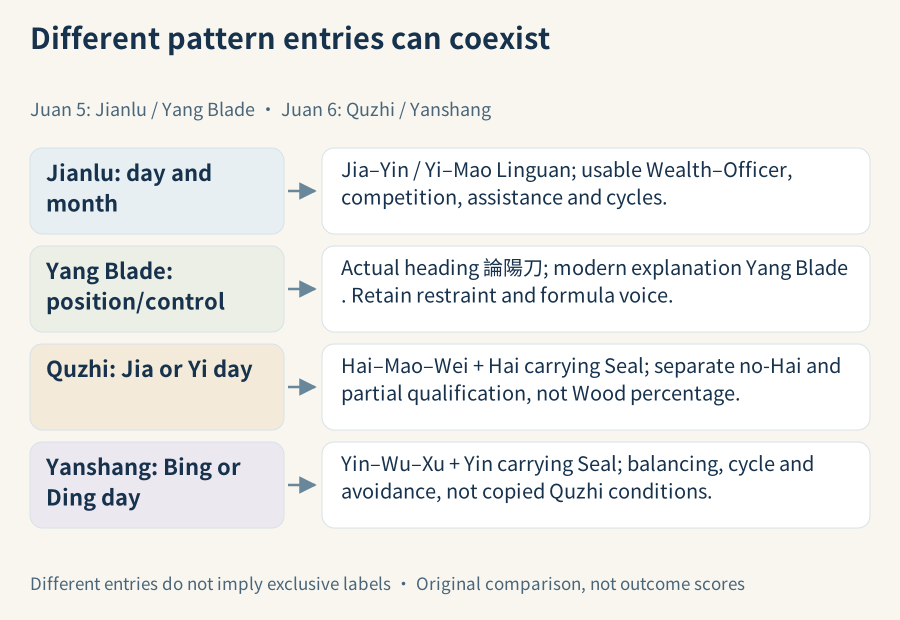
The complete figure is shown below. Select it to enlarge the labels. Open full-size figure · PNG
Different label sets can still be discussed together
The distinction concerns questions, not a ban on coexisting names. Fictional record A says: “Wood is highest, therefore Quzhi; Yang Blade appears, therefore Quzhi is cancelled.” It substitutes display proportion for the first question and assumes exclusivity for the second. Neither follows from the inspected passages.
Record B asks: What day/month or branch formation enters this section? Which character or control condition is required? Does the author state qualification, partial qualification or another evaluation? It retains original comparison cues and attribution labels. Multiple categories can then be recorded without first turning them into one score.
This phase proceeds from names to concrete qualifications so terminology remains attached to its textual task. Table, diagram and analysis are original. Examples are source fragments, not completed invented birth charts. We claim neither whole-book pattern collation nor real-world judgments about occupation, wealth, family or health.
Sources and related reading
Qin Shen'an/Wenming Sanming tonghui, juan 5, 論建祿, scan 120, printed page 61: day/month entry, Wealth–Officer turn and Month Rob Wealth comparison cue. View Jianlu
Actual heading 論陽刀, explained here as Yang Blade, scan 114, printed page 55, view the heading; control qualification and 祕訣云 on scan 118, printed page 59, view the condition. The 刀 form is recorded without a printing-error claim; separate pages do not become one long quotation.
Juan 6, 曲直 and 炎上, scan 153, printed page 32. Quotations are large-type main prose, distinct from small-type verse; punctuation is ours. View both qualification entries
NLC416-13jh000624-42998 catalogue, 1926, Qin Shen'an/Wenming: the actual later witness, not a verified 1578 original. View the catalogue
Preceding: Mixed Qi and tomb/storehouse entries. Basics: Earthly Branches and Five Phases cycles. Return to Relations and Structural Conditions.
Evidence and source roles
These roles distinguish ancient text, older commentary, historical scholarship and tool reproduction. The numbered notes in the article retain the precise scan pages and explanations. Library and academic sources do not endorse predictive claims.
- SM2-P15 · Ancient text evidence: 論建祿
Text layer in the witness: Main prose; original 此與月劫格同參 cue distinct - SM2-P16 · Ancient text evidence: 論陽刀(现代释读:阳刃)
Text layer in the witness: Actual 刀-form heading, main prose and small-type 羊刀 comparison cue; 祕訣云 on scan118 - SM2-P17 · Ancient text evidence: 曲直;炎上
Text layer in the witness: Separate large-type entries; small-type 詩曰 verse distinct - SM2-B01 · Library catalogue fields imported by Commons: 秦慎安校、文明书局《三命通會》传本,书目著录1926;NLC42998