Calling Chen, Xu, Chou and Wei Wealth storehouses immediately, or treating a preference for clashes as “every clash is good,” skips the entry point. Sanming tonghui's Mixed Qi discussion first considers stored components and their relation to the day stem, then exposure and seasonal qualifications. Its tomb-cycle appendix changes the question to what is operative and which cycle is entered. Shared tomb/storehouse vocabulary does not replace those levels.
The Qin Shen'an/Wenming witness is catalogued as 1926. Juan 5 has 論雜氣 at scan 98, printed page 39, and the separate heading 附論墓運 at scan 101, printed page 42. [1][2][3] They occupy different pages, with quoted formulas and subsequent summary voices distinguished. We do not assemble them into one unattributed universal rule.
Keep what is stored separate from what it is relative to me
論雜氣 opens 雜氣者,乃辰戌丑未, identifying the four branches, lists their stored components and explains 名所藏之氣而言,我日干或為官,或為財,或為印. Our translation: “The name concerns the qi stored; relative to my day stem it may be Officer, Wealth or Seal.” [1] One field records stored components; another records their relations to the day stem.
That distinction blocks the jump to “every storehouse is Wealth.” Different hidden stems in one branch can enter Officer, Wealth and Seal discussions relative to that day stem; changing the day stem requires checking those relations afresh. Stored qi is not a physical account of assets, and “mixed” is not a personality or moral judgment.
The page also explains the name through each storehouse's three components and uses Wealth supporting life and Seal supporting the person as comparisons. These are historical technical and everyday images, not measured financial sources or psychological traits. A diagram should show components and relations, rather than put a money bag beside each branch.
The Chou-month example continues beyond three names
The page first introduces a canon-labelled saying about storage in the seasonal endings, then gives Jia days in Chou month: Xin Metal as Officer, Ji Earth as Wealth and Gui Water as Seal. It then instructs 看天干透出何字為福,次分節氣淺深,何物當令. Our translation: “Examine which character is exposed in the heavenly stems for benefit; next distinguish depth within the seasonal interval and which component commands the season.” [1]
Knowing Xin–Ji–Gui's relations completes only classification. Exposure is then examined, followed by seasonal depth and precedence. We describe the source's order without converting seasonal precedence into independently validated website hidden-stem proportions. Exact day counts and modern numerical weights cannot be supplied from this sentence alone.
經云 is the page's attribution label, not proof that the quoted work has been independently collated here. The Chou-month example comes from the old text, not a newly calculated person's birth data, and does not itself validate calendar implementation.
The preference for exposure and clashes has explicit limits
The page states 此格喜透露衝刑,忌壓伏, “This pattern favors exposure, clashes and punishments, and avoids suppression.” Later it qualifies: 如無透出,衝刑少許,兼身旺為妙。忌身弱,衝刑太過,則福聚之氣散矣. Our translation: “Without exposure, a small amount of clash/punishment together with personal strength is desirable. Weakness and excessive clash/punishment are avoided, dispersing the gathered favorable qi.” It further restricts similar cycles when damaging factors already occur in the original pillars. [1]
No exposure, small amount, strength, weakness, excess and original-configuration conditions distinguish the account. Keeping only “favors clashes” removes the explanation of why not every clash receives the same evaluation. An automatic “open the Wealth storehouse” button would also erase the prior Officer–Wealth–Seal distinction.
We invent no numerical threshold for small amount or excess. They are the passage's condition words. A computational rule needs additional explicit grounds; our diagram's boxes identify reading requirements, not an already executable scoring function.
The tomb-cycle appendix changes the question
附論墓運 explicitly introduces 祕訣云, “a secret formula says,” discussing tomb/storehouse encounters in youth and old age. A subsequent 又云, “another saying says,” distinguishes flourishing Officer–Seal–Wealth from Hurting Officer, Food Spirit and personal strength in tomb/storehouse encounters. [2] These age and misfortune claims belong to historical formulas, not predictions about a reader's health, lifespan or life stages.
The subsequent summary says 可見凡官印傷官七煞為用神者,俱忌行墓庫之運, “It follows that when Officer, Seal, Hurting Officer or Seven Sha is the operative factor, entering a tomb/storehouse cycle is avoided,” with another qualification about one's own storehouse in later life. [2] “As the operative factor” and “entering a cycle” establish a different entry from the Mixed Qi section's month storage and exposed stems.
The quoted formula evaluates Hurting Officer with personal strength encountering a storehouse, while the later summary includes operative Hurting Officer among those avoiding tomb cycles. This leaves qualifications and collected voices to compare. We retain the issue rather than pretend to have completed controversy-level collation of the whole juan or reconciled every statement into a modern algorithm.
Recording differences is more useful than erasing them
Record the Mixed Qi path as “month storage—day-stem relations—exposure—seasonal precedence—clash and strength qualifications.” Record the appendix separately as “quoted formula—operative factor—tomb/storehouse cycle—other qualifications.” Then the same storehouse word does not silently switch the object under examination.
| Entry | First question | Subsequent material to retain |
|---|---|---|
| Mixed Qi storage | What do the four branches store? | Officer, Wealth or Seal relative to the day stem |
| Mixed Qi usage | What is exposed, and what commands the season? | Small clash with strength; excess and original-pillar restrictions |
| Appendix formulas | Whose voice, and under what qualification? | Do not merge with the following summary |
| Appendix summary | What is operative, and which tomb cycle? | Own-storehouse/later-life limits and unresolved differences |
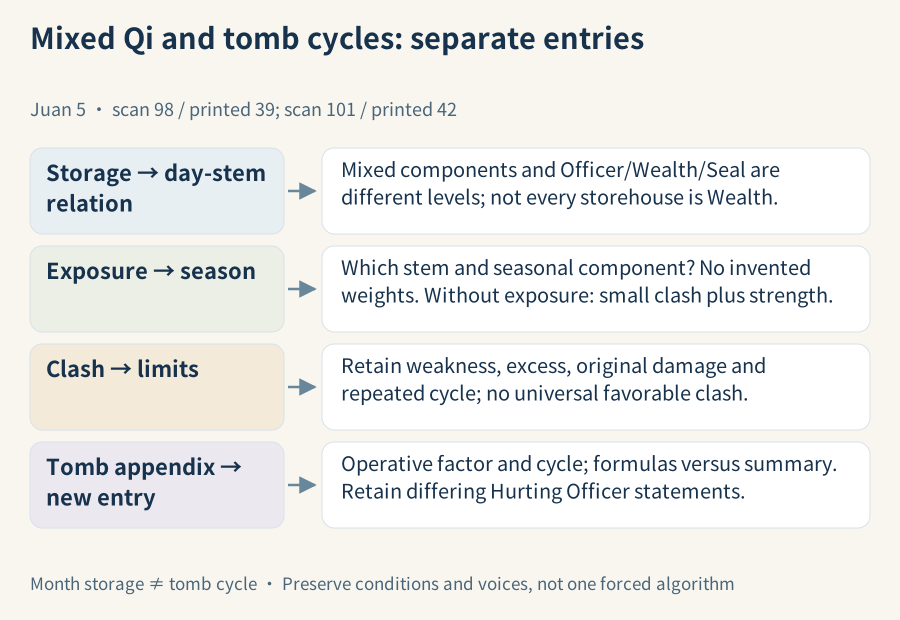
The complete figure is shown below. Select it to enlarge the labels. Open full-size figure · PNG
Two premature summaries and one checkable record
Fictional summary A says: “All four storehouses are Wealth; a clash releases it.” This erases Officer–Seal classification and clash qualifications together. Summary B says: “The tomb-cycle summary already explains every Mixed Qi case.” It transfers a cycle entry to a question about monthly stored components.
Summary C records actual heading, scan and printed page, voice, target and connecting conditions separately, leaving differing formula and summary statements for comparison. This requires no prediction of a reader's finances and supplies more checkable information than one tidy universal rule.
Table, diagram and explanations are original. Source scans and PDF remain research material and are not republished. The scope is selected witness passages, not complete-book collation, resolution of every tomb/storehouse dispute or scientific validation of the old method.
Sources and related reading
Qin Shen'an/Wenming Sanming tonghui, juan 5, 論雜氣, scan 98, printed page 39. Storage, the Chou-month example, exposure/season and complete clash qualifications are main prose; punctuation is ours. View Mixed Qi and its limits
附論墓運, scan 101, printed page 42, central section. 祕訣云, 又云 and the 可見 summary are recorded separately. View formulas and summary
NLC416-13jh000624-42998 catalogue, 1926, Qin Shen'an/Wenming. These locators belong only to this witness. View the catalogue
Preceding: Food Spirit and Hurting Officer. Basics: Earthly Branches and Ten Gods. Continue with Jianlu, Yang Blade and phase-pattern entries.
Evidence and source roles
These roles distinguish ancient text, older commentary, historical scholarship and tool reproduction. The numbered notes in the article retain the precise scan pages and explanations. Library and academic sources do not endorse predictive claims.
- SM2-P13 · Ancient text evidence: 論雜氣
Text layer in the witness: Main prose with distinct 經云 introduction - SM2-P14 · Ancient text evidence: 附論墓運
Text layer in the witness: Distinct 祕訣云 / 又云 formula voices followed by 可見 summary - SM2-B01 · Library catalogue fields imported by Commons: 秦慎安校、文明书局《三命通會》传本,书目著录1926;NLC42998