Modern introductions often describe what the day stem generates as “output.” That helps locate direction, but the inspected ancient pages do not use the term to merge Food Spirit and Hurting Officer into one heading. Sanming tonghui gives each its own discussion of paths and conditions. Retaining only “output” would lose the very reason to compare the entries.
We use the Qin Shen'an/Wenming witness catalogued as 1926. Juan 5 has 論傷官 at scan 101, printed page 42, with qualifications continuing on scan 102, printed page 43. 論食神 begins at scan 105, printed page 46 and continues on scan 106, printed page 47. [1][2][3] Hurting Officer precedes Food Spirit in this witness; our comparative learning route does not claim to reproduce its continuous order.
Hurting Officer's opening already supplies a qualified chain
The section says 傷官者,我生彼之謂, “Hurting Officer refers to what I generate,” and gives Jia encountering Ding and Yi encountering Bing. It then explains through Jia, Xin and Ding: 甲用辛為官,丁火乘旺,盜我之氣,尅制辛金,使不輔甲為貴,故名傷官. Our translation: “Jia takes Xin as Officer. Ding Fire, flourishing, draws off my qi and controls Xin Metal, preventing its assistance to Jia's distinction; hence the name Hurting Officer.” [1]
This is more than generation. It includes Jia using Xin as Officer, Ding flourishing and Ding acting on Xin. The naming follows a particular path from generation and depletion to the Officer affected. Removing Xin or flourishing, then claiming that all expression necessarily injures Officer, would expand the inspected passage.
The statement does not rank modern art, talent or personality. Output is our directional shorthand. Depletion and Hurting Officer belong to the source's technical, metaphorical and evaluative vocabulary. Translation should not merge them into praise or disparagement of actual people.
Wealth and Seal become different usage entries within the same section
The secure continuous passage on scan 102 reads 身旺者用財,身弱者用印。用印者須去財,方能發福。用財者不論印,亦主亨通。傷官用印,不忌官煞,去財方發. Our translation: “The strong person uses Wealth; the weak person uses Seal. Using Seal requires removing Wealth before benefit can occur. Using Wealth, without considering Seal, can also bring success. Hurting Officer using Seal does not avoid Officer–Sha; Wealth must be removed before benefit occurs.” [1] Strength and weakness first distinguish Wealth and Seal usage. Nonavoidance of Officer–Sha specifically follows Hurting Officer using Seal.
We retain those different entries rather than reduce them to “Hurting Officer encountering Officer always brings disaster” or “never causes harm.” The Wealth–Seal choice first requires knowing which usage is being discussed. The previous Seal entry included Wealth damaging Seal; here using Wealth under Hurting Officer brings another choice. Shared names need not perform the same task.
We have not independently encoded these short passages as automatic selection rules. More syntactically complex surrounding material is not supplied from a familiar circulating sentence. Seal usage cannot be dropped from the nonavoidance statement, and the earlier strong-person/Wealth entry cannot be turned into strength alone guaranteeing nonavoidance of Officer–Sha. Guaranteeing safety from “not avoided,” or disaster from “hurting,” would both exceed this paragraph's evidence.
Food Spirit moves from depletion to Wealth generation and Sha control
論食神 gives Jia taking Bing and Yi taking Ding as Food. It says 甲生丙,本為洩氣。丙生戊,為甲偏財, “Jia generating Bing initially drains qi; Bing generates Wu, which is Jia's Indirect Wealth.” [2] Generation's draining aspect is not denied; another path is added.
The continuation identifies Geng as Jia's Sha and Wu as Wealth, saying that Bing Food Spirit can control Geng so it does not injure Jia Wood, and can generate Wu Wealth, both serving Jia's use. [2] Compare Jia–Bing–Wu–Geng here with Jia–Ding–Xin in the Hurting Officer opening: targets and connections differ.
Both can be grouped as what the day stem generates for introductory purposes. Membership in one directional family does not prove identical operation in the two sections, much less that more output is always better. The move from depletion to generating Wealth and controlling Sha depends on particular relations, not a pleasant-sounding name.
Flourishing without damage and quantity limits belong together
A separate passage on the same page says 此格要日主食神俱生旺,無衝破. Our translation: “This pattern requires both the day master and Food Spirit to be vital and flourishing, without clashes or breaks.” [2] “This pattern” and “requires” reconnect the qualification to the local discussion. A diagram showing Wealth generation and Sha control must retain that requirement rather than become less conditional than the prose.
The page subsequently allows only one Food Spirit and cautions against too many draining the source qi, with a 經云-labelled saying about dispersed qi. It then states 食神多者宜行印運,食少者不宜,是梟神奪食, “For abundant Food Spirit, a Seal cycle is suitable; when Food is scant, it is unsuitable, being Xiao taking Food.” [2] Quantity changes the qualification under which the Seal cycle is discussed.
This connects with the Inverted Food exceptions: both operative target and state need checking. “All Seal is bad” and “all output should be increased” cannot accommodate the page's distinction between much and little. These are the old text's quantity discussions, not website weights or real-world ability scores.
| Comparison | Inspected Hurting Officer passages | Inspected Food Spirit passages |
|---|---|---|
| Generation examples | Jia–Ding, Yi–Bing | Jia–Bing, Yi–Ding |
| Local path | Jia uses Xin Officer; flourishing Ding controls Xin and drains Jia | Jia generates Bing; Bing generates Wu Wealth and controls Geng Sha |
| Added usage conditions | Strong person uses Wealth; weak person uses Seal; Seal requires Wealth removal | Day master and Food flourishing without damage; not too many |
| Seal or Officer discussion | Hurting Officer using Seal precedes nonavoidance of Officer–Sha and Wealth removal | Seal cycles discussed differently for much and little Food |
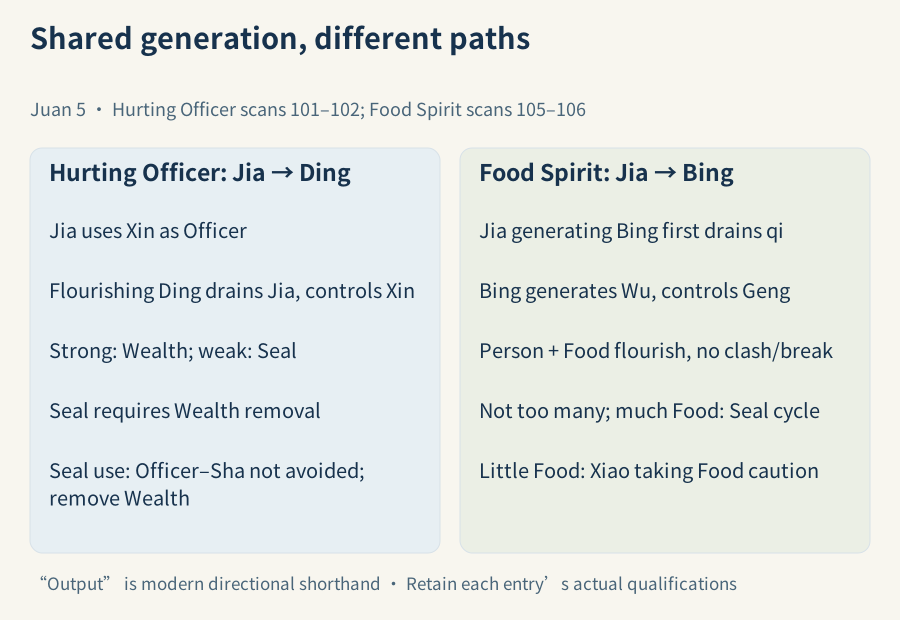
The complete figure is shown below. Select it to enlarge the labels. Open full-size figure · PNG
Read together without deleting the difference
First record the shared classification: generated relative to the day stem. Next retain the actual stems and targets: Ding acts on Xin, while Bing connects with Wu and Geng. Third preserve flourishing, Wealth/Seal usage, damage restrictions or quantity. Only then record the source's evaluation at that location.
Fictional summary A says: “Both are output, so one rule covers them.” It stops after the first step. Summary B says: “Food generates Wealth, so more is always favorable.” It skips the quantity limitation. Summary C retains both paths, their conditions and quoted voices without making claims about actual talent, income, reputation or safety.
This table and diagram are original comparison aids, not birth charts. We inspect the listed witness pages, not every quotation or the complete book, and do not establish the symbolic chains as modern scientific causation.
Sources and related reading
Qin Shen'an/Wenming Sanming tonghui, juan 5, 論傷官, scan 101, printed page 42, view the opening; Wealth/Seal and strength qualifications on scan 102, printed page 43, view the conditions. Punctuation and explanations are ours.
論食神, scan 105, printed page 46, view the heading and initial path; Sha control, flourishing without damage, quantity and Seal cycles on scan 106, printed page 47, view the continuation. Nonadjacent passages are not one continuous quotation.
NLC416-13jh000624-42998 catalogue, 1926, Qin Shen'an/Wenming, the adopted later witness. View the catalogue
Preceding: Seal and Inverted Food. Basics: Ten Gods and Five Phases cycles. Continue with Mixed Qi and tomb/storehouse entry points.
Evidence and source roles
These roles distinguish ancient text, older commentary, historical scholarship and tool reproduction. The numbered notes in the article retain the precise scan pages and explanations. Library and academic sources do not endorse predictive claims.
- SM2-P11 · Ancient text evidence: 論傷官
Text layer in the witness: Large-type main prose; small-type aliases distinct - SM2-P12 · Ancient text evidence: 論食神
Text layer in the witness: Main prose; preference aliases and 經云 sayings distinguished - SM2-B01 · Library catalogue fields imported by Commons: 秦慎安校、文明书局《三命通會》传本,书目著录1926;NLC42998