Different time spans do not imply one algorithm with a shorter step. Sanming tonghui distinguishes decade and minor cycles, preserves different starting points within the minor-cycle discussion, and gives Taisui two referents. Record interval, reference for calculation and interpretive qualification separately before attempting one unified timetable.
We use the Qin Shen'an/Wenming witness catalogued as 1926, object NLC94145. All passages here are in juan 2, scans 114–122, printed pages 36–44. [1–5] These locations belong to this actual witness, not an uncertain 1578 download or companion object NLC42998.
The ten-year interval does not supply every input
論大運 begins near the bottom of scan 114, printed page 36, comparing cycles with a lodging place. It connects their start to birth day, preceding or following solar terms and direction. Scan 115, printed page 37 explicitly says 一運管十年, “One cycle governs ten years,” alongside solar-term distance and conversion into years. [1]
Ten years describes an interval. It does not alone specify when that interval begins or which direction to follow. A vocabulary entry containing only ten years loses the starting-point task. Conversely, moving the traditional conversion directly into modern birth inputs would still leave calendar, time-zone and precise boundary conventions unresolved.
The page gives examples around solar terms. We neither complete them into modern birth dates nor claim independent validation of the website's entire calendar implementation. Later 又曰, “another saying says,” passages turn to cycle and birth-time strength conditions. This is another task after calculation, not a reason to merge every quoted voice into one axiom set.
The minor-cycle section states a year before explaining its lookup
論小運 on scan 119, printed page 41 says 夫大運司十年之休咎,小運掌一歲之災祥. Our translation: “The decade cycle administers the favorable and unfavorable over ten years; the minor cycle governs misfortune and auspiciousness over one year.” It subsequently says 小運一年一換, “The minor cycle changes once each year.” [2] The outcome language belongs to the old prediction discourse. One versus ten years describes intervals, not guaranteed actual events.
The text then asks 古人以男起丙寅,女起壬申,何也, “Why did the ancients start males from Bing–Yin and females from Ren–Shen?” The same page explains a first-year Bing–Yin sequence forward for males and Ren–Shen backward for females. [2] These are particular stem–branch starting points, not a shortened version of the preceding starting-point calculation. The historical male/female categories describe this method, not modern identity, character or social worth.
A record therefore needs annual change, the method called ancient here, each starting pair and its direction. “Annual layer” alone does not complete the lookup. Nor can “changes each year” supply unstated modern date-boundary or age conventions.
Another starting point actually occurs in the same section
The continuation on scan 120, printed page 42 states 醉醒子以為男女小運皆由時生而行之,逆順亦以年定陰陽. Our translation: “Zuixingzi considers minor cycles for both males and females to proceed from the birth hour, with forward or reverse direction also determined through the year's Yin–Yang.” Examples including a Jia–Zi hour follow. [2]
The sentence retains an attribution, an hour starting point and the year's polarity as reference. It is not the previous fixed Bing–Yin/Ren–Shen method merely expressed differently. Removing “Zuixingzi considers” hides a collected alternative; removing “through the year” silently changes the directional reference, perhaps to the day stem.
This inspection establishes how the witness reports Zuixingzi, not independent authentication of all his writings. It supports two actual paths on the inspected pages, not a declaration of the complete book's sole algorithm or a verdict on every modern chart product.
| Minor-cycle path | Starting point on these pages | Direction and scope |
|---|---|---|
| The method called ancient | Male Bing–Yin, female Ren–Shen, listed from the first year | This paragraph's forward/reverse account, not an hour-based start |
| The attributed Zuixingzi account | Birth hour, with a Jia–Zi example | Explicit year-polarity reference; cited writings not separately collated |
Taisui's two explanations cannot become one zodiac label
The separate 論太歲 heading on scan 120 begins 夫太歲者,乃一歲之主宰,諸神之領袖。起說有二. Our translation: “Taisui is the ruler of a year and leader of the spirits. Its explanation has two beginnings.” It distinguishes the birth-year Taisui within the pillars from the Taisui moving through successive years. [3]
One refers to the year in the birth record; the other to yearly movement. The shared name does not give them the same temporal object. Replacing Taisui with an animal-zodiac label would also miss the subsequent discussion of day and year, stem relations and birth hour.
A separately canon-labelled passage includes 入命未必為凶。如逢戰鬥之鄉, “Entering the configuration is not necessarily unfavorable; if a domain of conflict is encountered …” [3] “Not necessarily” prevents an unconditional conclusion; “if” adds a qualification. Conflict, punishment and unfavorable outcomes remain the source's technical and predictive vocabulary, not a claim that disaster will happen to a reader.
Scan 121, printed page 43 discusses Jia day and Wu year, saying 甲日見戊年為偏財, “Jia day encountering Wu year is Indirect Wealth.” It then adds day–year combination and birth-hour qualifications, using 或 and 亦有不凶者, “or” and “some are also not unfavorable.” [3] Day, year, hour and those connectors qualify the local account. A single zodiac label cannot replace the paragraph.
The timing summary changes to operative emphasis and natal qualifications
總論歲運 on scan 122, printed page 44 says 歲用天元,運用地支, “The year uses the heavenly stem; the cycle uses the earthly branch.” [4] This assigns emphasis in this passage's interpretation. It does not generate every earlier calculation start from eight characters.
The surrounding prose compares year-stem/day-stem directions and year/cycle clashes with month or day. Another passage qualifies its discussion by absence of Officer in the original configuration, excessive restraint of an existing Indirect Officer and an Officer stem encountered in the cycle, then says 亦可發財,不為官兆, “Wealth may also arise; this is not a sign of office.” [4]
An Officer label in the cycle therefore does not automatically mean real appointment here. Original presence or absence, degree of restraint and the incoming position belong with the evaluation. We record this entry without turning stem and branch into a one-input modern program or predicting a reader's career.
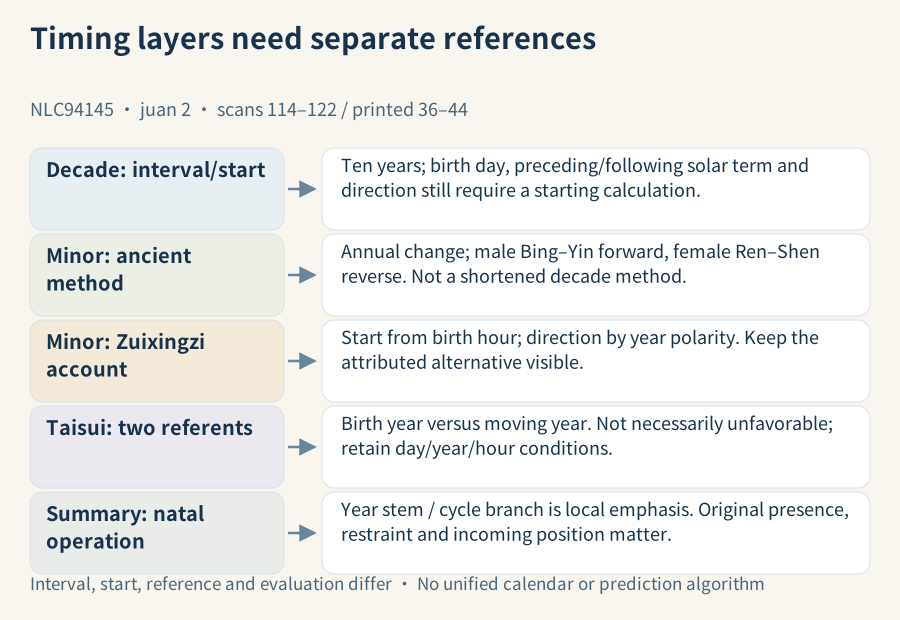
The complete figure is shown below. Select it to enlarge the labels. Open full-size figure · PNG
What makes a timing record checkable?
Use four fields: actual heading; ten-year interval, yearly movement or birth-year referent; starting and directional reference; added evaluative qualifications. This preserves scale while exposing alternatives within a section and different tasks across sections.
A summary saying “the minor cycle is the one-year version of the decade cycle” cannot explain the fixed pairs versus an hour-based start. A summary saying “Taisui entering a chart must be unfavorable” directly removes “not necessarily” and “if.”
A fuller record is still not a birth calculation. It identifies the account selected on the page, the temporal object and the interpretation still needing reading. Yuanhai's three-layer article supplies a foundation; this article adds the compilation's actual differences in lookup and attribution.
Table, diagram and translations are original readings. Examples remain partial symbolic material in the source, not newly completed dates or personal charts. The scope is the listed witness passages, not whole-book collation or evidence of real-world predictive effectiveness.
Sources and related reading
Qin Shen'an/Wenming Sanming tonghui, NLC94145, juan 2, 論大運: heading and opening scan 114, printed page 36, view the start; ten years and solar-term conversion scan 115, printed page 37, view the continuation. Punctuation is ours.
論小運, scan 119, printed page 41, view the ancient method; Zuixingzi continuation scan 120, printed page 42, view the alternative. The two passages are not one algorithm.
論太歲, scan 120, printed page 42, view the two referents; day/year/hour qualifications scan 121, printed page 43, view the conditions. Canon-labelled material has not been independently collated against its quoted work.
總論歲運, scan 122, printed page 44: operative emphasis and original-configuration qualifications are separate passages. View the summary
Catalogue for NLC416-13jh000156-94145: 1926, Qin Shen'an/Wenming, holdings :1,3. The catalogue year does not replace an independent imprint not seen here. View the catalogue
For foundations see natal, decade and annual layers and the website's methodology. Preceding: auxiliary-star references and conditions. Continue with Returning to Lu and Mouse Noble comparisons.
Evidence and source roles
These roles distinguish ancient text, older commentary, historical scholarship and tool reproduction. The numbered notes in the article retain the precise scan pages and explanations. Library and academic sources do not endorse predictive claims.
- SM3-P20 · Ancient text evidence: 論大運
Text layer in the witness: Main heading and prose; later 又曰 material distinguished - SM3-P21 · Ancient text evidence: 論小運
Text layer in the witness: Main prose; 古人 account and 醉醒子以為 attribution distinguished - SM3-P22 · Ancient text evidence: 論太歲
Text layer in the witness: Main prose with distinct 又經云 saying - SM3-P23 · Ancient text evidence: 總論歲運
Text layer in the witness: Main prose; operative emphasis distinct from earlier calculation starts - SM3-B01 · Library catalogue fields imported by Commons: Qin Shen’an/Wenming Sanming tonghui, NLC94145; catalogued as 1926, independent 1926 imprint not inspected; not verified 1578