A table can sort auxiliary-star names into favorable and unfavorable columns without explaining their lookup reference, location or further qualifications. The inspected Sanming tonghui passages use different references and explicitly demand adaptive comparison. Keeping only names and evaluations can change even the lookup question.
We read the Qin Shen'an/Wenming witness catalogued as 1926, NLC94145, juan 3. 論驛馬 occurs at scan 147, printed page 5; 論天乙貴人 at scan 153, printed page 11; 總論諸神煞 begins separately at the lower left of scan 185, printed page 43, continuing to scan 190, printed page 48. [1–4] The actual heading prints 煞, not the description page's 殺. Its boundary is distinct from the preceding discussion of combined stem–branch Sha.
First establish what the passage looks up
Traveling Horse opens 所謂驛馬者,乃先天三合數也, “What is called Traveling Horse is the primordial number of the threefold combinations.” [2] It then works through Yin–Wu–Xu, Shen–Zi–Chen, Si–You–Chou and Hai–Mao–Wei, with places where phases are said to begin. That entry differs from Heavenly Noble's stems, Noble positions and day/night divisions. One table without a reference column cannot cover both faithfully.
The Noble continuation includes 甲貴在丑, “Jia's Noble is at Chou.” [3] This local sentence does not universally assign the entire section to either day-stem or year-stem lookup. Rewriting it as “Jia day has Noble at Chou” adds a reference not established here. A modern table may declare a particular convention, but should not silently insert it into the ancient sentence.
The general discussion's explanation of 尅身, ‘controlling the person,’ uses birth-year Taisui Nayin as its comparison. [1] Threefold combinations, particular stem characters and Nayin therefore perform different tasks in these inspected materials. Finding a name does not establish that every auxiliary star uses the same year, day or branch entry.
The Horse position does not complete the evaluation
Scan 152, printed page 10 contains the secure example 如申子辰馬在寅, “For Shen–Zi–Chen, the Horse is at Yin.” It occurs under 又曰,凡看驛馬有四事, “Another saying says: examining Traveling Horse has four matters,” followed by distinctions in particular stem–branch positions. [2] We retain that voice rather than call every Yin the same distinguished Horse.
A separate continuous passage says 凡人遇馬,喜專旺,而嫌空亡,駁雜為不達. Our translation: “In encountering Horse, concentrated flourishing is favored and emptiness avoided; mixed complexity is treated as failure to attain.” [2] Once a branch position is identified, flourishing, emptiness and mixture remain to be considered. Name, location and qualification can be recorded separately; the first cannot automatically fill the others.
Subsequent statements involve declining states, Food and Wealth, merchants and other historical evaluations. Translating Horse directly into modern relocation, travel or career success would skip conditions and add an unvalidated conclusion. We analyze the account without predicting a reader's journeys, earnings or work.
The Noble distinctions cannot all become one day/night switch
Scan 155, printed page 13 says 今六壬選擇諸術,或分陰陽,或分晝夜,蓋本此二說, describing arts of Liuren and selection as dividing by Yin–Yang or day–night, based on two accounts. It then introduces 壺中子云 and the qualification 以晝生遇晝貴,夜生遇夜貴為得力, “Day-born encountering daytime Noble and night-born nighttime Noble are considered effective.” [3]
Keep both the section's presentation of several arts and the attributed Huzhongzi account of matching. The quotation label remains; we have not independently collated all Huzhongzi writings or Liuren traditions.
The continuation also mentions divisions by Yin/Shen, the winter/summer solstices and sunrise/sunset. [3] These are not automatically interchangeable expressions. Turning them into one modern interface switch would require declaring the selected boundary and account, rather than claiming they have already been proved equivalent here.
We impose no modern time zone or fixed clock hour on these statements, and do not turn “effective” into promised real assistance from a powerful person. The contribution is to keep collected distinctions and their attributions visible within one heading.
The controlling-the-person passage changes the target to Nayin
On scan 190, printed page 48, the general discussion explains 以上諸煞,凡言尅身,謂凶煞下納音尅生年太歲納音. Our translation: “Among the Sha above, controlling the person refers to the Nayin under an unfavorable Sha controlling the birth-year Taisui Nayin.” [1] This defines a local term and comparison; it is not the common formula for stem-based Noble or threefold-combination Horse lookup. The adjoining text explicitly says 太歲納音為身, taking Taisui Nayin as shen here. That locally specified reference cannot silently become the day stem or actual bodily injury. [1]
Reading “unfavorable Sha” is consequently insufficient for an unfavorable judgment. The continuation compares qi presence or absence, the pillars' phases and stem–branch combinations, occupied position and interaction among Sha. [1] We keep these qualifications local, without constructing a supposedly collated whole-book auxiliary-star score.
Its concluding method statement reads 吉凶神煞不可拘定輕重,較量要在通變. Our translation: “Favorable and unfavorable spirits and Sha cannot be rigidly fixed as weighty or light; comparison requires adaptive understanding.” [1] This calls for further comparison rather than rigidity. It neither licenses arbitrary rule changes nor validates prediction scientifically. Lookup and judgment perform distinct tasks; adaptive understanding does not remove the need for evidence.
| Inspected material | Local lookup or reference | Further checks |
|---|---|---|
| Traveling Horse | Threefold combinations and position; Shen–Zi–Chen to Yin | Attributed positional account, flourishing, emptiness and mixture |
| Heavenly Noble | Stem–branch position, Yin–Yang or day–night divisions | Do not supply a universal year/day reference; distinguish boundaries and voices |
| General controlling-the-person passage | Sha Nayin controlling birth-year Taisui Nayin | Qi, combinations, occupied position and interactions qualified locally |
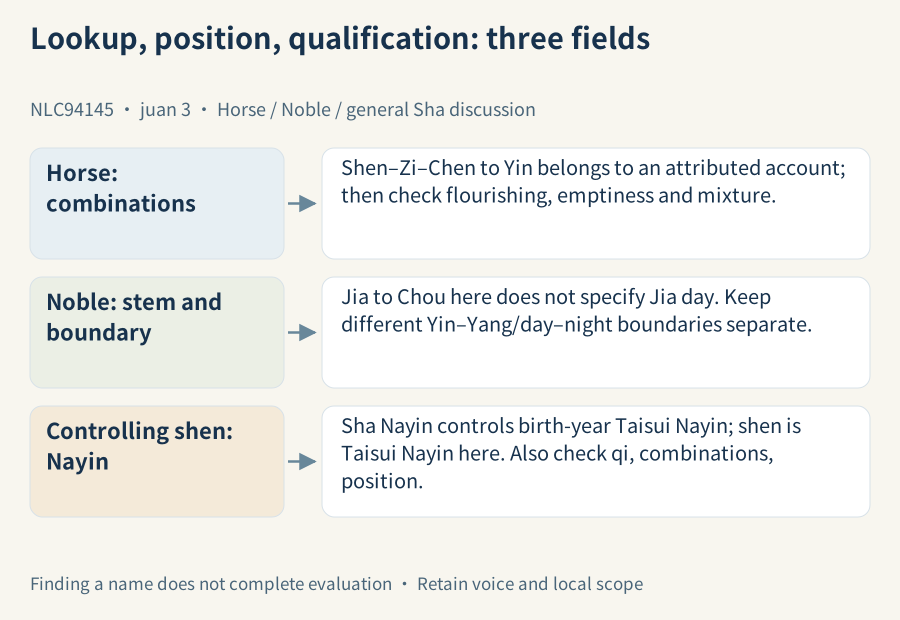
The complete figure is shown below. Select it to enlarge the labels. Open full-size figure · PNG
How a study table can still return to the source
Useful fields are actual heading, quoted voice, lookup reference, resulting symbol or position and evaluative qualifications. This needs more space than two good–bad columns, but prevents combination, stem and Nayin questions being merged.
For “Jia's Noble at Chou,” retain Jia and Chou and note that this local sentence does not universally specify year or day stem. For the Horse at Yin, identify the “another saying” passage and record flourishing, emptiness and mixture separately. For 尅身, identify Nayin and birth-year Taisui, without substituting another day-stem relation or an actual injury judgment.
This preserves rather than diminishes the conditions and makes a summary checkable. Is a difference in lookup, location or evaluation? Before those are separated, an apparent favorable–unfavorable disagreement may not even concern the same object.
Our table, diagram and explanations are original, with no reproduced source facsimile or exhaustive list of the book's auxiliary stars. The scope is the listed witness passages. An auxiliary-star label does not establish a real person's health, work, wealth, character or safety, or a scientific predictive mechanism.
Sources and related reading
Qin Shen'an/Wenming Sanming tonghui, NLC94145, juan 3, 總論諸神煞: heading scan 185, printed page 43, lower left, view the heading; Controlling-the-person/Nayin and adaptive comparison scan 190, printed page 48, view the continuation. Punctuation is ours.
論驛馬, scan 147, printed page 5, view the opening; positional saying and separate flourishing/emptiness passage scan 152, printed page 10, view the qualifications. Cross-passage excerpts do not become a continuous quotation.
論天乙貴人: heading scan 153, printed page 11, view the heading; position, divisions and attribution scan 155, printed page 13, view the accounts. Different boundaries and voices remain distinct.
NLC416-13jh000156-94145 catalogue, 1926, Qin Shen'an/Wenming. This is not an independently inspected imprint or verified 1578 original. View the catalogue
Foundations: auxiliary stars within the whole chart and Earthly Branches. Phase entry: Timing Auxiliary Stars and Examples. Continue with decade, minor-cycle and Taisui references.
Evidence and source roles
These roles distinguish ancient text, older commentary, historical scholarship and tool reproduction. The numbered notes in the article retain the precise scan pages and explanations. Library and academic sources do not endorse predictive claims.
- SM3-P10 · Ancient text evidence: 總論諸神煞
Text layer in the witness: Separate main-text heading; not preceding 論干支諸字雜犯神煞 - SM3-P11 · Ancient text evidence: 論驛馬
Text layer in the witness: Main prose with separately labelled 又曰 account - SM3-P12 · Ancient text evidence: 論天乙貴人
Text layer in the witness: Main text, 六壬選擇諸術 account and 壺中子云 voice distinct - SM3-B01 · Library catalogue fields imported by Commons: Qin Shen’an/Wenming Sanming tonghui, NLC94145; catalogued as 1926, independent 1926 imprint not inspected; not verified 1578