Finding a clash and then a combination does not establish resolution merely through the order in which they appear. This Ziping zhenquan section lists paths in which combinations resolve a clash, then a counterexample in which an initial resolution does not hold. The needed order concerns argumentative dependency: how one relationship depends on another and which position is protected. It is not a story of year-pillar events occurring before hour-pillar events.
We use the Qin/Wenming combined volume 2, NLC46443, with a verified January 1926 imprint. Lun xingchong huihe jiefa begins in scan 22's fourth column, printed 9, continuing to the Yongshen title on scan 23, printed 10.[1–4] The selections are partial conditions from the source, not newly calculated four-pillar births.
Keep the common You-month/Mao-clash entrance
Scan 22 says “支中刑衝,俱非美事,而三會六合可以解之,” evaluating branch punishment/clash unfavorably while allowing hui groups and six pairings to resolve it. It then enters a particular example: “如甲生酉月,逢卯則衝,” Jia born in a You month encountering Mao.[1] Jia, the You month and incoming Mao share one entrance. Removing You and merely listing Mao's possible partner loses the clash under discussion.
The actual print says 三會 and proceeds through Hai/Wei and Si/Chou components. We retain its term and actual components rather than silently replace the wording or impose a modern directional-group table using another set such as Yin–Mao–Chen. Modern terminology needs a separately stated system; it cannot rewrite the ancient example's inputs.
“Not fine things” is the work's historical evaluation here. Its resolution discussion still has particular objects and conditions. We do not translate clash into an actual accident, conflict or illness, nor guarantee safety from discovering a combination name.
Two pairings connect different sides of the clash
The text continues “或支中有戌,則卯與戌合而不衝;有辰,則辰與酉合而不衝”: Xu joins Mao, while Chen joins You, each described locally as preventing clash.[1] On the common You–Mao entrance, these are different connected objects, not one identical route.
A relationship table should therefore record Xu and Chen with their respective sides. One field saying “a six-pair combination exists” cannot make every such pairing sufficient to change You–Mao. Whether the listed combination is actually supplied still returns to the source qualifications. Two examples do not establish that every combination takes priority over every clash.
Nor does word order establish event chronology. The paragraph first supplies a common entrance and then adds alternatives. Its arrangement develops an argument rather than a reader's life in which Mao arrives first and Xu or Chen later.
Hui cannot lose its stated components
The next alternatives say “有亥與未,則卯與未亥會而不衝;有巳與丑,則酉與巳丑會而不衝”: Hai and Wei join Mao; Si and Chou join You, again described as preventing clash.[1] The two components in each alternative are jointly stated. Keeping only one cannot be called the source's complete example.
Hui changes the explanatory route of an existing relationship here. The selection does not supply a universal priority table for every position, disclosed stem, transformation, punishment or clash. We analyze the components provided rather than expand the fragment into unconditional cancellation logic.
| Addition to the same You–Mao entrance | Side connected | Source result and scope |
|---|---|---|
| Xu present | Mao pairs with Xu | No clash in this example, not every pairing |
| Chen present | Chen pairs with You | No clash here; a different object from the preceding route |
| Hai and Wei present | Mao joins Wei/Hai | Both components retained; no substituted directional group |
| Si and Chou present | You joins Si/Chou | Both components retained; not universal resolution whenever hui appears |
The section's own counterexample reopens “resolved”
Scan 23 says “又有刑衝而會合不能解者,如子年午月,日坐丑位,丑與子合,可以解衝;而時逢巳酉會,則子復衝午.”[2] It lists Zi year, Wu month and Chou day-position; Chou joins Zi and can resolve the clash. With the subsequently stated hour-related Si/You hui, Zi again clashes with Wu. Initial clash, pairing, additional qualification and renewed clash all enter one argumentative counterexample.
“Can resolve” is therefore a proposition needing continuing checks. Reading Chou–Zi and stopping misses the later condition; treating any subsequent hui as sufficient further resolution misses the text's stated exception. The work itself uses the case to discuss combinations that cannot resolve.
We preserve “時逢巳酉會,” the hour-related Si/You hui expression. This fragment provides no complete set of pillar stems/branches or calendar birthday. It does not authorize putting several branches into one hour pillar. We do not fill missing positions, alter source characters or invent birth data to make the example look complete. A schematic records only the relationships the passage lists.
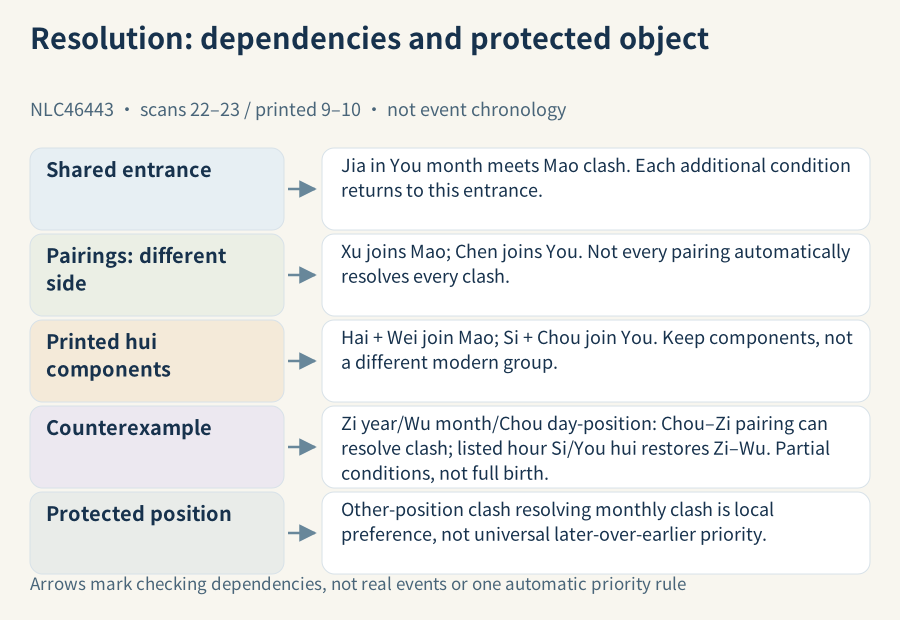
The complete figure is shown below. Select it to enlarge the labels. Open full-size figure · PNG
Ask which position is being protected
The ending includes “不如以別位之刑衝,解月令之刑衝矣,” preferring resolution of the Month Command's punishment/clash through another position's punishment/clash. A following example involves Bing in a Zi month and Mao/You branches.[3] The paragraph thus distinguishes the month from other positions, not merely whether punishment or clash exists.
A clash evaluated unfavorably in one sentence can enter a resolution discussion at another position. Deleting every clash as uniformly bad loses that object distinction; declaring every other-position clash favorable loses the protected relationship's qualification.
We record the passage's traditional preference without making it the entire work's compulsory priority program. Use still requires identifying the chapter's monthly object and wider relationships. The next article on yongshen and xiangshen develops the roles of primary selection and assistance.
Record dependencies without inventing a timeline
A study record can retain initial relationship, additional characters/group, the relationship changed, and stated counterexample or protected position. You–Mao first fixes the entrance, then checks whether a pairing connects Mao or You. Zi–Wu–Chou retains the later Si/You hui and renewed clash. Appearance order does not become actual life events.
This is an order of checking tasks. It shows which conditions support a judgment and why additional conditions require reassessment. It does not assign automatic legal-style precedence to year, month, day and hour, or make later appearance universally override earlier appearance.
Hui, pairing and clash are first interpreted through their stated objects here. Different terms or qualifications in another book may be compared, but a familiar modern lookup table cannot silently replace this witness's terms. Table, diagram and interpretation are original, without facsimiles or complete section/book collation. The relationships provide no real-person health, safety, financial or destiny guarantee.
Sources and further reading
NLC46443, scan 22, printed 9: title, Jia/You/Mao entrance, Xu/Chen pairings and Hai–Wei/Si–Chou alternatives. Actual 三會 and listed components retained; punctuation is ours. View the entrance and four routes
Scan 23, printed 10: Zi-year/Wu-month/Chou-day-position and 時逢巳酉會 counterexample. No complete birth is supplied or silently repaired. View the counterexample
Same page's ending: protecting the Month Command via other-position relations, ending before the Yongshen title. View the protected object
Object record and actual scan 74 imprint: January 1926 publication/distribution. Modern commentary page numbers are not substituted.
Return to this phase, or continue to Yongshen and xiangshen roles. Compare Stem pairing and operation for positional qualifications.
Evidence and source roles
These roles distinguish ancient text, older commentary, historical scholarship and tool reproduction. The numbered notes in the article retain the precise scan pages and explanations. Library and academic sources do not endorse predictive claims.
- ZP1-P20 · Ancient text evidence: 論刑衝會合解法
Text layer in the witness: Ancient main text / attached discussion, single-line print; actual heading and qualification boundaries retained - ZP1-P21 · Ancient text evidence: 論刑衝會合解法
Text layer in the witness: Ancient main text / attached discussion, single-line print; actual heading and qualification boundaries retained - ZP1-P22 · Ancient text evidence: 論刑衝會合解法
Text layer in the witness: Ancient main text / attached discussion, single-line print; actual heading and qualification boundaries retained - ZP1-P06 · Ancient text evidence: 刊记
Text layer in the witness: Actual independent end colophon: publication/distribution and other separately arranged fields - ZP1-B01 · Library catalogue fields imported by Commons: NLC46443 combined Yuanhai/Ziping volume 2 object and imported NLC catalogue