The two inspected Ziping zhenquan sections distinguish yongshen, selected through the Month Command, from xiangshen, assistance in forming a configuration. Assistance is not only generation: Wealth assists Officer when Officer receives Wealth generation; Officer assists Wealth in the Wealth-flourishing example; Food assists Sha through restraint. Defining yongshen beforehand as an invariably favorable factor and xiangshen as something always generating it would erase these examples.
We use Qin/Wenming combined volume 2, NLC46443, with a verified January 1926 imprint. Lun yongshen begins on scan 23's left, printed 10, ends on 24, printed 11, and is followed by a new success/failure-rescue section on 25. Lun xiangshen jinyao begins on 32, printed 19, ending before Mixed-Qi selection on 33, printed 20.[1–5] We explain roles inside the read sections; the existing cross-book comparison remains separately available. Familiar modern terms are not imposed upon the old wording.
Month and day stem jointly supply the selection entrance
Scan 23 begins “八字用神,專求月令。以日干配月令地支,而生尅不同,格局分焉.”[1] Yongshen is sought through the Month Command; matching the day stem with its branch yields different generating/controlling relationships and differentiated configurations. Month and day stem have distinct tasks: the location of selection and the relational reference. This is not simply choosing a factor whose name sounds helpful.
The opening also gives no procedure for replacing missing phases by numerical count. Translating yongshen solely as whatever strengthens the self loses the day-stem/month relationship and the following treatment of different factors. Our reading uses the actual opening and subsequent qualifications rather than claiming identical definitions across all books.
The day stem is a traditional symbolic reference here. Month Command is not merely a modern civil-month name. An established entrance does not finish every evaluation; the preceding question about protected positions still needs particular relationships rather than being erased by the word yongshen.
Following and opposing treatment both occur
The continuous passage says “財官印食,此用神之善而順用之者也;煞傷刃劫,此用神之不善而逆用之者也。當順而順,當逆而逆,配合得宜,皆為貴格.”[1] Wealth, Officer, Seal and Food enter following treatment; Sha, Hurting Officer, Blade and Rob Wealth enter opposing treatment. The factors termed not good remain within the yongshen discussion, rather than being defined as eternally unusable.
An “always a good thing” summary is therefore unsupported. Good/not good connects to treatment within configurations, not a reader's morality, ability or social worth. Noble configuration is likewise a historical evaluative category, not our promise of actual status or success.
The demand to follow or oppose appropriately also preserves a qualification of fitting treatment. Wealth/Officer/Seal/Food alone do not establish nobility; Sha/Injury/Blade/Rob Wealth are not unconditionally deleted. We continue to selection and assistance without creating one favorable/unfavorable button for each category.
Exclusive monthly selection still has a stated alternative entrance
Scan 24 criticizes arbitrary selection outside the Month Command, then says “然亦有月令無用神者,” there are also cases without yongshen in the Month Command. Its Wood-in-Yin/Mao example says the self cannot be the use, then checks Wealth, Officer, Sha and Food through disclosed stems or branch gatherings elsewhere.[2]
Criticism and exception belong together. Exclusive monthly selection cannot become an eternal prohibition on alternatives; the exception cannot become permission to select any desired factor. The alternative retains a stated entrance and candidate relationships rather than making the monthly principle meaningless.
Wood in Yin/Mao supplies partial source conditions, not complete day/month pillars or a birthday. Its discussion of sameness does not authorize filling every pillar character identically. We analyze the entrance without completing a new chart or using unavailable real outcomes to decide which selection is accurate.
Xiangshen first explains the assisting role
Scan 32 begins “月令既得用神,則別位亦必有相,若君之有相,輔我用神者是也.”[3] After monthly selection, another position supplies assistance, compared to a ruler having a minister. The political analogy explains primary and assisting responsibility. It neither predicts that readers become rulers/ministers nor makes xiangshen an actual career title.
Three consecutive examples read “如官逢財生,則官為用,財為相;財旺生官,則財為用,官為相;煞逢食制,則煞為用,食為相.”[3] Wealth-generates-Officer can have different primary/assisting roles in the stated entrances. The Food-restrains-Sha example also makes control an assisting operation.
| Stated entrance | Factor used | Assisting factor | Operation retained |
|---|---|---|---|
| Officer receives Wealth generation | Officer | Wealth | Wealth generates Officer and assists Officer here |
| Flourishing Wealth generates Officer | Wealth | Officer | Retain flourishing Wealth; Wealth is not permanently the assistant |
| Sha receives Food restraint | Sha | Food | Food restrains Sha; assistance is not solely generation |
The two Wealth/Officer examples do not authorize arbitrary label switching in one complete configuration. Each has its stated entrance, which determines the recorded roles. Fixed “Wealth equals assistant” misreads the second. Defining assistance only as generating the factor used fails to retain the second and third completely.
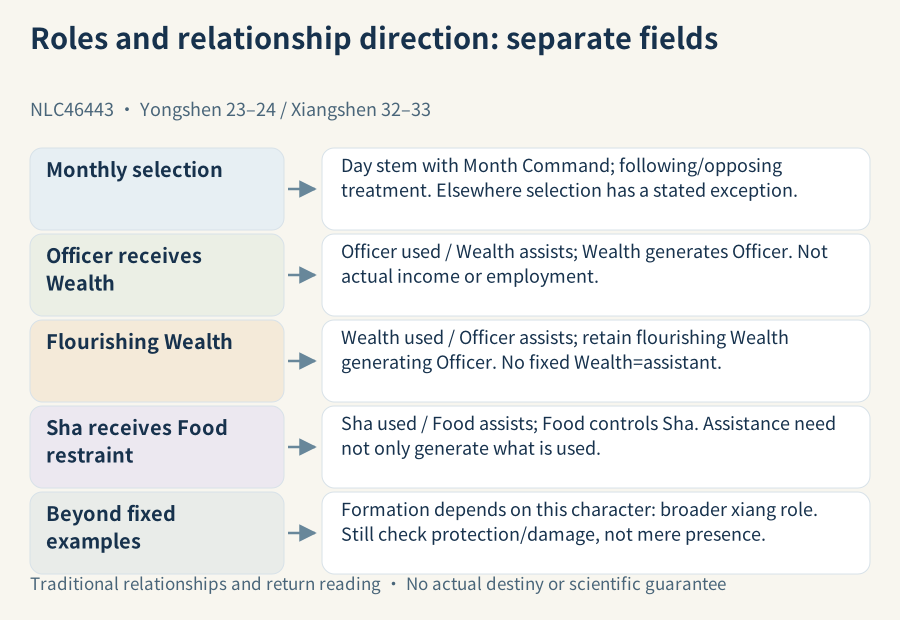
The complete figure is shown below. Select it to enlarge the labels. Open full-size figure · PNG
The text broadens the role immediately after its fixed examples
The same paragraph continues “然此乃一定之法,非通變之妙。要而言之,凡全局之格,賴此一字而成者,均謂之相也.”[3] It distinguishes fixed examples from the subtleties of adaptation and broadens xiang to the character on which the whole configuration's formation depends. “However” prevents three examples from becoming an exhaustive list.
The broader role is not permission to call any factor an assistant. The criterion still requires identifying which configuration depends on which character and operation. Presence alone does not establish that a factor already performs the role.
Scan 33's continuation summarizes assistance after particular examples, discussing unbroken xiangshen and damage in relation to configuration formation/failure.[4] These are the work's traditional assertions. We distinguish tasks of protection and damage without making them reliable predictions of actual success or failure. Evaluating assistance still returns to its particular operation rather than treating all factors identically.
Put role and operation in different fields
A study card can record selection entrance, factor used, assistance on which formation depends, its operation, and further protection/damage/adaptation qualifications. Officer receiving Wealth has a Wealth-to-Officer generating arrow, with Officer-use/Wealth-assistance in separate role fields. Flourishing Wealth generating Officer retains that direction while changing the role fields according to its own entrance. Diagram arrows mark traditional relationships and return reading, not real causal mechanisms.
Food restraining Sha demonstrates that effective assistance need not only generate the principal factor. Effective still means functioning in the book's configuration argument, not a guarantee of actual wealth, health or happiness. Primary/assisting roles and generating/controlling directions are different dimensions; separate fields prevent one from hiding the other.
Table, diagram, translation and interpretation are original, without facsimiles or modern commentary copied. We have not collated every yongshen/xiangshen occurrence in the book. Its read definitions are not automatically equivalent to identical words in other texts, and names, selection entrances or noble-configuration language do not establish scientific prediction.
Sources and further reading
NLC46443, Lun yongshen, scan 23, printed 10: monthly/day-stem entrance, following/opposing categories and fitting treatment. View the opening
Scan 24, printed 11: criticism of arbitrary selection and the explicit Wood/Yin–Mao alternative. Scan 25's new section is not merged backward. View the exception
Lun xiangshen jinyao, scan 32, printed 19: primary/assisting roles, three examples and the subsequent fixed/adaptive distinction. Punctuation is ours. View the definition
Scan 33, printed 20: particular examples and assistance protection/damage summary, ending before Mixed-Qi. View the continuation
Object catalogue and actual scan 74 imprint: January 1926 Qin/Wenming publication/distribution, with main-text responsibility distinct from modern commentary.
See the existing Yuanhai–Ziping yongshen comparison, or return to Clash and combination paths. Return to Text Editions and Method; subsequent reading continues through actual sections and their identified sources.
Evidence and source roles
These roles distinguish ancient text, older commentary, historical scholarship and tool reproduction. The numbered notes in the article retain the precise scan pages and explanations. Library and academic sources do not endorse predictive claims.
- ZP1-P23 · Ancient text evidence: 論用神
Text layer in the witness: Ancient main text / attached discussion, single-line print; actual heading and qualification boundaries retained - ZP1-P24 · Ancient text evidence: 論用神
Text layer in the witness: Ancient main text / attached discussion, single-line print; actual heading and qualification boundaries retained - ZP1-P25 · Ancient text evidence: 論相神緊要
Text layer in the witness: Ancient main text / attached discussion, single-line print; actual heading and qualification boundaries retained - ZP1-P26 · Ancient text evidence: 論相神緊要
Text layer in the witness: Ancient main text / attached discussion, single-line print; actual heading and qualification boundaries retained - ZP1-P06 · Ancient text evidence: 刊记
Text layer in the witness: Actual independent end colophon: publication/distribution and other separately arranged fields - ZP1-B01 · Library catalogue fields imported by Commons: NLC46443 combined Yuanhai/Ziping volume 2 object and imported NLC catalogue