In the passages examined here, the shared word 用神, yongshen, does not authorize direct substitution. First ask whether a sentence sets a protection requirement or defines how to select a factor, where it locates that factor and what its neighbors say about cooperation.
We compare the Jishan pian in the 1634 Yuanhai ziping with 論用神 and 論相神緊要 in the Ziping zhenquan printed in a 1926 combined witness collated by Qin Shen'an. The latter is an identifiable later witness, not a Qing original printing located in this study. These pages cannot establish the history of every occurrence of yongshen in either work.
The selected Yuanhai passage sets a requirement
In the 1634 witness, juan 2, scan 2, left half, the large text reads 用神不可損傷,日主最宜健旺. [1] Our translation is: “The factor being used must not be damaged; the Day Master is preferably sound and vigorous.” The sentence principally makes a demand.
Its adjacent small note considers monthly Officer, Wealth and Resource cases, retaining a requirement for a strong Day Stem. [2] Here, yongshen has not become an arbitrarily chosen color, material or “lucky element” detached from the monthly command and specific relations.
Yet the selected large sentence does not give an exhaustive definition of how to select it. The note reveals several referents; it does not prove that every Yuanhai occurrence contains only those three categories or matches another work's complete classification.
The selected Zhenquan passage states the starting point
Scan 23, printed page 10, of the 1926 Zhenquan object bears the heading 論用神. It begins 八字用神,專求月令,以日干配月令地支,而生尅不同,格局分焉. [3] Punctuation is ours.
Our translation: “Seek the eight-character chart's yongshen specifically in the monthly command. Match the Day Stem with the month's Earthly Branch; distinctions in generation and control differentiate the configurations.” This adds an explicit selection instruction beyond the selected Jishan sentence's protection requirement.
The following text classes Wealth, Officer, Resource and Food as 用神之善而順用之者, favorable yongshen to be used in a following manner. It also classes Killings, Hurting Officer, Blade and Rob Wealth as 不善而逆用之者, unfavorable yongshen to be handled in an opposing manner. [3] Translating every instance as “an element that always benefits the Day Master” would leave those distinctions unexplained.
“Favorable” and “unfavorable” describe this passage's technical categories. They are not moral ratings of people. The occurrence of a Ten God does not establish that someone is good or dangerous. The text discusses arrangements of factors; judgments about real people need independent factual evidence.
Xiangshen separates selection from assistance
Scan 32, printed page 19, bears the heading 論相神緊要. It begins 月令既得用神,則別位亦必有相,若君之有相,輔我用神者是也. [4]
Our translation: “Once the monthly command provides the yongshen, other positions must also have an assistant, as a ruler has a minister: it assists the yongshen being used.” The ruler-and-minister image assigns roles. An assisting factor in another position cooperates with the selected monthly factor. Xiangshen is not simply a second, luckier yongshen or an arbitrary extra elemental preference.
Three neighboring examples make the distinction concrete:
| Relation in Zhenquan | Factor called yongshen | Factor called xiangshen |
|---|---|---|
| Wealth generates Officer | Officer | Wealth |
| Strong Wealth generates Officer | Wealth | Officer |
| Food controls Killings | Killings | Food |
Officer and Wealth exchange roles in the first two examples. [4] A role belongs to the configuration being discussed; we cannot permanently label “Wealth” and carry that label into every passage. The third example shows assistance through restraint. Helping does not require arranging every factor along a single chain of generation.
The text then qualifies these examples with 然此乃一定之法,非通變之妙, saying that this is a fixed method rather than the subtlety of adaptable treatment, before giving situations requiring attention to the whole configuration. [4] Our table preserves three inspected examples. It is not an exhaustive xiangshen program or a formula for scoring any chart.
A shared monthly concern still needs context
There is a real basis for comparison: the Jishan note discusses monthly Officer, Wealth and Resource; the Zhenquan main text explicitly selects from the monthly command and separately describes assisting factors. [2–4] That lets us ask more precise questions without claiming the passages have no relationship.
The similarities remain bounded. The earlier selected large text stresses protection and the Day Master's state, with the note adding monthly cases. The later selected main text directly describes selection, following and opposing treatment, then defines assistance in another section. Summarizing all of this as “the classics say to add a favorite element” would lose content from both sides.
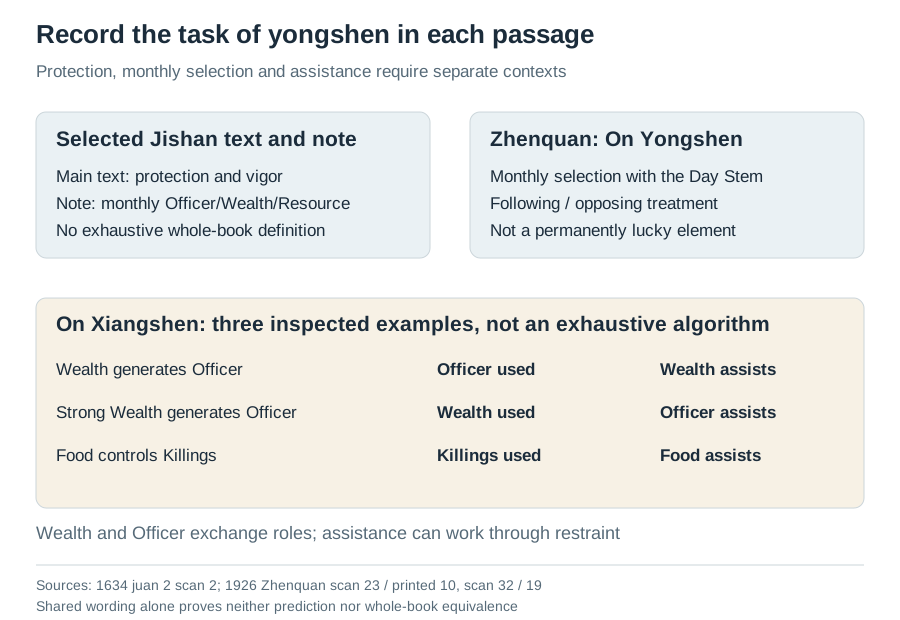
The complete figure is shown below. Select it to enlarge the labels. Open full-size figure · PNG
Keep three questions on a terminology card: Where is this sentence? What task does the word perform here? Which conditions would change if another passage's definition were substituted? Only then compare commonalities or differences.
The text explains how climate enters its account
The selected Zhenquan material does not conceal climatic considerations. Scan 31, printed page 18, bears 論用神配氣候得失 and opens 論命惟以月令用神為主,然亦須配氣候而互參之. [5]
Our translation: “In discussing a chart, take the monthly yongshen as primary, but also consider climate in conjunction with it.” This gives a local textual basis for their relationship. It does not say that suitable cold or warmth removes the need to examine configurations, or that every selection should be renamed climate adjustment.
Similarly, the Jishan preference for a vigorous Day Master cannot simply be replaced by Zhenquan's instruction to seek in the monthly command. One describes the Day Master's state; the other gives a selection starting point. Both tasks can exist. Establishing how they cooperate within a complete account requires further connected reading, not one word substitution.
Configuration, strength and climate are question axes used here to examine a sentence's task. They are not permanent school labels assigned to the two books.
Two fictional terminology cards reveal a substitution error
These are reading cards, not chart readings or career and financial advice.
Card A says: “Yongshen always benefits the Day Master; anything that controls it must be excluded.” Insert that card into the Food-controls-Killings example and the relationship can be misread as damage to yongshen. The passage instead calls Killings the yongshen and Food the assistant. The unified definition conceals the assigned roles.
Card B says: “In this Zhenquan example, Killings is used and Food assists it. In the selected Yuanhai monthly-Officer note, first examine why that Officer is to be protected.” Each entry is checkable against its own location. We can still investigate shared structural concerns without erasing differences in advance.
This also matters in translation. “Useful factor” needs a passage-specific explanation of its role. “Lucky element” introduces a guarantee of fortune that the sentence does not provide. “Assisting factor” can convey xiangshen, provided the translation retains which yongshen it assists.
The comparison we can retain
In the inspected passages, Yuanhai's large text requires protection and vigor, with its note providing monthly cases. Zhenquan states monthly selection, following or opposing treatment and assistance more explicitly. A shared technical word may express corresponding concerns while still requiring role-by-role comparison.
We do not claim that the books never share a usage, or that every term in both has been collated. The bilingual explanations, table and diagram are our work. Reading these historical technical relationships does not establish that birth information reliably predicts real outcomes.
Sources and related reading
1634 Shanchengtang witness, juan 2, scan 2, left half, Jishan pian large text. View the passage
Small double-line note in that location, monthly Officer, Wealth and Resource cases and the strong-Day-Stem condition. View the note
1926 Qin Shen'an combined witness, Ziping zhenquan object, scan 23, printed page 10, 論用神 main text. View selection
Same object, scan 32, printed page 19, 論相神緊要; continuation on scan 33. View assisting factors
Same object, scan 31, printed page 18, opening of 論用神配氣候得失. View the climatic relationship
Object catalogue naming Qin Shen'an, Wenming Book Company and 1926. The later witness must not be described as an original Qing printing. View its catalogue
For layered reading, see main text and old note. Review the Day Master and Ten Gods before analyzing the relations.
Evidence and source roles
These roles distinguish ancient text, older commentary, historical scholarship and tool reproduction. The numbered notes in the article retain the precise scan pages and explanations. Library and academic sources do not endorse predictive claims.
- YH3-P01 · Ancient text evidence: 繼善篇
Text layer in the witness: 下欄大字正文 - YH3-P02 · Older commentary evidence: 繼善篇
Text layer in the witness: 正文區雙行小注 - YH3-P10 · Ancient text evidence: 論用神
Text layer in the witness: 正文篇题与单行正文 - YH3-P11 · Ancient text evidence: 論相神緊要
Text layer in the witness: 正文篇题与单行正文 - YH3-P12 · Ancient text evidence: 論用神配氣候得失
Text layer in the witness: 正文篇题与单行正文 - YH3-B02 · Library catalogue record: NLC1926 Yuanhai/Ziping combined volume2 catalogue