If two texts bear the title 喜忌篇, Xiji pian, and contain corresponding sentences, what can we compare? Verify each actual heading, check a continuous passage and record its notes and section boundaries. A similar title or search result cannot replace those steps.
We compare the 1634 Shanchengtang Yuanhai ziping with the Sanming tonghui witness collated by Qin Shen'an and issued by Wenming Book Company, catalogued as 1926. [1–4] This is a local comparison of two selected witnesses, not a reconstruction of the complete earliest texts of both works.
Find the heading before naming the passage
The Yuanhai heading appears in juan 1, scan 30, left half; its text continues on scan 31, right half. [1] The selected Sanming object has 345 PDF images. Its independent 喜忌篇 heading appears in juan 11, scan 288, printed page 47. [2,4] Scan numbers identify electronic image order; printed numbers identify pages in the book. Preserve both with the correct witness.
On the right of that Sanming page, the preceding Mingtong fu still has large text with small double-line notes. After the Xiji heading on the left, the text is single-line. [2] The presence of small type elsewhere on the page does not give every Xiji sentence the same embedded notes. That would cross the section boundary.
The selected passage on the right half of Yuanhai scan 31 does have large text with double-line old notes. [1] This is a checkable layout difference; a modern contents list is unnecessary to assign annotation layers.
Align a genuinely continuous passage
Our selection runs from 有見不見之形 to 其殺/煞反為權印. All punctuation below is ours. The table's rows organize comparison rather than reproduce physical printed columns.
| Aligned position | 1634 Yuanhai large text | Selected Sanming main text |
|---|---|---|
| 1 | 有見不見之形,無時不有。 | 有見不見之形,無時不有。 |
| 2 | 神煞相絆,輕重較量。 | 神煞相絆,輕重較量。 |
| 3 | 若乃時逢七殺,見之未必為凶。 | 若乃時逢七煞,見之未必為凶。 |
| 4 | 月制干強,其殺反為權印。 | 月制干強,其煞反為權印。 |
These four sayings occur consecutively in Yuanhai scan 31, right half, and in the same sequence after the Sanming heading on scan 288. [1–2] They are not assembled from distant fragments to manufacture a “shared original.”
Our shared passage translation is: “There are visible and unseen forms, present at all times. The symbolic factors are entangled; weigh their relative significance. If Seven Killings occurs in the hour, its appearance need not be adverse. When the month restrains it and the stem is strong, that Killing instead becomes an emblem of authority.” The last phrase retains 權印 as authority imagery rather than silently identifying it with Resource.
The connectives matter in both witnesses. 若乃 introduces a situation, 未必 prevents immediate certainty and 反 marks a reversal. Their shared sequence permits a comparison of the passage's organization. The previous phase's dedicated reading examines the conditions in detail; here the focus is attribution and inclusion in each collection.
Record 殺 and 煞 separately as printed. They occupy corresponding Seven Killings positions. The character difference alone does not prove different restraint mechanisms. A separate search-normalization field may group them under one term while the quotations retain their forms.
Which witness owns the explanations?
In the selected 1634 Yuanhai passage, small type elaborates the Officer/Killings relations, occurrence in the hour and conditions of restraint. [1] These are annotations in this witness. Corresponding main text does not make them explanations printed in the selected Sanming passage too.
No corresponding double-line note follows the Sanming Xiji heading. The poem continues through scans 289 and 290 and closes in the upper portion of scan 291, printed page 50, before an independent Jishan pian heading. [2–3] The inspected poem uses single-line main text. The preceding Mingtong fu shows that the object can print double-line notes, but this does not identify a compiler's intention to remove them from Xiji.
We can report that the selected location does not print the corresponding embedded notes. We cannot infer that an original author never needed those conditions or that a compiler opposed Yuanhai's explanation. Establishing omission, relocation or different sources requires more witnesses and compilation evidence than this study supplies.
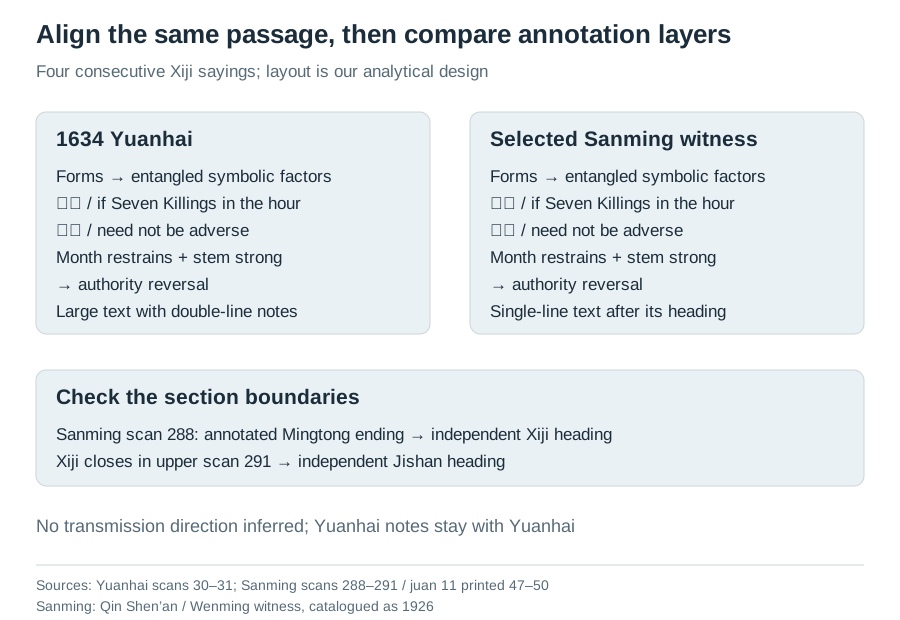
The complete figure is shown below. Select it to enlarge the labels. Open full-size figure · PNG
Fewer printed notes do not necessarily make a passage unconditional. 若乃, 未必 and 反 remain in its main text. Readers can examine neighboring material in the same book, but should not import a note from another work and then call it part of this source.
Bound the phrase “the same poem”
The headings match, and the selected passage has corresponding order and principal wording. That is a substantive result. It supports describing this location as corresponding material from a same-titled poem included in two witnesses.
Here, “the same poem” does not mean every character of both complete poems has been verified as identical. The observed character difference already deserves recording. Additions, omissions, rearrangements and word changes elsewhere require further collation.
Matching sentences also do not establish transmission direction. Comparing a 1634 printing with a witness catalogued as 1926 does not show that the later copy directly borrowed from that particular earlier printing. Formation of a work, choice of its source and publication of a later edition are different dates. Shared wording alone does not establish personal authorship either.
The selected Sanming catalogue names Qin Shen'an as collator and Wenming as issuer; its cover names the book company. No separate 1926 imprint statement was inspected here. [4] We therefore retain “catalogued as 1926,” keep preface and publication dates distinct and do not project this layout onto a specific Wanli original printing.
Repetition is not independent empirical verification
Two texts containing “its appearance need not be adverse” establish that the limitation occurs in both selected passages. They do not supply two independent real-world experiments supporting prediction.
Texts may share material; studying that relationship requires witness evidence. Establishing a reliable relationship between birth information and real events requires separate empirical work. Two corresponding quotations are not two successful forecasts and should not become “the classics agree, so this must work.”
Read historical language about rank, fortune and authority as part of its technical and social setting. We can analyze the organization of conditions without applying unsupported class-value or ability judgments to real people.
A reproducible side-by-side reading card
The following is a fictional reading note.
Column A records the four Yuanhai sayings, juan 1, scan 31, right half, with notes in another field. Column B records the Sanming passage, juan 11, scan 288, printed page 47, retaining 七煞 and 其煞. Column C records its heading and ending boundary. Only column D concludes: “The main-text organization corresponds; the selected witnesses have different annotation layers.”
Changing D to “the books are completely identical” would require complete comparison. Changing it to “the Sanming author adopted every Yuanhai note” would require annotation and attribution evidence not found here. The card can be short, but every conclusion needs its own source scope.
The method is portable: align shared wording continuously, record differences by witness and keep explanations in their own layer. This already prevents mixed quotations without presenting limited reading as a complete critical edition.
Sources and related reading
1634 Shanchengtang witness, juan 1; Xiji heading on scan 30, left half; selected passage on scan 31, right half, main-register large text and double-line notes. View the passage
Qin Shen'an/Wenming Sanming tonghui witness, catalogued as 1926, juan 11, scan 288, printed page 47: Xiji heading and four consecutive sayings; Mingtong fu ends on the right. View the opening
Same object, scan 291, printed page 50: Xiji closes before the independent Jishan heading. View the boundary
Object catalogue and mechanical public-domain scan designation, holdings MG/B992.3/15/:2,4. Catalogue publication and preface dates remain separate. View the object identity
For the passage's connected conditions, see why the Xiji sayings need connected reading. For notes, see main text and old explanation.
Evidence and source roles
These roles distinguish ancient text, older commentary, historical scholarship and tool reproduction. The numbered notes in the article retain the precise scan pages and explanations. Library and academic sources do not endorse predictive claims.
- YH3-P08 · Ancient text evidence: 喜忌篇
Text layer in the witness: 下欄连续大字;双行旧注另记 - YH3-P09 · Ancient text evidence: 喜忌篇
Text layer in the witness: 独立篇题后单行正文 - YH3-P13 · Ancient text evidence: 喜忌篇结束/繼善篇起首
Text layer in the witness: 独立篇题与篇界 - YH3-B03 · Library catalogue record: NLC Sanming Qin/Wenming witness catalogue