A character may differ only in display form, or it may determine which lookup item a verse names. Reading 論起玉堂天乙貴人 requires separate records for the source glyph, another witness's reading and the interpretation we propose to use, rather than an immediate clean table.
This article follows the first phase's uncertain-character evidence at two local positions; it does not repeat the auxiliary-star instructions. The historical Noble Person label does not guarantee help from an actual person.
Two positions with different evidence
In the 1634 Shanchengtang witness, juan 1, scan 15, right half, the main-register heading is 論起玉堂天乙貴人. The strings 甲戊庚牛羊 and 辛逢馬虎 remain readable. The character after 乙己 has a 處-like form, while an isolated character before 辛 sits at the end of the preceding physical column. Each needs its own record. [1]
We conservatively transcribe the selected strings as 乙己[疑字]猴鄉 and [疑字]辛逢馬虎. The bracketed marker means “unresolved character” and is ours, not original printing. The first slot retains 處/鼠 candidates and notes the observed 處-like form; the second retains 大/六 candidates. Familiarity with a verse does not resolve both slots automatically.
In the 1926 Qin Shen'an witness, volume 1, scan 41, printed page 22, the same heading's large text reads 乙己鼠猴鄉 and 六辛逢馬虎. [2] Those are actual readings in another witness. They assist comparison but do not transform the earlier image's ink into 鼠 or 六.
The evidence therefore has different identities: 鼠 and 六 are readable characters in the 1926 witness; the two 1634 slots remain locally qualified here. The first gives a difference to investigate. The second does not yet establish a confirmed 大/六 variant. “Readable in another witness” must not become “uniquely readable in the base image.”
Transcription, normalization and emendation change different things
Keep separate fields rather than repeatedly overwriting one text:
| Field | Example here | Effect on mapping |
|---|---|---|
| Source transcription | 1634 乙己[疑字]猴鄉, with a 處-like candidate | Records the reading limit without supplying an animal |
| Display normalization | Display 鄉 as 乡 and 馬 as 马 | Changes character presentation while retaining the word |
| Other-witness reading | 1926 乙己鼠猴鄉 and 六辛逢馬虎 | Identifies that copy's wording without overwriting the base |
| Proposed reading | Suggest 鼠 for the unresolved slot, with grounds and confidence limit | Adds a semantic choice pointing to Rat |
| Lookup interpretation | Rat → Zi; Monkey → Shen; Horse → Wu; Tiger → Yin | A separate animal-to-branch interpretation |
Displaying 鄉 as 乡 generally preserves the word. Replacing a 處-like unresolved slot with 鼠 introduces an animal that has not yet been uniquely established in the source. These operations must not both be called a traditional-to-simplified conversion.
Even if that slot is ultimately established as 處, its simplified display would be 处. Replacing 处 with 鼠 would still be an emendation choice. If the original image instead supports 鼠, that would update the transcription result. In either case, preserve the original record and the grounds for revision so readers can locate the changed layer.
A proposed emendation does not prove that an earlier printer made an error merely because a later witness differs. A copying difference, damaged image, carving error or insufficient glyph recognition would need specific evidence. We do not establish a cause here.
Where the lookup starts to change
In the selected 1926 sentence, Yi and Ji form the lookup group; Rat and Monkey are the animal targets. Under the conventional animal-to-branch correspondence, Rat means Zi and Monkey means Shen, yielding Yi/Ji → Zi/Shen. [2–3]
That is an interpretation from readable words to table entries. Treating the earlier unresolved slot as Rat is what allows Zi to enter its complete mapping. Label that as an interpretation assisted by another witness or as the lookup convention adopted, rather than proof that every 1634 character is uniquely legible.
Under the current conservative transcription alone, the first target after Yi/Ji remains unresolved; Monkey's Shen target can be retained separately. A local gap does not require discarding the entire sentence, nor does the known second target justify supplying the first.
This distinction matters in automated organization. A parser accepting animal names should report an unmatched token or uncertain slot for the 處-like reading. Silently replacing it with Rat at input and producing an unqualified table would present more certainty than the image supports.
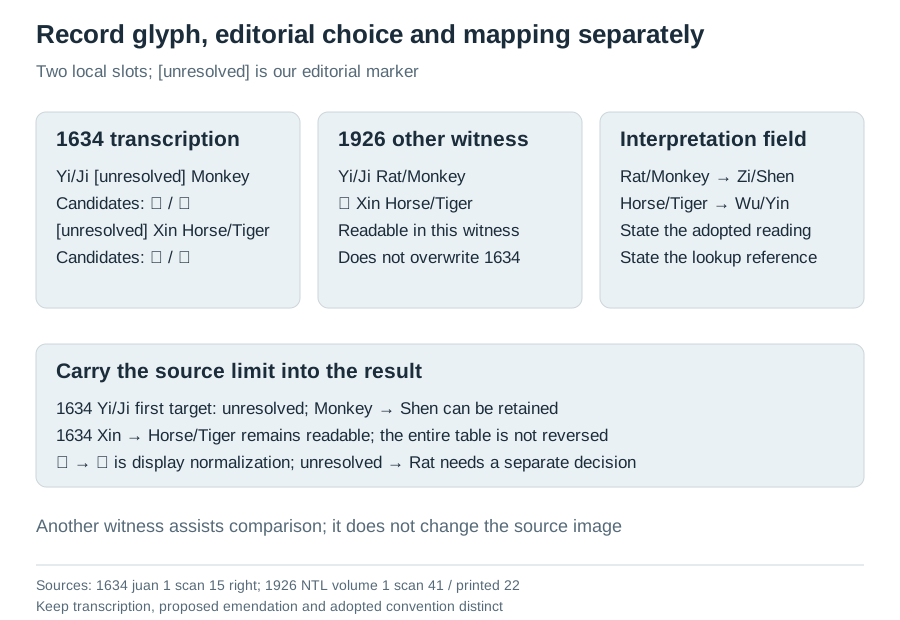
The complete figure is shown below. Select it to enlarge the labels. Open full-size figure · PNG
The character before Xin does not overthrow every target
Xin, Horse and Tiger remain readable in the selected 1634 string 辛逢馬虎. The later witness's 六辛逢馬虎 provides a readable 六 for comparison. [1–2] The earlier isolated character still retains 大/六 here; the later copy does not determine it.
Within this readable local string, the connection between Xin and Horse/Tiger survives that uncertainty. It would exaggerate the evidence to claim that one uncertain character reverses the entire Noble Person table. The slot concerns how the preceding expression is read; the Xin-to-Horse/Tiger target information remains separately recordable.
One uncertain slot can affect whether a target is established. Another need not change a currently readable target. Assess the actual position rather than enlarging every historical character difference into a rule-system conflict.
This part of the poem also does not fix one exclusive Year-Stem or Day-Stem reference for every use. An applied lookup needs its adopted reference and rule source recorded separately. Confirming a target mapping does not automatically settle the reference point.
A fictional database exercise
This is a reading-record example, not a calculated birth chart.
Record A keeps the 1634 source, Tianyi heading, scan 15, right half; transcription 乙己[疑字]猴鄉; a 處-like candidate; first target unresolved and second target Shen. It preserves both known material and the first target's gap.
Record B keeps the 1926 source, scan 41, printed page 22; transcription 乙己鼠猴鄉; interpreted mapping Yi/Ji → Zi/Shen. It represents another actual location rather than an overwrite of A.
Record C proposes reading A's slot as Rat on the basis of B and the conventional lookup. It does not claim that A's image proves 鼠 or a printer's error. If a site displays that proposal, label it “proposed reading” or “adopted lookup convention.”
The three records may link to one another. Do not delete A and retain only C's clean result. Software adopting a rule table should also keep that table's version distinct from the classical quotation.
A qualified result is still useful
The new contribution is a readable 鼠 and 六 at two genuinely corresponding positions in the later witness, with a statement of what they support and what they cannot establish about the earlier image. This adds a traceable evidence chain beyond another familiar Noble Person table.
An unresolved field is not a failed reading. It prevents glyph uncertainty from becoming unqualified rule certainty. A clearer image or additional witness can later change only the affected slot. This is local textual work, not a complete collation or a guarantee of real-world results.
Sources and related reading
1634 Shanchengtang witness, juan 1, scan 15, right half, 論起玉堂天乙貴人 large text. The slot after Yi/Ji retains a 處-like candidate; the isolated pre-Xin slot retains 大/六. Brackets are ours. View the source page
1926 Qin Shen'an witness, volume 1, scan 41, printed page 22: 乙己鼠猴鄉 and 六辛逢馬虎 under the same heading. Open the library reading entry
Our animal-to-branch interpretation: Rat/Monkey → Zi/Shen and Horse/Tiger → Wu/Yin. This is an explanatory field, not added ancient wording. Earthly Branch reference
Catalogue naming Qin Shen'an, Wenming and 1926, registration 31111003618756. Images are inspected rather than republished here. View the object identity
For labels and interpretation, revisit auxiliary stars in the whole chart. For a first reading, see how to read Yuanhai ziping.
Evidence and source roles
These roles distinguish ancient text, older commentary, historical scholarship and tool reproduction. The numbered notes in the article retain the precise scan pages and explanations. Library and academic sources do not endorse predictive claims.
- YH3-P05 · Ancient text evidence: 論起玉堂天乙貴人
Text layer in the witness: 下欄大字正文 - YH3-P06 · Ancient text evidence: 論起玉堂天乙貴人
Text layer in the witness: 正文區大字 - YH3-P07 · Site lookup explanation: Animal-to-branch interpretation of the selected verse
- YH3-B01 · Library catalogue record: NTL1926 Yuanhai/Ziping combined volume1 catalogue