The Jishan pian sentence 用神不可損傷,日主最宜健旺 can look like a general rule ready to apply. Our translation is: “The factor being used must not be damaged; the Day Master is preferably sound and vigorous.” [1] Those two clauses alone do not fully determine what the “factor being used” is, or which relation would damage it. We compare the 1634 Shanchengtang witness with a 1926 witness collated by Qin Shen'an to identify where the main text stops and what the small-type note adds.
The comparison concerns two physically printed passages. The later witness's catalogue publication date is 1926; that is not the composition date of every classical sentence or note it contains. Its later date does not automatically make it a corrected answer to the earlier witness.
Establish two locations that can be checked again
In the 1634 witness, the passage appears in juan 2, scan 2, left half, at the opening of 繼善篇 in the main register. The two clauses use large characters, with a separate small double-line note beside them. [1–2] Cite them as “the 1634 large-text passage,” rather than treating every type size on the page as one quotation.
The other witness is available through the Taiwan eBook collection, with images from the National Taiwan Library. Its catalogue names Qin Shen'an as collator, Wenming as publisher and 1926 as publication year. Volume 1 has 207 scan images, registration number 31111003618756. [5] Scan 84, printed page 1, bears the title 評註淵海子平卷二 and begins 繼善篇. The two large-text clauses occupy the final column; their small-type explanation continues on scan 85, printed page 2. [3–4]
The two sets of scan numbers are not interchangeable. “Scan 2” and “scan 84” identify electronic images in different objects. The printed numbers 1 and 2 identify these pages in the later witness. Match the main text first and its note second, so the comparison concerns the same passage rather than similar search results.
What each layer does
Both selected large-text passages read 用神不可損傷,日主最宜健旺. They ask for protection of the factor being used and express a preference for the Day Master's vigor. [1,3] This short statement does not exhaust the method of identifying that factor or supply a numerical vigor threshold.
The nearby 1634 note begins 如月令有官不可傷: “If the monthly command contains Officer, it must not be damaged.” It then considers protection of Wealth and Resource in the monthly command, says that a useful factor in the pillars should not be damaged and retains a requirement for a strong Day Stem. [2] The corresponding 1926 note has these monthly cases too, physically continuing onto the next image. [4]
| Layer | Content | What this reading establishes |
|---|---|---|
| Large text | Do not damage the factor being used | A protection requirement, not a complete selection method |
| Large text | The Day Master is preferably vigorous | A preference without a fixed score or threshold |
| Small-type explanation | Protect Officer, Wealth or Resource in the stated monthly case | Several concrete referents for this paragraph |
| Small-type explanation | A strong Day Stem is still needed | Protection and the Day Master's condition remain related checks |
| Our analysis | Record the factor and conditions for each case | A modern analytical table, not an additional classical sentence |
The opening 如, “if” or “for example, when,” matters. The note introduces several monthly situations. Removing that word could turn them into a requirement that every chart simultaneously contain Officer, Wealth and Resource. Collapsing the three objects into an undifferentiated “good element” would also erase the relations being discussed.
The note's greater specificity does not mean that the large text already spells out all its conditions. A plausible relationship between text and explanation does not establish real-world predictive effectiveness either. Attribution, interpretive fit and empirical evidence require separate answers.
A page break can change the reading unit
The selected 1634 image lets us read the large text and neighboring note together in one half. The later witness leaves the large text on printed page 1 and continues its explanation at the top of printed page 2. [1–4] A screenshot of scan 84 alone keeps the sentence while losing its elaboration. A screenshot of scan 85 alone could encourage a reader to attach all the opening small type to the subsequent 年傷日干 sentence.
The sentence has not acquired a new meaning. The screenshot boundary has changed the available reading unit. Preserve the preceding page's final sentence, the next page's initial small type and the next large-text starting point. A note's target needs support from layout sequence and its actual content, rather than proximity alone.
Record the upper register separately as well. Both witnesses have small text above the main area; that physical layer does not automatically belong to our selected sentence or its embedded note. Type size, location and meaning help match passages. On their own they cannot establish authorship, composition date or the origin of an entire annotation system.
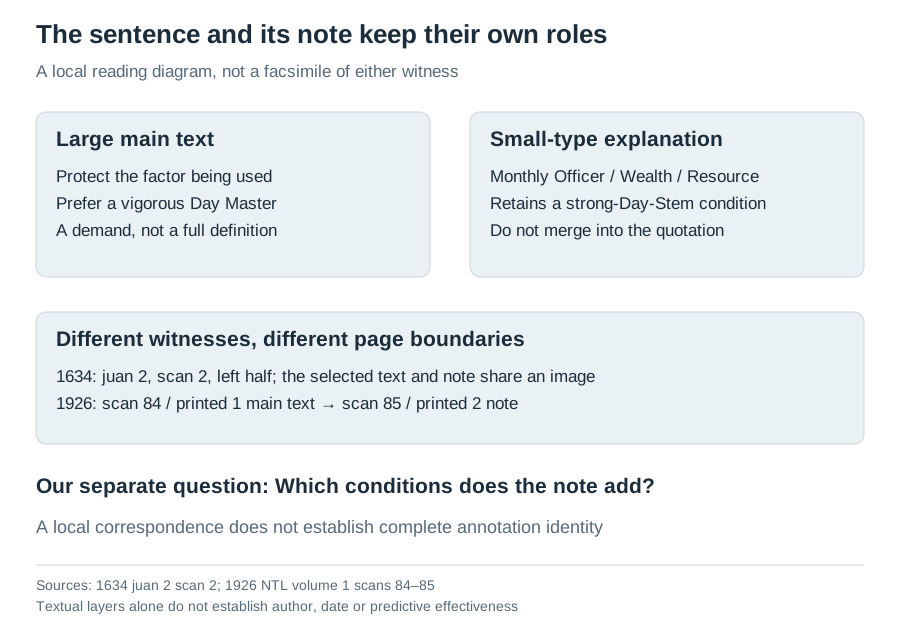
The complete figure is shown below. Select it to enlarge the labels. Open full-size figure · PNG
A local match is a bounded result
The selected main-text requirements match, and the selected notes have corresponding monthly-case structures. This supports a local conclusion: the later witness retains the relationship between text and explanation in the passage examined here.
It does not establish that the two witnesses' annotations are completely identical. Such a claim would require further comparison of characters, section boundaries, additions, omissions, relocations and notes on other pages. We have not transcribed the complete contents or collated the entire books.
Nor does the later volume's attribution make every note Qin Shen'an's composition. “Collator” is not the authorship of all printed material. We also describe the 1634 annotation by its physical layer without assigning an unsupported personal author.
“No change in this condition was observed in the selected passage” has a specific scope. “The later witness changes no conditions anywhere” requires work that has not been done.
A reading exercise without a birth chart
The following are fictional reading notes, not judgments about real people.
Note A says: “The sentence asks for protection of the useful factor, so every controlling relation is bad.” It moves from protecting a particular factor to rejecting all restraint. Neither the selected large text nor the Officer, Wealth and Resource cases establish that conclusion.
Note B says: “The note says not to damage monthly Officer, so only Officer can be used in every chart.” It turns one conditional situation into a universal definition. The adjacent Wealth and Resource cases already show what that reading leaves out.
Note C keeps three entries: “The main text asks for protection; this witness's note gives monthly Officer, Wealth and Resource cases; I still need to examine how this paragraph and neighboring sections identify the factor being used.” It produces no immediate life prediction, but every inferential step remains inspectable.
The exercise locates where a reader introduces new content. No fictional birth time is supplied, so there is no chart-calculation claim or suggestion that this teaching example predicts wealth, health or employment.
Keep the three voices available for comparison
Retain the wording and location when quoting the large text. Attribute the small type to “this witness's note.” Label translation and analysis as our work. When comparing witnesses, keep each sentence's identity too: a character supplied from the later copy must not silently become part of a quotation attributed to the 1634 printing.
Main text and notes can help explain one another. Keeping them distinguishable reveals which conditions a note adds and makes it possible to ask whether the explanation narrows, expands or preserves the sentence's scope. The next cross-text comparison rests on the same kind of local evidence.
Sources and related reading
1634 Shanchengtang witness, juan 2, scan 2, left half: Jishan pian large text in the main register. Punctuation is ours. View the page
The small double-line note in that location; monthly Officer, Wealth and Resource cases are recorded separately from the large text. View its position
1926 Qin Shen'an witness, volume 1, scan 84, printed page 1, 評註淵海子平卷二·繼善篇. Scan numbers refer to this object. Open the library reading entry
Same volume, scan 85, printed page 2, opening continuation of the small note; read with the preceding page's final sentence. Open the same volume
Taiwan eBook catalogue for the 1926 witness, registration 31111003618756. The institutional images are inspected, not republished here. View the catalogue
For connected conditions, see the Jishan pian paragraph. For the term's cross-text boundaries, see yongshen in Yuanhai and Ziping zhenquan.
Evidence and source roles
These roles distinguish ancient text, older commentary, historical scholarship and tool reproduction. The numbered notes in the article retain the precise scan pages and explanations. Library and academic sources do not endorse predictive claims.
- YH3-P01 · Ancient text evidence: 繼善篇
Text layer in the witness: 下欄大字正文 - YH3-P02 · Older commentary evidence: 繼善篇
Text layer in the witness: 正文區雙行小注 - YH3-P03 · Ancient text evidence: 繼善篇
Text layer in the witness: 正文區大字 - YH3-P04 · Older commentary evidence: 繼善篇
Text layer in the witness: 正文區小字注续文 - YH3-B01 · Library catalogue record: NTL1926 Yuanhai/Ziping combined volume1 catalogue