A quotation can be accurate and still be used badly. In Jishan pian, the sentence about Wood receiving Water is followed immediately by a limit on that support; the sentence about Metal receiving Earth does the same. The connective after both examples tells the reader what kind of conclusion to draw. Reading only the first halves changes the argument.
This second series looks at the work done by a paragraph, rather than introducing the relationships again. Our passage is in the lower, large-character text of juan 2, scan 10, right half, of the 1634 Shanchengtang witness. Punctuation, paragraph boundaries and the English below are our editorial choices. They should not be mistaken for punctuation printed in the woodblock. [1]
Begin with the kind of statement being made
Near its opening, the same chapter says that the four pillars “喜見財官” and that the day master “最宜健旺.” Our translations are “prefer the presence of Wealth and Officer” and “is especially suited to being robust.” [2]
The wording matters. 喜 expresses a preference in the traditional reading; 最宜 strengthens that preference. Neither word tells us that every possible occurrence of the named factor has the same effect. Nor does a preference, by itself, define the circumstances in which the book considers a configuration established.
The nearby old small-type annotation adds its own explanation of protecting factors in the month command, with different cases for Officer, Wealth and Resource. Its conditional cases belong to the annotation layer. A clean quotation of the large text should not quietly incorporate them. The annotation is nevertheless relevant evidence of how this printed witness guides its reader. [2]
Keep two records: what the large text explicitly says, and what this edition's annotation adds. That small habit prevents a modern explanation from becoming an invented original sentence.
Read the support and its limit as one unit
The selected passage reads:
“木從水養,水盛而木則漂流。金賴土生,土厚而金遭埋沒。是以五行不可偏枯,務稟中和之氣。”
Our translation: “Wood receives nourishment from Water; when Water is abundant, Wood then drifts. Metal depends on Earth for generation; when Earth is thick, Metal is buried. Therefore the five phases should not become one-sided and depleted; the text calls for receiving a harmonious, balanced qi.” [1]
The passage has three moves. First it names an ordinarily supportive relation. Next it introduces a degree word that changes the described result. Finally it draws a general conclusion from the pair of examples.
In the first example, 盛 is the hinge. The sentence does not say that Water always causes drifting. It describes a Water-abundant condition. In the second, 厚 plays the corresponding role. The relation 土生金 remains the named premise, but “thick Earth” changes what the image emphasizes.
These are images within a historical explanatory system. 漂流 and 埋沒 make the change easy to picture. A literal claim about a present-day person's home, health or money would require a separate evidential argument that the passage does not provide.
| Part of the paragraph | What it contributes | What a shortened quotation loses |
|---|---|---|
| 木從水養 | A named supportive relation | The relation's ordinary direction |
| 水盛而木則漂流 | A degree condition and a changed image | The limit on increasing support |
| 金賴土生 | A second supportive relation | The parallel structure |
| 土厚而金遭埋沒 | A second degree condition | The repeated warning about excess |
| 是以 | A conclusion connected to the preceding examples | The reason the following summary appears |
| 不可偏枯、務稟中和 | The paragraph's stated norm | Its aim and the need for contextual judgment |
“Therefore” is a reading instruction
是以 is not decorative. It connects the demand for 中和 to what came before. Removing the Water and Earth examples and presenting “balance” as a freestanding slogan makes the argument less specific. The examples explain why a familiar relationship can be insufficient information for judging a whole configuration.
The conclusion is also narrower than a numerical formula. The passage gives no percentages, additive weights or threshold at which 盛 or 厚 begins. An element chart can summarize the calculator's own scoring convention; it cannot silently supply quantities that this paragraph never states.
The diagram below maps sentence functions. Its arrows represent the order of an argument, not the transfer of a measurable substance.
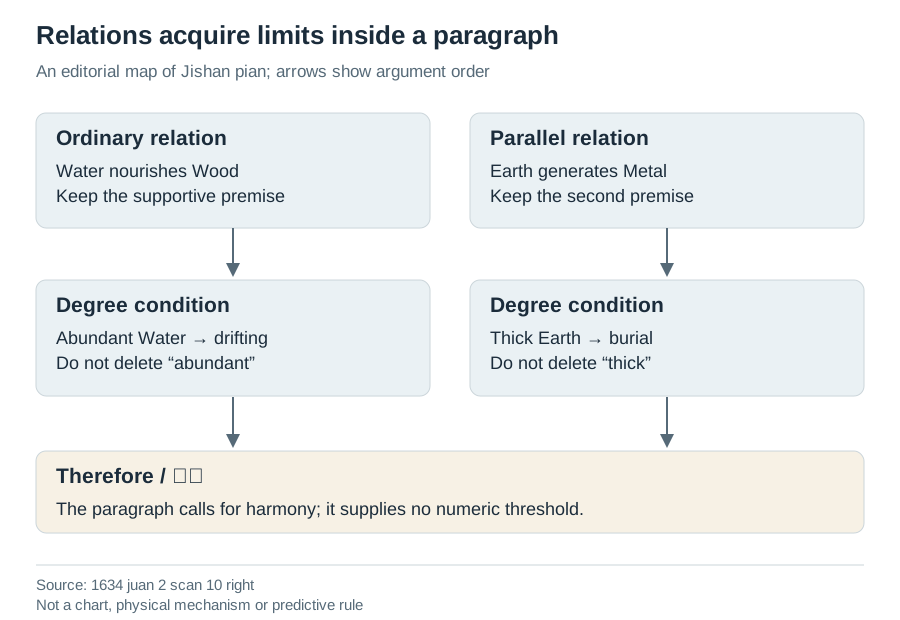
The complete figure is shown below. Select it to enlarge the labels. Open full-size figure · PNG
A close-reading exercise with three possible answers
This is a fictional text exercise, not a natal chart. A reader is given only the statement “Water supports Wood” and asked whether adding more Water improves the arrangement.
Answer A says, “Yes, because generation is favorable.” It identifies the first relation but ignores the condition introduced by 盛.
Answer B says, “No, because Water makes Wood drift.” It makes the opposite error. It treats the adverse image as universal and drops the degree condition attached to it.
Answer C says, “The relation is supportive in the passage's first clause, while abundant Water introduces a limiting case. The exercise has not supplied enough context to say which case applies.” It preserves both clauses and records the missing premise.
C is the defensible reading of the supplied text. It does not establish that a particular chart contains too much Water. That would require an inventory, seasonal context, the other relations and a stated interpretation method. The difference is between understanding a conditional sentence and proving that its condition holds.
Now replace Water/Wood with Earth/Metal. If your answer changes merely because the image changes from drifting to burial, reread the parallel syntax. Both examples ask you to retain the relation and its limit together.
Do adjacent sentences always limit each other?
They can, but adjacency alone is insufficient. Sometimes a text starts another example, introduces another category, or changes its reference. Here the paired syntax and 是以 support a connected reading. In other places, a reader must identify a connective, repeated subject, degree word or explicit shift before treating several sayings as a single argument.
That is why our paragraph is a selected reading unit rather than a claim about the original book's paragraph layout. We group these sentences because their syntax supports it. The physical scan remains available so that someone else can examine that decision.
A separate chapter, 正官論, begins in the left half of scan 10. Its separate heading is another important boundary. Continuing a quotation across that heading without identifying the change would join two different discussions. [3]
What to keep in a reading note
Write down the edition and scan; distinguish the large text from the annotation; preserve the condition alongside the result; explain why the chosen sentences belong together; and state which premise a proposed application still lacks.
The result is a more useful note than “Water is good” or “Water is bad.” It tells a later reader what the passage actually argues, where the argument changes direction, and how far the interpretation can go.
Sources and related reading
1634 Shanchengtang witness, juan 2, 繼善篇, scan 10, right half, lower large text. The quoted sequence and degree words were checked against the complete page render. View the source page
Same witness, juan 2, 繼善篇, scan 2, left half. Large-text preferences and the distinct small-type annotation were checked separately. View the opening page
Same witness, scan 10, left half, 正官論 heading. This establishes the local chapter boundary, not a complete table of contents. View the chapter boundary
For the relationship vocabulary, see the first-series reading on generation, control and transformation. For the starting seasonal inquiry, see the month-command framework.
Evidence and source roles
These roles distinguish ancient text, older commentary, historical scholarship and tool reproduction. The numbered notes in the article retain the precise scan pages and explanations. Library and academic sources do not endorse predictive claims.