“Read the surrounding text” is useful advice only if we can say what the surrounding text does. In the opening of Xiji pian, one saying gives a general instruction to weigh relations; the next applies that instruction to a particular position and condition. A subsequent saying moves into another subject. These are three different kinds of connection.
The 1634 witness places the 喜忌篇 heading near the end of the left half of juan 1, scan 30. The opening continues on scan 31, right half. This location is important: a modern chapter list from another edition cannot establish the juan number or heading in this one. [1]
First establish the reference and the task
The large text opens with “四柱排定,三才次分” and tells the reader to coordinate the stems and branches with the day-position heavenly stem. A later opening pair reads:
“有見不見之形,無時不有。神煞相絆,輕重較量。”
Our reading: the text considers both manifest and unmanifest forms, then asks the reader to weigh the relative significance of interacting factors. [2]
The edition's small-type notes give specific explanations and examples. They do not make every modern meaning of “auxiliary stars” interchangeable with the words 神煞 here. In the annotation beside the latter sentence, the discussion includes keeping or removing Officer and Killings. That is a local technical context, rather than a license to import every item in a contemporary star catalogue. [2]
At this point the task is comparative: distinguish relations and weigh them. The passage has not yet supplied a result for every possible mixture.
Then identify the condition in the next saying
Immediately after that instruction, the large text says:
“若乃時逢七殺,見之未必為凶。月制干強,其殺反為權印。”
Our translation: “If Seven Killings occurs at the hour, seeing it is not necessarily adverse. With restraint from the month and a strong stem, that Killings instead becomes a sign of authority.” [2]
若乃 introduces a case. 時 narrows its position. 未必 blocks an automatic adverse conclusion. The next clause adds 月制 and 干強 before 反為 describes a changed reading. None of these pieces can be dropped without making the sentence less conditional.
“Not necessarily adverse” is not the same as “always favorable.” The verse has suspended an immediate conclusion and supplied circumstances to investigate. It also gives no numerical probability. Translating 未必 as a low percentage of harm would add a quantity that is absent from the text.
權印 here is historical language of authority. It should not be casually substituted for the separate technical category 印綬, nor expanded into a promise of promotion. The wording describes the book's status-oriented interpretation. It provides no evidence that a symbol causes an actual appointment.
| Wording | Function in this case | Question it leaves the reader |
|---|---|---|
| 若乃 | Introduces a particular case | Is this the case under discussion? |
| 時逢七殺 | Specifies the position | Is the factor at the hour, or somewhere else? |
| 未必 | Rejects an automatic conclusion | What other conditions matter? |
| 月制 | Names a restraint condition | What relation is doing the restraining? |
| 干強 | Adds a strength condition | What evidence supports that assessment? |
| 反為 | Describes a reversal under the supplied conditions | Have those conditions actually been established? |
The annotation narrows the example further
The adjacent small-type annotation discusses a single occurrence at the hour, repeated appearances in other positions, a flourishing day stem and the importance of suitable restraint. These details explain how this edition understands the verse. They are an additional layer, rather than extra words secretly contained in the large sentence. [2]
This distinction changes a reading note. “The verse says an hour Killings can be interpreted differently under month restraint and stem strength” is supported by the large text. “This witness's annotation also asks about one occurrence and repetition elsewhere” is supported by the small text. The two statements have different sources even when printed beside one another.
It would be inaccurate to attach every one of those additional requirements to all Seven Killings references throughout the book without checking their individual passages. A local annotation can illuminate its local case without becoming a universal specification.
A limited comparison that tests what is missing
Partial structural exercise, not two computed birth charts: use Jia 甲 as a day-stem reference and Geng 庚 as the Seven Killings relation. The naming follows their Wood/Metal relation and matching polarity.
Exercise A places the Geng reference at the hour and stipulates both relevant month restraint and day-stem support. Exercise B keeps the same named day-stem/Killings relation but supplies neither of those conditions. We have deliberately left the other stems, branches and birth data unspecified.
For A, the verse's positive reversal becomes a question worth investigating. The stipulations still do not establish an actual chart, and the annotation's additional checks remain open. For B, the reader lacks premises for claiming the same reversal. B does not become demonstrably adverse merely because the premises have not been provided.
The comparison is useful because a list of names alone would make A and B look alike. A sentence containing a position and two conditions demands more information than that list contains.
Notice when the reading window changes
After this case, the text turns to Wealth, Officer and Resource being concealed in the four seasonal storehouses. The opening concerns a different grouping and location problem. Scan 31 then continues into further named arrangements on its left half. [3]
The general demand for careful weighing remains relevant as a reading attitude. But the new sentence is not automatically another condition of the preceding hour-Killings example. If we made it one, we would invent a combined rule requiring every hour-Killings case to have all three factors concealed in storehouse branches.
The diagram marks three windows: general task, particular conditional case, and subsequent topic. The windows are our analytical aid, not sections claimed to be printed in the original.
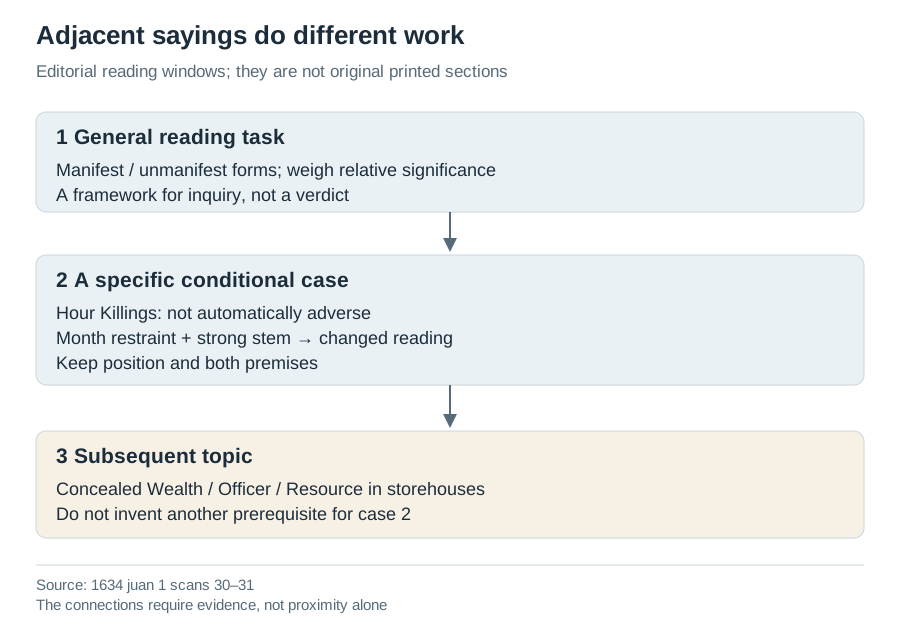
The complete figure is shown below. Select it to enlarge the labels. Open full-size figure · PNG
How much context should a quotation retain?
Enough to identify the subject, reference, position and conditions that govern the result. For this case, quoting only “其殺反為權印” removes the premises; quoting only “未必為凶” preserves a caution but loses the explanation of when the reading may change.
A responsible short citation can retain the full two-sentence case while separately explaining the previous weighing instruction and the next topic boundary. It need not reproduce several pages of verse to demonstrate that connection.
In your own notes, label an adjacent sentence as a general frame, an added condition, an illustration or a new topic. If the connection is uncertain, say so before constructing a larger rule. Close reading is more dependable when it records why sentences were joined, rather than simply joining everything nearby.
Sources and related reading
1634 Shanchengtang witness, juan 1, scan 30, left half, lower large text, 喜忌篇 heading and beginning. View the heading
Same witness, scan 31, right half, lower large text and separately read small-type annotations. This supports the quoted sequence and its local annotation context. View the conditional case
Same scan, right-half final large-text column and continuation on the left. The shift to concealed Wealth, Officer and Resource is a topic boundary, not an added prerequisite we impose on the preceding case. View the continuation
For the relationship names, see Officer, Killings and restraint. For a complementary paragraph exercise, see the conditions in Jishan pian.
Evidence and source roles
These roles distinguish ancient text, older commentary, historical scholarship and tool reproduction. The numbered notes in the article retain the precise scan pages and explanations. Library and academic sources do not endorse predictive claims.