A list of eight names can look like eight clean boxes that a calculator ought to recognize automatically. Shenqu ba fa offers something less tidy and more interesting: a vocabulary of configurations, accompanied by examples and limits. A reader still has to ask what earns each name, how the day stem and branches participate, and what the month, roots or later cycle changes.
In the 1634 Shanchengtang witness, juan 3, scan 15, right half, the heading lists 類、屬、從、化、返、照、鬼、伏. The explanations develop Type, Affiliation, Following and Transformation, then Illumination, Reversal, Ghost and Latency, continuing into scan 16. [1–3] The order of the list and the order of exposition differ slightly. Before making a modern chart, we should notice how this physical page actually organizes its material.
The English labels used here are our reading aids. They are not established scientific categories, and a single English word cannot carry all the conditions supplied by the Chinese example.
A configuration name begins a question
象 here is not an image already generated by a website, nor the name of one isolated branch. Each passage describes several relations and discusses circumstances that alter the reading. The name is therefore an invitation to inspect the example, rather than a result obtained by counting one kind of symbol.
Our task is to compare the grounds of classification. One passage considers a grouping of the same kind, another a different branch formation, another requires a rootless day stem, and another begins with a combination and its possible transformation. Those differences disappear if we retain the labels alone.
Large text, small interlinear annotation and upper-register additions also remain different textual layers. The table below is our editorial comparison of the large-text discussions. It does not turn everything printed around them into eight original computer instructions.
Why Type and Affiliation remain distinct
The 類象 example places Jia/Yi Wood alongside the complete Yin–Mao–Chen arrangement. It describes a same-kind configuration associated with the eastern direction and discusses interruption, damage and the subsequent cycle. [2] Its branch organization matters. “A lot of Wood” is too coarse a summary of the arrangement it actually names.
屬象 instead uses Jia/Yi with Hai–Mao–Wei. [2] Both groups include Mao, but Yin–Mao–Chen and Hai–Mao–Wei are different sets of branches. Reducing both to a Wood percentage removes information that the text uses to distinguish them.
Keep the named branch group before compressing anything into an element summary. A modern element chart may classify both under Wood for its own purpose. That tells us how the chart groups symbols; it does not establish that the original passages make identical claims.
Following and Transformation ask different questions
從象 asks whether the day stem has roots or support of its own. Its example uses rootless Jia/Yi with an all-Metal branch arrangement, then considers why the presence of roots prevents the same description from applying straightforwardly. [2]
化象 begins with particular stem combinations and discusses month, other factors and later cycles. In the Jia–Ji example, the appearance of a pair does not settle transformation. The passage also says that a cycle in which Jia/Yi Wood flourishes can leave the transformation uncompleted. [2]
Following therefore asks whether the specified rootless and following conditions hold. Transformation asks whether a particular combination sustains the described change under the example's seasonal and relational conditions. Both involve a changed organization of the reading, but that does not make them one binary switch.
| Name and our English aid | What its example first asks us to inspect | A check that should remain visible |
|---|---|---|
| 類 Type | Same-kind and directional arrangement, such as Yin–Mao–Chen | Interruption, damage and cycle changes |
| 屬 Affiliation | The named three-branch arrangement, such as Hai–Mao–Wei | Completeness and the other relations |
| 從 Following | Rootlessness and the factor followed | Roots or support that defeat the premise |
| 化 Transformation | The specified combination and change | Month, other factors, competing combinations and cycle |
| 照 Illumination | The example's stated positions and correspondence | Day stem, branch group, hour and scope |
| 返 Reversal | Month-command use redirected to an hour position | How the example specifies its “extinction” position |
| 鬼 Ghost | The particular Jia/Yi, autumn and Metal case | The distinction between flourishing Ghost and flourishing self |
| 伏 Latency | Ren, Yin–Wu–Xu, the fifth month and unexposed Ding | Rootlessness, non-exposure and the relation inside Wu |
This is not a complete set of decision rules. It also does not prove that the eight categories are mutually exclusive. The table preserves differences between the examples' leading questions; it does not assign every unmentioned chart to a category.
The remaining four require their particular examples
Illumination includes a particular day stem, branch group and hour position. Reversal considers the month-command factor brought to a specified hour position and discusses “using what is not used.” [2–3] Their suggestive names do not remove the need to read the actual case.
Ghost is especially easy to misread emotionally. The passage discusses Jia/Yi with autumn Metal and distinguishes a flourishing Ghost from a flourishing self. [3] 鬼 is a technical historical label here. Its presence is not evidence of a supernatural entity or a real-world threat.
Latency considers manifested and unmanifested relations together. The Ren-day example includes Yin–Wu–Xu and the fifth month, requires Ding not to be exposed among the stems and Ren to lack roots, then discusses Ding within Wu combining with Ren. [3] Quoting only “Ding inside Wu” would omit almost the whole case.
The historical text also uses status and life-and-death vocabulary around these descriptions. That tells us what its traditional system attempts to explain. It supplies no reliable evidence for diagnosing a present-day person's illness, predicting death or guaranteeing office. Our comparison does not adopt those claims.
Two partial exercises test the classification ground
Exercise A supplies Jia/Yi as a reference and the branches Yin, Mao and Chen. Exercise B retains Jia/Yi but substitutes Hai, Mao and Wei. These are fictional partial exercises. There is no birth input, and the other stems and branches have not been specified.
Asking whether both receive one label because they concern Wood misses the difference between the branch groups. A better answer records both arrangements separately and notes that the full passages' remaining conditions have not been supplied. It does not declare either configuration established.
Try another case: Jia/Yi and an all-Metal branch grouping are supplied, but the presence or absence of roots is unknown. “There is much Metal” cannot by itself justify Following. If further material reveals roots of the self, the rootless premise must be checked again. This is a test of a textual premise, rather than a claim that a real person's destiny has changed.
The exercises deliberately avoid dressing incomplete information up as complete natal charts. They isolate the kind of missing information that each classification question needs.
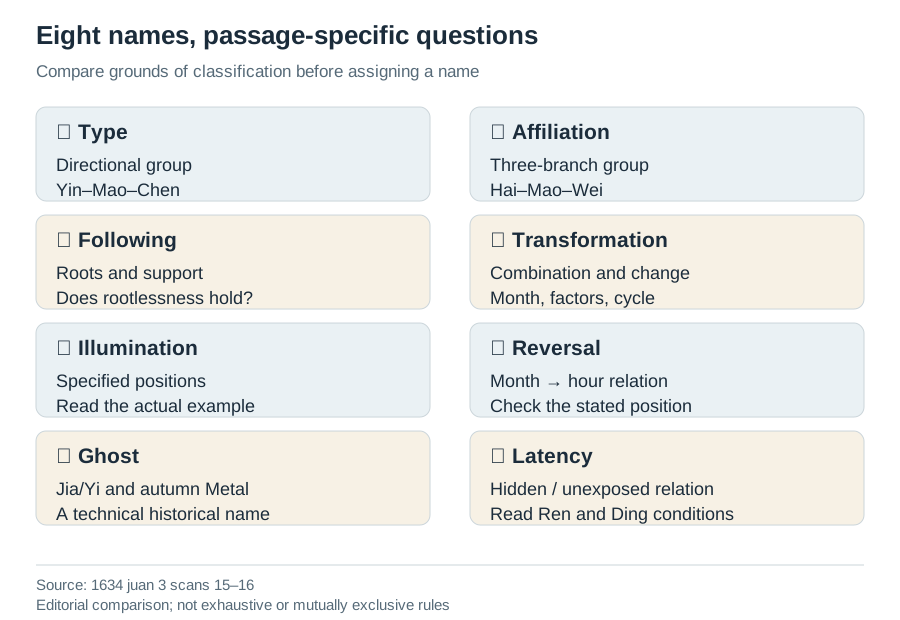
The complete figure is shown below. Select it to enlarge the labels. Open full-size figure · PNG
Why the table is still not software
A program needs specified inputs, determinate conditions, conflict handling and a defined output. If several local descriptions appear applicable, which takes priority? How are roots, flourishing, interruption and incomplete transformation operationalized? These pages alone do not provide one specification resolving all those questions.
An editor may prepare a comparative table. A developer may separately propose an implementation convention. The latter must be identified as modern, explain its tested scope and avoid suggesting that an eight-row table means the website has calculated all eight traditional methods.
For reading, finish the condition record of one passage before comparing another. Check whether the references and levels are actually the same. An unresolved classification can be more faithful to the source than a premature automatic label.
Sources and related reading
1634 Shanchengtang witness, juan 3, scan 15, right half, lower large text, 神趣八法 heading and list. View the heading
Same scan, right to left, large-text explanations of Type, Affiliation, Following, Transformation, Illumination and Reversal. Only the discussed examples and ordering have been checked for this article; the whole juan is not claimed to be collated. View the exposition
Same witness, scan 16, right half, continuation of Reversal, Ghost and Latency, followed by the separate 論格局生死引用 heading. View the continuation
For combination and change, revisit generation, control and transformation. For establishing prerequisites, see when a pattern is established.
Evidence and source roles
These roles distinguish ancient text, older commentary, historical scholarship and tool reproduction. The numbered notes in the article retain the precise scan pages and explanations. Library and academic sources do not endorse predictive claims.