A sentence that resembles a scene in nature has not thereby supplied scientific evidence. Wuxing yuanli xiaoxi fu uses floating Wood and buried Metal to make traditional relations imaginable. It also connects symbolic arrangements to judgments about status and human fortunes. We need to notice both activities: avoid treating the image as a demonstrated outcome, while not rewriting every historical prediction as harmless literature.
The heading 五行元理消息賦 appears in the lower right half of juan 3, scan 31, of the 1634 Shanchengtang witness. Its text continues through the left half and scan 32. [1] This article examines selected wording and relations. It is neither a complete translation nor a claim that the whole poem has been collated.
Begin with what an image invites us to picture
The large text on scan 31's left half includes the nearby strings 水泛木浮 and 土重金埋: our translations are “Water spreads, Wood floats” and “Earth is heavy, Metal is buried.” [2] Water, Wood, Earth and Metal are phase names, while floating and burial evoke visible physical situations.
That connection can produce a misleading argument: because wood can be seen floating on water, the entire claim about a birth chart and a person's life must be true. But these are separate questions. Floating wood can help explain a metaphor about support changing under degree conditions. It does not establish that birth symbols operate through the same physical mechanism, or that such a mechanism predicts an individual's experiences.
The words 泛 and 重 also matter. The images do not simply say “Water exists” and “Earth exists.” A modern paraphrase that makes every appearance of Water float Wood, or every appearance of Earth bury Metal, loses the degree language and changes the scope.
We quote only the short, legible strings needed here. The longer neighboring wording remains visible in the scan. We have not completed a smooth-looking quotation by importing another edition's sentence.
Image, position and conclusion are different layers
The same page also arranges polarity, branch positions and traditional flourishing, death or extinction terminology. Scan 32 continues with configurations, other relations and cycles. [2–3] One picture of floating Wood is consequently insufficient to describe the whole poem as a one-dimensional element-count model.
A useful reading note separates the image, the specified symbols or positions, the conditions and the traditional conclusion. Some lines principally describe a structure; others move into assertions about people's lives. Keeping the layers apart lets us see where that move occurs.
| Layer | How this article recognizes it | What it can support |
|---|---|---|
| Image | Floating, burial and other imaginable states | An account of how the historical text organizes a relation |
| Degree | Spreading, heaviness and strength wording | Retaining the limits governing a change of reading |
| Position and configuration | Specific symbols, formation and cycle | Identifying the case being discussed |
| Historical judgment | Status, fortune and life-and-death conclusions | Recording the system's predictive or evaluative claim |
| Modern evidence | Testable information and reliable research | Separately assessing a claim about actual outcomes |
The final row is a check a modern reader needs to add. It is not evidence already supplied by the original poem. The table prevents one layer from impersonating another.
Life and death terminology needs local decisions
In phase and branch discussions, birth, flourishing, death and extinction can belong to a vocabulary of symbolic states. Beside a specified branch position, first ask whether the term describes the traditional status of a symbol.
That does not mean every life-and-death expression in this work is merely technical metaphor. The text also connects combinations with human fortune. Where it makes such a prediction, an accurate explanation acknowledges the historical predictive claim and states that we do not use it to diagnose illness, estimate lifespan or assess a real person's safety.
There are two opposing errors. One translates a technical state directly as “this person will die.” The other modernizes every severe prediction into “only a metaphor.” The former escalates the claim; the latter conceals what the historical source actually attempts to say.
A careful paraphrase specifies its subject. “The passage calls a branch-associated state death or extinction” differs from “the passage makes a prediction about a person's longevity.” The evidence boundaries may lead us to reject both as guides to present-day health decisions, but their textual identities still matter.
The poem's harmony is not equal proportions
Near the beginning of scan 32's right half, the large text says 大抵八字須得中和, which we translate as “Broadly, the eight characters should attain harmony and balance.” [3] The surrounding columns add configurations and conditions. They do not give a formula assigning equal shares to five elements.
Turning 中和 into “exactly twenty percent of each” adds a measurement method, weights, an ideal proportion and a tolerance. The selected passage specifies none of those. A website may explain its own statistical convention; it cannot borrow this sentence as historical validation of its plotted numbers.
Floating Wood and buried Metal similarly supply no universal numeric boundary at which every Wood or Metal chart must change its interpretation. The images explain why degree matters within the traditional argument. Converting degree into a program condition requires another, explicitly modern convention.
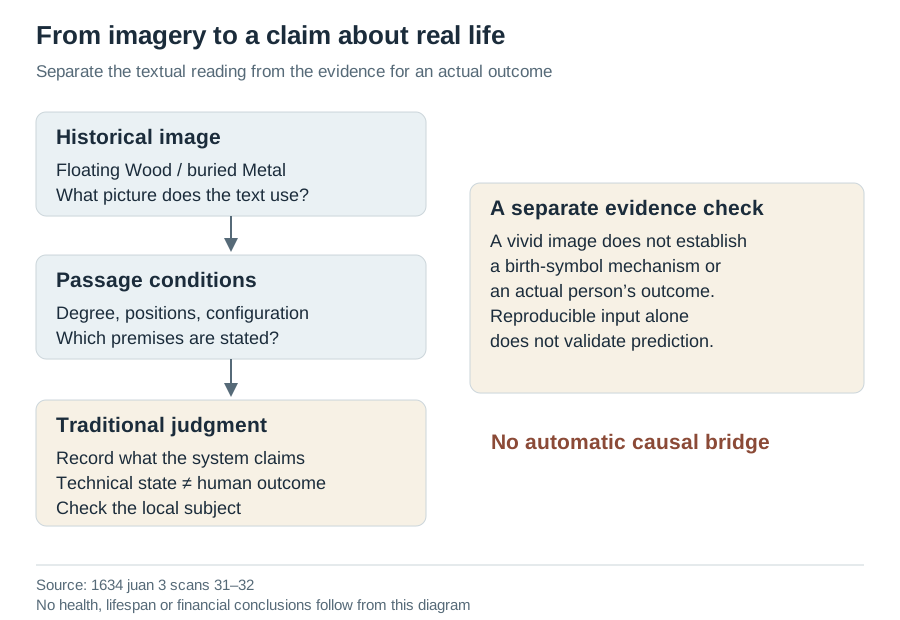
The complete figure is shown below. Select it to enlarge the labels. Open full-size figure · PNG
Use a computed fictional chart to resist overtranslation
We retain phase one's fictional input: Los Angeles, 18 April 2001 at 12:18, with the male setting. Under the documented website time convention, the corrected local fields passed to the calendar library are 11:25. The four pillars are Xin–Si, Ren–Chen, Xin–Hai and Jia–Wu: 辛巳、壬辰、辛亥、甲午. [4]
This supplies a genuinely computed inventory of symbols. It supplies no real person or biographical outcome. The day stem is Xin Metal; visible stems, hidden stems and the seasonal context of Chen are all present. Merely finding Earth and Metal cannot establish “heavy Earth buries Metal,” still less translate burial into financial confinement or illness.
Someone proposing that reading should record three steps: the scope of the selected poem passage; the evidence that this example meets its degree condition; and separate evidence for any move from traditional structure to actual outcomes. Computing the pillars supplies input needed for the first part. It does not complete all three steps.
A larger number in the website's element plot also cannot silently fill the second step and become an original threshold. The plot and the poem's degree word have different sources that should remain identified.
The phase-one calculation limit remains important. This reproduces the website's convention of passing corrected local date-time fields to the library. It is not an independent astronomical validation of an overseas absolute birth instant against globally synchronized solar-term instants. Reproducible symbolic input is useful for this reading exercise; reproducibility alone does not demonstrate predictive validity.
What an explanation should leave unresolved
A concise conclusion can say: the poem organizes traditional relations through degree-sensitive images; application to a chart requires its scope and conditions to be checked; an actual outcome has not been established by the image.
If a glyph is unclear, a subject changes or an annotation adds a premise, record those issues separately. Do not substitute a familiar saying for the visible letters of this witness. Identify whether the explanation is interpreting a source sentence, proposing a present-day analogy or evaluating a prediction. That distinction lets the reader follow the evidence rather than the vividness of the language.
Sources and related reading
1634 Shanchengtang witness, juan 3, scan 31, right half, 五行元理消息賦 heading and opening position. View the heading
Same scan, left half, lower large text. 水泛木浮 and 土重金埋 are the checked short strings used here; they have not been expanded with another witness's wording. View the images
Same witness, scan 32, both halves and right-half opening continuation, including 大抵八字須得中和, conditions and historical judgments. View the continuation
Phase one's documented fictional input and time convention; the phase-two source package retains the same fact sheet and a new reproduction record. Read the complete fictional example
For degree words in an argument, read the paragraph in Jishan pian. For the boundaries of relational interpretation, see generation, control and transformation.
Evidence and source roles
These roles distinguish ancient text, older commentary, historical scholarship and tool reproduction. The numbered notes in the article retain the precise scan pages and explanations. Library and academic sources do not endorse predictive claims.
- YH2-P10 · Ancient text evidence: 五行元理消息賦
Text layer in the witness: 下欄篇題 - YH2-P11 · Ancient text evidence: 五行元理消息賦
Text layer in the witness: 下欄大字正文 - YH2-P12 · Ancient text evidence: 五行元理消息賦
Text layer in the witness: 下欄大字正文 - YH2-C01 · Fictional-example reproduction: Reproduced fictional chart and relation inventory