“First inspect” and “next use” genuinely establish an order of reading. Order is not yet a conclusion. Baofa defines an initial reference but repeatedly returns to comparative significance, formation, changing conditions and cycles. Reciting several steps cannot establish that all the checks demanded by the passage have been completed.
The 1634 Shanchengtang witness prints 寶法第一 in juan 3, scan 20, left half, and 寶法第二 in scan 21, right half. [1–2] These are visible headings in this edition, rather than modern chapter numbers transferred to a scan. Our table and diagram organize the discussion editorially; we do not claim that the woodblock supplies the same numbered process.
The first passage combines reference with scope
Baofa One begins with yin-yang change before turning to the Ziping method. It makes the day stem the reference, attends to the factor used in the framework and considers the other positions, formations and their relative significance. [1]
Making the day stem primary answers where relations are organized from. The framework identifies an initial emphasis. The remaining positions show how that factor sits within the wider configuration. These are connected activities, rather than three conclusions that replace one another.
The discussion of “relative weight and depth” is particularly important. It asks for discrimination. Merely listing the day stem, month and branches does not establish those assessments. This witness prints 所用之物 in the relevant phrase, “the factor used.” We have not silently replaced it with the familiar 所藏之物, “the factor contained,” from another transcription. Interpretation can discuss their relationship, but a quotation must retain its witness's wording.
Read first, next and only then together
Baofa Two begins:
“子平之法,以日為主,先看提綱為重,次用年日時支合成格局,方可斷之。”
Our translation: “The Ziping method takes the day as its reference, first gives weight to inspecting the framework, then uses the year, day and hour branches to form a configuration; only then may a judgment be made.” [2]
The important words include not only 先 and 次 but 合成 and 方. “Next use” does not say that the mere existence of the next item completes the task. “Form a configuration” requires structural conditions, while “only then” places the judgment after the preceding work.
Compressing this into “day master → month → other branches → verdict” can hide its most difficult demand inside an arrow. Which branches participate? How is the proposed relation maintained? Is it disrupted or contested? An order of inspection does not by itself answer these questions.
| Action in the passage | What it first resolves | What it does not establish |
|---|---|---|
| Take the day as reference | The standpoint for naming relations | A completed strength assessment |
| First inspect the framework | An initial priority | Permission to ignore other positions |
| Next use year, day and hour branches | Wider positional consideration | That branches merely need to be counted |
| Form a configuration | A demand for structural prerequisites | That a name alone establishes it |
| Only then judge | Judgment placed after prerequisites | Guaranteed actual outcomes or accuracy |
“Only then judge” is a condition within this historical method. It is not our promise that the method predicts real life.
“Encounter Officer, inspect Wealth” is a cross-check
The second passage goes on to list 逢官看財,逢財看殺,逢殺看印,逢印着官. Our rendering is: “On encountering Officer, inspect Wealth; Wealth, inspect Killings; Killings, inspect Resource; Resource, attend to Officer.” [2]
These phrases direct attention from a present factor toward related factors. They prevent a reader from stopping at one name. The Officer/Wealth discussion can consider generation; Wealth calls for checking Killings; Killings/Resource opens another chain.
The connections do not imply that every chart containing Wealth has already established effective Wealth-to-Killings generation. Nor does every occurrence of Resource supply the same solution. The page's concrete discussion distinguishes situations involving Wealth and asks how a flourishing Wealth condition may change a reading when Killings is present. [2] Wealth is not assigned one fixed favorable function in every position.
A modern reading diagram should therefore preserve a main reference beside several cross-checks, rather than a single route followed blindly to the end. That is a way of organizing notes, not an ancient mechanism in which more arrows produce more fortune.
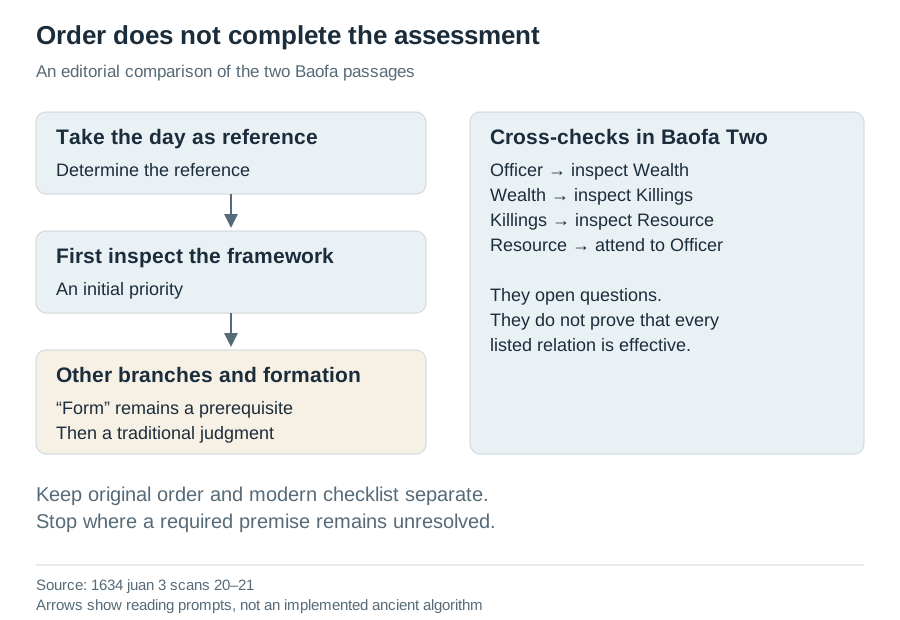
The complete figure is shown below. Select it to enlarge the labels. Open full-size figure · PNG
Record claims of accuracy as claims
Both passages promote a method, criticize mistakes in taking formations and use confident language about results. Baofa Two discusses fixed approaches and adaptation. One cannot responsibly keep a convenient sentence while removing the rest of its discussion. [1–2]
A note can identify where the passage recommends an approach and where it criticizes another treatment. Whether the premises align completely requires local reading. A tension between statements need not be resolved in advance by rewriting the compilation as a seamless modern tutorial.
A declaration such as “without a single failure” is first a claim made by the text. It does not supply a sample, failure record, validation method or demonstration of real-world accuracy. We retain its documentary identity without converting it into a service guarantee.
A fictional chart takes a checklist only so far
Retain the reproduced pillars 辛巳、壬辰、辛亥、甲午: Xin–Si, Ren–Chen, Xin–Hai and Jia–Wu. [3] Xin is the day-stem reference. Visible Jia has the Wealth relation and Ren the Hurting Officer relation. Among hidden stems, Bing and Ding respectively have Officer and Seven Killings naming relations to Xin; Wu and Ji have Resource relations.
This inventory makes “encounter Wealth, inspect Killings” a useful next question. It does not automatically connect visible Jia to every hidden Ding as an effective Wealth-to-Killings chain. The reader still has to record exposure, position, season, support and the conditions used by the selected passage.
Finding Resource similarly does not prove that a Killings–Resource chain is the principal organization of the entire chart. First record candidate relations, then ask what each does in context. That is more transparent than stringing all the names found in a lookup into a favorable verdict.
The chart has actual fictional input and a reproducible calculation. It supplies no real person's wealth, office or health outcome. Naming six categories also does not establish that the calculator fully implements either Baofa passage.
Identify the origin of your own checklist
Keep two parallel records. One preserves the passage's order and source location. The other records modern checks needed for an application: input convention, visible versus hidden stems, position, support and counterexamples, time layers and unresolved conditions.
Some modern checks serve a calculator's requirements rather than steps stated in the passage. Others expand “relative weight” or “formation” into questions a reader can explain. Those origins should remain distinct.
Finally, stop where a premise is missing. If reference and inventory are the only completed work, write “reference and inventory recorded; formation conditions unresolved.” That is more faithful to “only then” than allowing a tidy process graphic to impersonate an unfinished judgment.
Sources and related reading
1634 Shanchengtang witness, juan 3, scan 20, left half, 寶法第一, day-stem reference, framework and relative-significance discussion. 所用之物 is retained from this witness's visible wording. View Baofa One
Same witness, scan 21, right half, 寶法第二, opening order, six-category checks and Wealth/Killings/Resource discussion. View Baofa Two
The phase-one fictional input and this phase's reproduction are retained in the calculation fact sheet. Its time-convention limitations remain unchanged. Read the complete fictional example
For the reference, see reading from the day stem. For structural prerequisites, revisit when a pattern is established.
Evidence and source roles
These roles distinguish ancient text, older commentary, historical scholarship and tool reproduction. The numbered notes in the article retain the precise scan pages and explanations. Library and academic sources do not endorse predictive claims.
- YH2-P13 · Ancient text evidence: 寶法第一
Text layer in the witness: 下欄篇題及大字 - YH2-P14 · Ancient text evidence: 寶法第二
Text layer in the witness: 下欄大字正文 - YH2-P15 · Ancient text evidence: 寶法第二
Text layer in the witness: 下欄大字正文 - YH2-C01 · Fictional-example reproduction: Reproduced fictional chart and relation inventory