Large characters, small characters and an upper register do not mean that everything on a page comes from one voice. When a modern website adds punctuation, translation and diagrams, the layers become easier to confuse. Before explaining a poem's technical terms, identify which text is speaking and where it is actually printed.
Our original plan named Xinjing wuqi fu as a candidate and required its physical heading to be checked first. In the 1634 Shanchengtang witness, juan 3, scan 25, left half, the visible title is 心鏡歌, Xinjing ge. [1] We retain the planned question about textual layers while introducing the selected passage under this witness's actual heading. We do not print a common alternate name as the original title, or add an author attribution that has not been established here.
A short opening performs two different actions
The large-text opening reads 人生富貴皆前定,術士須詳論. Our translation is: “The poem says that people's wealth and status are predetermined; the practitioner must examine them carefully.” [1]
The first part asserts a historical position about fate. The second instructs the interpreter. These neighboring actions cannot serve as evidence for one another. An instruction to examine carefully does not prove predetermination; an assertion of predetermination does not explain how every possible configuration should be handled.
Together they disclose the opening's standpoint and the task it gives its reader. The subsequent text still needs to be read to understand its elaboration.
Replacing “predetermined” with “birth data accurately predict your life” would add data, method and demonstrated effectiveness that the short sentence does not establish. Replacing it with “everyone has many possibilities” to soften its determinism would conceal its actual claim. A translation should first record the statement faithfully, then separately explain how we assess it.
Use physical layout to identify the layers
The heading and opening in this page's main register use large type. A small-type block occupies the register above. The same left half also retains the continuation of the preceding discussion, 傷官說, to the right of the new heading. [1–2] Recognize the section boundary before assigning all nearby text to the new poem.
Small type does not automatically mean a word-by-word note on the poem beneath it. The upper block includes explanations involving Jia/Yi, Bing/Ding and their relations. Assigning one of its statements to the opening verse would require semantic or layout evidence. Its placement above the new heading alone is insufficient. [2]
We therefore record that block's physical position and visible character without inventing a proven line-note relationship. That is not a failure to explain the page. It prevents an unsupported connection from becoming part of the source.
| Textual layer | How it is identified here | How to cite it |
|---|---|---|
| Original large type | Xinjing ge heading and opening | Record this witness's heading, juan and scan |
| Small double-line type inside the main register | A separate checked Jishan example below | Say “this witness's old annotation” |
| Upper-register small type | A distinct area above this page's main text | Record position before asserting its target |
| Our explanation | Added punctuation, translation and analysis | Identify it as our translation or reading |
| Modern evaluation | Assessment of evidence, risk and ethics | Keep it distinct from source attribution |
Type size helps identify a layer; it does not by itself establish the author or date of every statement. Those require further bibliographic and textual evidence.
Check the method against an unambiguous annotation
Our first article in this phase checks the small double-line note beside 用神不可損傷,日主最宜健旺 in Jishan pian. It develops cases involving protection of Officer, Wealth and Resource in the month command. [3]
Here the distinction is clear. Large type states a preference and requirement; small type develops several cases; our present-day table explains their difference. All three can be useful. They should not be copied into a single extended quotation and represented as one large-type original sentence.
Why use another passage while reading Xinjing ge? Because we should not pretend that every layer around our chosen poem opening has an equally clear attachment merely to fill a three-part demonstration. An unambiguous annotation can provide a methodological comparison. The poem opening should retain the actual strength of its own evidence.
Layout therefore does not replace semantic checking. Small type beside a sentence is a clue, but one must still determine which words it explains, whether it continues across a column and which condition it adds.
A translation should disclose its additions
Modern Chinese punctuation is already an editorial decision. Woodblock columns and marks do not necessarily correspond to a website's commas, full stops or paragraph breaks. English adds further lexical and grammatical decisions, which must preserve conditions, subjects and attribution while improving readability.
“The poem says that wealth and status are predetermined” keeps the claim's speaker visible. “Your wealth is predetermined” turns that documentary statement into a direct assertion to the reader.
The distinction does not delete the ancient sentence's determinism. It explains who asserts it. Readers can understand a historical view of fate without being told that this website has demonstrated it as a fact.
Similarly, leave “this witness's annotation” attached to an explanation supplied by small type. Use “our reading” or “requires further checking” for a present-day inference. A few attribution words can determine whether the evidential chain remains intelligible.
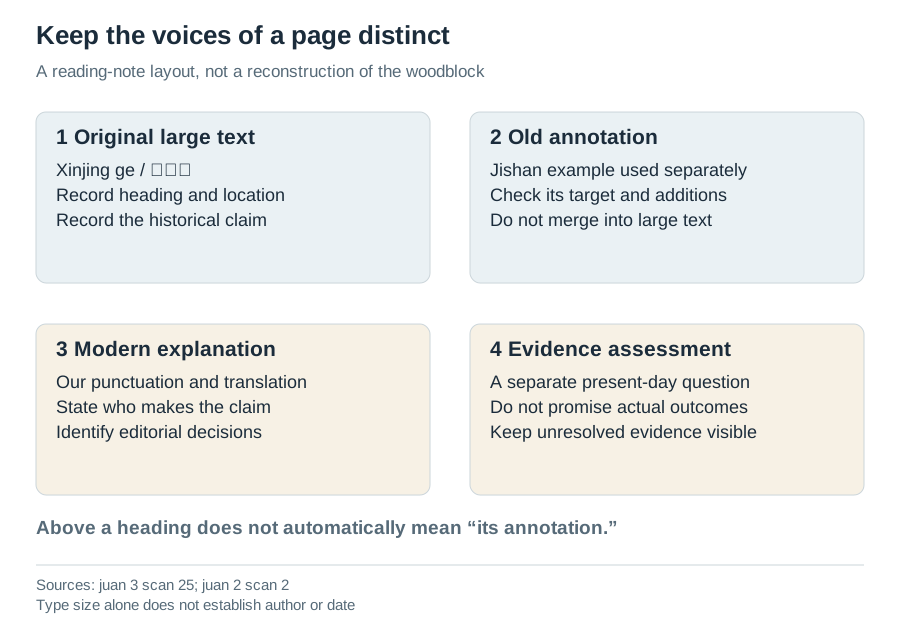
The complete figure is shown below. Select it to enlarge the labels. Open full-size figure · PNG
A four-card exercise in attribution
These are fictional reading notes, not chart results.
Card A records 人生富貴皆前定,術士須詳論 alongside juan 3, scan 25, left half and the large-type opening of Xinjing ge. It records a textual fact without yet evaluating the claim.
Card B places Jishan's month-command protection cases in another column and identifies the witness's double-line small type. It may illuminate that Jishan passage; it should not impersonate Xinjing's opening.
Card C says, “The song first asserts predetermination, then requires careful examination.” This is our explanation of two actions in the sentence. A reader can compare it with the source; it is not another ancient quotation.
Card D says, “This statement does not demonstrate that a real person's wealth is determined by a birth instant.” That is a modern evidential assessment. It is neither attributed to the old text nor omitted because the old assertion sounds confident.
All four cards may sit together on one website. Preserve their labels. Adjacency makes comparison easier; it does not merge their textual identities.
Know when to stop completing the source
When a heading, annotation target or glyph remains uncertain, record that specific gap. Do not complete a familiar sentence with a modern common text and quietly assign it to this witness. Do not label an unread modern commentary “the meaning of the original.”
We reproduce no full passage of a modern commentator's explanation here. The Chinese and English explanations and diagrams are original editorial work. Other editions and modern scholarship can support comparisons when actually read, precisely cited and used within their rights. Access to read an interpretation is different from permission to reproduce its translation or annotation.
A good layered note answers four questions: where the statement is; which textual layer it belongs to; what the modern explanation adds; and which evidence is missing for a real-world claim. That allows a historical poem to remain recognizable without letting it carry unsupported decisions about present-day people.
Sources and related reading
1634 Shanchengtang witness, juan 3, scan 25, left half, 心鏡歌 heading and 人生富貴皆前定,術士須詳論. The heading follows this edition. View the opening
Same scan, left-half upper small-type register and lower section boundary. We identify its position without assigning the whole block to the poem solely from proximity. View the layout
Same witness, juan 2, scan 2, left half, Jishan pian large text and double-line small annotation, used as a clear comparison. View the annotation
For the initial method, revisit how to read Yuanhai Ziping. For connected reading, see adjacent sayings in Xiji pian.
Evidence and source roles
These roles distinguish ancient text, older commentary, historical scholarship and tool reproduction. The numbered notes in the article retain the precise scan pages and explanations. Library and academic sources do not endorse predictive claims.