Knowing pairings such as Jia–Ji or Yi–Geng does not establish how a combination operates in this passage. Ziping zhenquan distinguishes intervening restraint, distance, self-combination and competition, retaining a degree such as partial combination for distance. A single combining/not-combining switch compresses several different questions into one judgment.
We use the Qin Shen'an corrected, Wenming combined volume 2, NLC46443, with a verified January 1926 imprint. The combined heading for stem pairing/disposition and combining/not combining begins on scan 18's left, printed 5. Its final words remain on scan 21's rightmost column, printed 8, before the next title.[1,5–6] These are not two independently numbered sections here, nor do we silently replace the topic with combining without transformation.
“Controlling me” supplies a specific direction
Scan 20, printed 7, gives two intervening cases. The first reads “如甲與己合,而甲己中間,以庚隔之,則甲豈能越剋我之庚而合己?”: with Geng intervening between Jia and Ji, how can Jia cross the Geng controlling it to combine with Ji? The second continues “以乙間之,則己豈能越剋我之乙而合甲?”: with Yi intervening, how can Ji cross the Yi controlling it to combine with Jia? It concludes “此制於勢也,合而不敢合也,” restraint by the configuration's circumstances: combining, yet not daring to combine.[1]
These cases cannot be reduced to an unspecified character between Jia and Ji. Geng controls Jia in the first; Yi controls Ji in the second. The intervening character, controlled object and grammatical subject all change. Together they form the explanation.
This also does not establish that any intervening character invalidates every pairing. The actual examples supply particular controlling directions and restraint by circumstances. A summary must retain those qualifications. Our schematic records source characters rather than supplying birth year, month, day and hour or judging actual relationships.
The passage itself distinguishes distance from restraint
The following paragraph says “又如隔位太遠,如甲在年干,己在時上,如人地北天南,不能相合一般”: Jia in the year stem and Ji in the hour position resemble people too far apart to meet. It then retains “然於有所制而不敢合者,亦稍有差。合而不能合也,半合也”: this differs somewhat from being restrained and not daring to combine; it is inability to combine, partial combination.[2]
Summarizing both as absolute noncombination removes the stated difference and partial degree. The passage discusses operation, not solely a binary outcome. We can retain year-stem Jia and hour-position Ji while leaving the intervening characters unlisted, as the source fragment does. No fictional complete chart is needed.
North-and-south separation is a positional analogy, not a diagnosis of a reader's long-distance romance. Year and hour positions also do not establish a modern story in which one event first occurs in a year and another later occurs in an hour. We examine how symbolic positions enter the text's qualifications.
Self-combination need not mean removal
The same page says “又有合而不以合論者,本身之合也,” introducing self-combination as another entrance. A later secure excerpt reads “惟是本身十干合之,不為合去,” distinguishing this combination from combination-removal.[3] The excerpts remain separate rather than forming a fabricated continuous quotation with intervening words deleted. Encountering a combination does not automatically cross out its Wealth or Officer.
The surrounding explanation uses the six Yang stems encountering Wealth and six Yin stems encountering Officer, then considers combinations involving the self and other stems.[3] Self needs its day-stem reference; every identical pairing in a column is not automatically something another person has taken away. Role and position matter, while the pairing name alone has not completed the explanation.
Wealth and Officer remain traditional relationship names. Self-combination does not establish actual income or an appointment; another stem's combination does not establish real interpersonal competition. We record the symbolic operations that this text discusses and those not automatically supplied by the word combination.
Competition does not erase all combining intent
The text also introduces “爭合妒合,” competing or jealous combinations, with two Xin combining with Bing or two Ding combining with Ren. It then says “到底終有合意,但情不專耳,” retaining an inclination to combine but without exclusive relation, and adds “若以兩合一,而隔位全無爭妒,” qualifying competition through separated positions.[4] Keeping only “two against one means invalid” deletes both degree and position.
Qing, relation or inclination here, does not directly mean an actual person's romantic disloyalty. These examples still have combining intent. Like the preceding partial combination, they preserve incompleteness and qualification rather than making every imperfect condition zero operation.
The separated-position qualification also prevents judgment by merely counting Xin around Bing or Ding around Ren. The text asks for position. We supply no new competition percentage, nor use these fragments to predict modern romance, personality or relationships.
| Entrance | Qualification supplied | What simplification easily loses |
|---|---|---|
| Geng or Yi between Jia–Ji | Jia controlled by Geng versus Ji controlled by Yi | Specific intervening character and subject direction |
| Year Jia / hour Ji | Excessive distance differs from restraint; partial combination retained | Degree and unlisted intervening positions |
| Self-combination | Not combination-removal; distinguish self and other stems | Automatically treating Wealth/Officer as removed |
| Two Xin–Bing / two Ding–Ren | Combining intent remains; separated positions qualify competition | Universal invalidation for two against one |
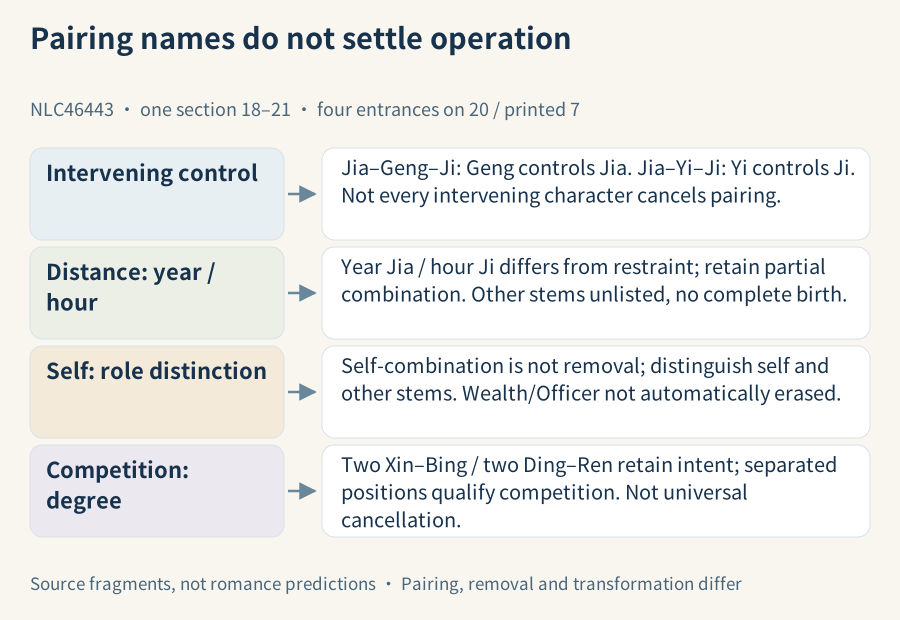
The complete figure is shown below. Select it to enlarge the labels. Open full-size figure · PNG
Pairing, operation and transformation require different checks
Our material first asks whether particular relationships, positions or references change a pairing, then how removal and degree are discussed. Those questions cannot automatically become combining without transformation. Discussing transformation would require its actual textual location and qualifications; that familiar issue does not replace this heading.
A study table can record original pairing, stated characters/positions, the passage's operation and conditions still unobtained. The Jia–Ji/Geng case places Geng's control of Jia in the second field and restraint by circumstances in the third. Distance retains year and hour, difference from restraint and partial combination; it does not import the preceding case's controlling cause.
For self-combination, ask what supplies the self-reference and whether the passage actually says removal. For competition, retain combining intent, nonexclusive relation and separated-position qualification. This restores the text's questions rather than unifying every pairing into one new predictive algorithm.
Retain analogy without transferring it to actual people
The interpersonal and spatial images explain traditional character relationships. We can examine what the images emphasize while retaining the distance between analogy and symbolic object. Turning north-and-south into inevitable romantic failure, or nonexclusive relation into an accusation of disloyalty, exceeds the evidence of this passage.
All illustrated examples are partial symbolic fragments from the book, not newly calculated births. Table, diagram, translation and interpretation are original, without facsimiles or complete section/all-edition collation. Looking up pairings and using independent real evidence to assess a person's life are different tasks. This article does not validate the latter.
Sources and further reading
NLC46443, scan 20, printed 7: the Geng/Yi intervening examples and actual controlling directions. The combined title starts on 18, printed 5. View the cases
Same page: distant year Jia/hour Ji, distinction from restraint and partial combination. View the continuous passage
Same page: self-combination and nonremoval. Two excerpts remain separate; punctuation is ours. View self-combination
Same page: competition, retained combining intent and separated-position qualification. View the later passage
Actual contents, scans 10–13: pairing/disposition and failed combination are one entry. The section continues into 21 before the next title.
Object record and actual scan 74 colophon: January 1926 Qin/Wenming combined print, not a Shen autograph or every edition.
Return to Text Editions and Method, or continue to Clash and combination paths. Compare the preceding book's Yujing qi/qing distinction.
Evidence and source roles
These roles distinguish ancient text, older commentary, historical scholarship and tool reproduction. The numbered notes in the article retain the precise scan pages and explanations. Library and academic sources do not endorse predictive claims.
- ZP1-P16 · Ancient text evidence: 論十干配合性情與十干合而不合
Text layer in the witness: Ancient main text / attached discussion, single-line print; actual heading and qualification boundaries retained - ZP1-P17 · Ancient text evidence: 論十干配合性情與十干合而不合
Text layer in the witness: Ancient main text / attached discussion, single-line print; actual heading and qualification boundaries retained - ZP1-P18 · Ancient text evidence: 論十干配合性情與十干合而不合
Text layer in the witness: Ancient main text / attached discussion, single-line print; actual heading and qualification boundaries retained - ZP1-P19 · Ancient text evidence: 論十干配合性情與十干合而不合
Text layer in the witness: Ancient main text / attached discussion, single-line print; actual heading and qualification boundaries retained - ZP1-P27 · Ancient text evidence: 子平真詮目錄
Text layer in the witness: Independent old contents or later-preface layer, distinct from main text - ZP1-P06 · Ancient text evidence: 刊记
Text layer in the witness: Actual independent end colophon: publication/distribution and other separately arranged fields - ZP1-B01 · Library catalogue fields imported by Commons: NLC46443 combined Yuanhai/Ziping volume 2 object and imported NLC catalogue