“In season yet not flourishing; out of season yet not weak” does not remove the month from evaluation. The inspected section first gives the Month Command importance, then uses particular characters, roots and controlling/generating relationships to show why season cannot finish the judgment alone. Reading it as the month being meaningless misses half the argument, just as month-only evaluation does.
Our Qin/Wenming combined volume 2, NLC46443, has a verified January 1926 imprint. The actual title on scan 21, printed 8, is “論十干有得時不旺失時不弱,” continuing through the first three columns of scan 22, printed 9, before Clash/Combination begins.[1–4] The title's 有 and this witness's wording are retained rather than replaced by another edition's title or numbering.
The sentence retains both month and other positions
Scan 21 says “故八字雖以月令為重,而旺相休囚,年月日時亦有橫蓋之權,不可執一論也.”[1] It gives the Month Command importance while granting year, month, day and hour an overriding capacity, henggai, in the discussion of flourishing, vigor, rest and imprisonment. The actual image has 年月日時 and 橫蓋之權. We do not replace them with the familiar alternative omitting month and speaking of increase/decrease, or call either witness a printing error.
The structure is concessive: although the month is important, pillar relationships still act. Henggai suggests more than simple addition/subtraction. Read with the following spring/autumn examples, it indicates effects capable of defeating a season-only judgment. This is our passage-level interpretation, not an established numerical weight assigned to every pillar.
Month Command and year/month/day/hour are not four scores that can be summed without identifying objects. The month supplies a seasonal entrance; actual character relationships within the pillars continue the evaluation. The printed phrase also retains month itself. Emphasizing other positions does not justify deleting that character. We record the argument's structure without creating a complete strength algorithm.
Spring Wood still has controlling and generating qualifications
A secure continuous excerpt says “如春木雖強,金太重而木亦危”: although spring Wood is strong, overly heavy Metal can endanger it.[1] The passage first supplies a seasonal qualification, then a turning condition, excessive Metal. It continues with Geng/Xin stems, You/Chou branches, absent Fire restraint and incoming Earth generation, finally describing being in season without flourishing.
Spring joined to Wood is therefore insufficient for universal strength; the word Metal alone is also insufficient for inevitable danger. The text says overly heavy and continues with particular characters and relationships. We analyze how a preliminary judgment is qualified, without supplying a measured definition of excessive Metal or predicting real danger from particular characters.
The ancient continuation also includes wealth and lifespan judgments. They are historical assertions within the work, not our conclusions about readers' income, longevity or safety. The important reading move is retaining the connection between seasonal starting judgment and subsequent qualifications, rather than extracting the strongest outcome word.
Autumn weakness cannot erase root qualifications
The next secure excerpt is “秋木雖弱,木根深而木亦強”: although autumn Wood is weak, deep roots can make Wood strong.[1] Its final words cross into the adjoining column but remain one continuous sentence. The text proceeds through Jia/Yi stems and Yin/Mao branches, capacity to receive a disclosed Officer, and excess through Water generation, describing being out of season without weakness.
This is not universal approval of Water whenever autumn Wood appears. The source retains deep roots and strength while also considering excess from Water. Writing “autumn Wood is weak, so Water always helps” drops the actual degree and qualifications. Universal rejection of Water merely because Wood is strong also skips the particular relationships.
Together the examples resist a one-direction inference. Favorable season can be qualified by controlling/generating relationships; unfavorable season does not replace actual roots. The paragraph uses different terms—strong, endangered, not flourishing and not weak. A summary need not compress all of them into one binary strength switch.
| Source entrance | Qualifications still checked | Conclusion not supplied by the entrance alone |
|---|---|---|
| Spring Wood initially strong | Overly heavy Metal; stated characters, absent Fire restraint, Earth generation | Spring Wood flourishes in every configuration |
| Autumn Wood initially weak | Deep roots; stated characters, Officer reception, Water excess | Autumn Wood always weak or always needs Water |
| Month Command important | Actual year/month/day/hour relationships and henggai | Month alone suffices, or month may be ignored |
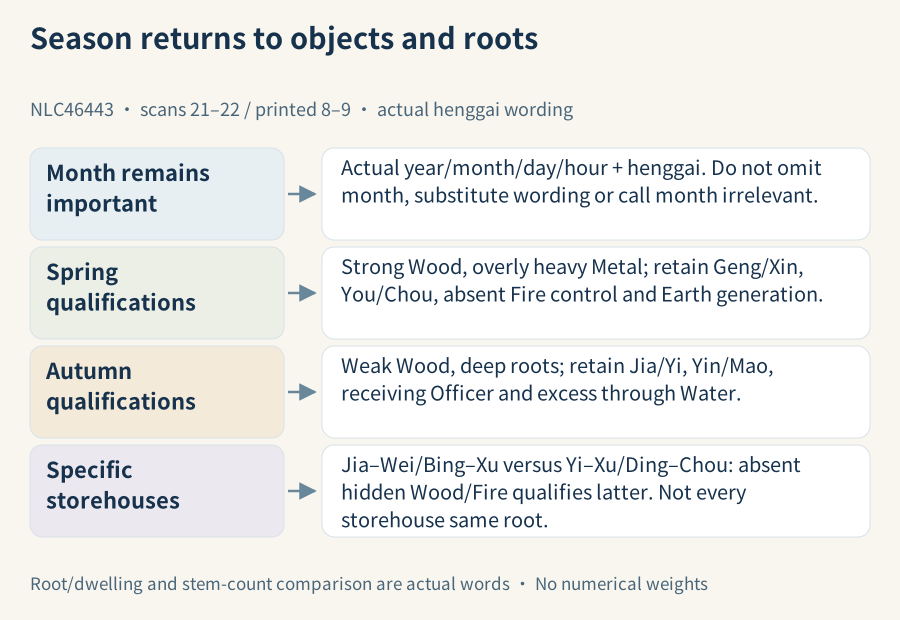
The complete figure is shown below. Select it to enlarge the labels. Open full-size figure · PNG
Storehouse examples connect roots to particular hidden stems
Later on the same page, “得一比肩,不如得支中一墓庫,如甲逢未、丙逢戌之類” compares one Peer with a tomb/storehouse in a branch, giving Jia–Wei and Bing–Xu examples. It immediately qualifies this: “乙逢戌、丁逢丑不作此論,以戌中無藏木,丑中無藏火也,” excluding Yi–Xu and Ding–Chou because Xu lacks hidden Wood and Chou lacks hidden Fire.[2] The shared storehouse name does not establish identical objects or hidden-stem qualifications.
Keeping only “Peer is inferior to storehouse” drops the following exclusion. Jia–Wei and Bing–Xu are the paragraph's root examples; Yi–Xu and Ding–Chou are qualified by the missing phases. We retain subject, branch and hidden relationship rather than make every storehouse the same root, still less everyone's Wealth storehouse.
This also shows why returning to the preceding attached discussion's polarity distinctions matters. That passage differentiates Yang and Yin Long Life and storehouse operation; this one specifies stems, branches and hidden phases. A generic name cannot replace local explanation. We have not compressed both sections into a table resolving every Yin–Yang root question.
The rooting analogy supplies no numerical model
A continuous sentence on scan 22 reads “通根如室家之可住,干多不如根重,理固然也”: rooting resembles having a home to inhabit; numerous stems are inferior to substantial roots, which the passage calls reasonable.[3] These adjoining clauses are actual words, not an editorial synthesis assembled from elsewhere. A dwelling analogy explains root before the comparison with stem abundance.
The comparison discourages merely counting same-type stems. It still gives no universal number of stems equivalent to a root, or proportional weights for different hidden stems. The house analogy does not establish a real housing situation. We recover the paragraph's questions rather than create calculator weights.
Turning old-text roots, vigor and weakness into modern percentages requires separate explanation of the chosen model. A calculated percentage does not prove that each ancient degree term had the same numerical definition. Precise decimals cannot replace textual objects and exceptions.
Make a season summary that remains checkable
A summary can retain four things: initial seasonal judgment, stated characters and relationships, particular rooting or controlling/generating qualifications, and how the paragraph changes the initial judgment. Unlisted complete birth inputs remain unlisted. A source fragment is not completed into a newly calculated chart.
Spring retains excessive Metal and its other relationships; autumn retains deep roots and Water excess. Storehouse examples separately retain Jia–Wei/Bing–Xu and Yi–Xu/Ding–Chou. Finally check whether “although,” “yet,” “excessive” or “not applicable here” disappeared, or whether henggai was silently replaced with another witness's wording.
These are original reading checks. Table, diagram, translation and analysis reproduce no scans and claim no complete section/all-witness collation. The fragments do not validate real people's health, wealth, lifespan or destiny. They establish connections between argumentative entrances and qualifications, not a model in which month or character count determines life.
Sources and further reading
NLC46443, scan 21, printed 8: actual heading, 年月日時/橫蓋之權, separately quoted spring/autumn fragments and subsequent qualifications. View the section
Same page: Jia–Wei/Bing–Xu versus Yi–Xu/Ding–Chou and the hidden-stem limitation. Punctuation is ours. View the objects and exceptions
Scan 22, printed 9: dwelling/root and numerous-stems/substantial-root clauses form one continuous sentence. The section ends after the first three columns. View the analogy
Object record and actual scan 74 imprint: January 1926 publication/distribution, not a Qing autograph.
For background, see Hidden Stems, or return to Yin–Yang life stages and strength. Return to this phase, or continue to Stem pairing and operation.
Evidence and source roles
These roles distinguish ancient text, older commentary, historical scholarship and tool reproduction. The numbered notes in the article retain the precise scan pages and explanations. Library and academic sources do not endorse predictive claims.
- ZP1-P13 · Ancient text evidence: 論十干有得時不旺失時不弱
Text layer in the witness: Ancient main text / attached discussion, single-line print; actual heading and qualification boundaries retained - ZP1-P14 · Ancient text evidence: 論十干有得時不旺失時不弱
Text layer in the witness: Ancient main text / attached discussion, single-line print; actual heading and qualification boundaries retained - ZP1-P15 · Ancient text evidence: 論十干有得時不旺失時不弱
Text layer in the witness: Ancient main text / attached discussion, single-line print; actual heading and qualification boundaries retained - ZP1-P06 · Ancient text evidence: 刊记
Text layer in the witness: Actual independent end colophon: publication/distribution and other separately arranged fields - ZP1-B01 · Library catalogue fields imported by Commons: NLC46443 combined Yuanhai/Ziping volume 2 object and imported NLC catalogue