Sheng, “birth” or “generation,” does not always perform the same task in an old text. Mutual generation names a relationship; Long Life names a traditional stage; a person's birth can supply an analogy. Reading all three as the creation of actual life, or applying Death and Tomb directly to a person's death, also misreads how the passage discusses strength. Our selected Ziping zhenquan pages place these tasks in adjoining sections.
We use the second volume of the Qin Shen'an corrected combined Yuanhai Ziping / Ziping zhenquan, NLC46443, catalogued as 1926. The actual main text has Lun ganzhi on scan 14, printed 1; Lun yinyang shengsi, with an attached discussion of Day Master strength, begins in the lower half of scan 15, printed 2. Lun yinyang shengke begins only on scan 17's left half, printed 4.[1–5] Titles, combination and order differ from some circulating contents lists. We do not impose their Stems/Branches–Generation–Life/Death sequence upon this witness.
Stems and Branches first supplies a traditional vocabulary
On scan 14, Lun ganzhi begins: “天地之間,一氣而已。惟有動靜,遂分陰陽。有老少,遂分四象.”[1] It describes one qi between Heaven and Earth, differentiated through movement and stillness into Yin–Yang and through old and young into four images. This is the work's theoretical entrance for discussing its symbols. Recording the argument does not make qi a modern physical quantity or an experimentally established universal substance.
The entrance also encourages attention to a term's reference. Yin–Yang supplies classification and relational explanation here, rather than a binary personality judgment. When day stem, Month Command and other positions enter later, their objects must be distinguished; a broad polarity label cannot replace a particular stem/branch relationship.
The actual title matters too. A circulating “Ten Stems and Twelve Branches” title can help locate material, but is not this page's verbatim heading. Familiar contents wording can create a false impression that this witness's numbering and organization have already been matched exactly to another edition. The actual new heading identifies the transition to Life/Death and its attached discussion.
Life/Death uses human stages to explain stages of qi
On scan 16, printed 3, the section says “長生猶人之初生也,沐浴猶人既生之後,沐浴以去垢也”: Long Life resembles a person's first birth; Bathing resembles washing away dirt after birth.[2] Both uses of “猶,” resembles, mark analogy. These labels explain a traditional qi sequence. A label in a reader's chart does not directly establish an actual birth event, bathing behavior or health diagnosis.
Scan 17, printed 4, continues: “死則氣盡而無餘也,墓者造化收藏,猶人之埋於土也.” Death first means qi exhausted without remainder; Tomb means creation's gathering and storing, compared with a person's burial.[2] Removing the object and analogy marker easily changes a stage explanation into an assertion about someone's lifespan.
These verified fragments distinguish language tasks rather than supply a complete twelve-stage lookup table for every edition. Long Life is not automatically active generation of another phase. Death and Tomb do not supply illness, danger or mortality predictions. The quoted wording does not establish a modern validated connection between a traditional label and an actual event.
The attached strength discussion connects stages to position and roots
The attached discussion on scan 17 says the Day Master need not be born at Lu or prosperity: even with the Month Command in rest or imprisonment, finding Long Life or Lu/prosperity in year, day or hour can make it not weak; even encountering a storehouse can mean having a root. It immediately rejects the contemporary saying that a storehouse must be clashed.[3] Stage vocabulary now serves another task: evaluating qualifications across positions rather than forecasting actual stages of someone's life.
The first statement rejects an assumed necessary condition: birth at Lu/prosperity is not the only route to being not weak. It checks positions outside an unfavorable Month Command and then considers storehouse and root. Month, other positions, rooting and the claim about clash cannot become an evaluation based solely on a stage's name.
Rejecting “storehouses must be clashed” is criticism of an attributed contemporary saying within this root discussion. It does not establish the opposite rule that every storehouse clash is bad, or automatically turn every storehouse elsewhere into a Wealth storehouse. Rejecting a compulsory condition and establishing a universal prohibition are different moves.
Do not erase the subsequent Yin–Yang qualification
The same continuous paragraph adds: “但陽長生有力,陰長生不甚得力,而亦不弱;若逢庫,則陽為有根,而陰則無用.”[3] It distinguishes Yang Long Life's force from Yin Long Life, which has less force but is still not weak; encountering a storehouse also receives differing Yang and Yin treatment. “But” further limits the preceding generalization. Retaining only “storehouse means root” drops the later distinction; retaining only Yin's lesser force drops “still not weak.”
The attached discussion therefore does not give one unconditional stage-strength table for all objects. It differentiates the force of Yang and Yin Long Life and the storehouse's rooting function. We retain this witness's local argument without asserting agreement across all fate-calculation writings. Yin's “without use” is not a statement that a real person lacks value.
“Not weak” and “forceful” are also not automatically synonyms. The paragraph explicitly joins lesser force with not being weak for Yin Long Life. This combination shows why one yes/no switch cannot always preserve a state judgment. Record its object and scale rather than collapse relative terms into absolute strength or weakness.
| Verified vocabulary | Local task | What does not follow directly |
|---|---|---|
| Long Life, Bathing | Human-stage analogy for stages of qi | Actual birth, habits or bodily diagnosis |
| Death, Tomb | Exhaustion, storing and burial analogy | A real person's death, lifespan or danger |
| Finding Long Life/Lu prosperity | Day Master qualifications outside the month | Complete strength evaluation from the name alone |
| Yang/Yin Long Life and storehouse | Further distinction of force, nonweakness and roots | One unconditional table for every object |
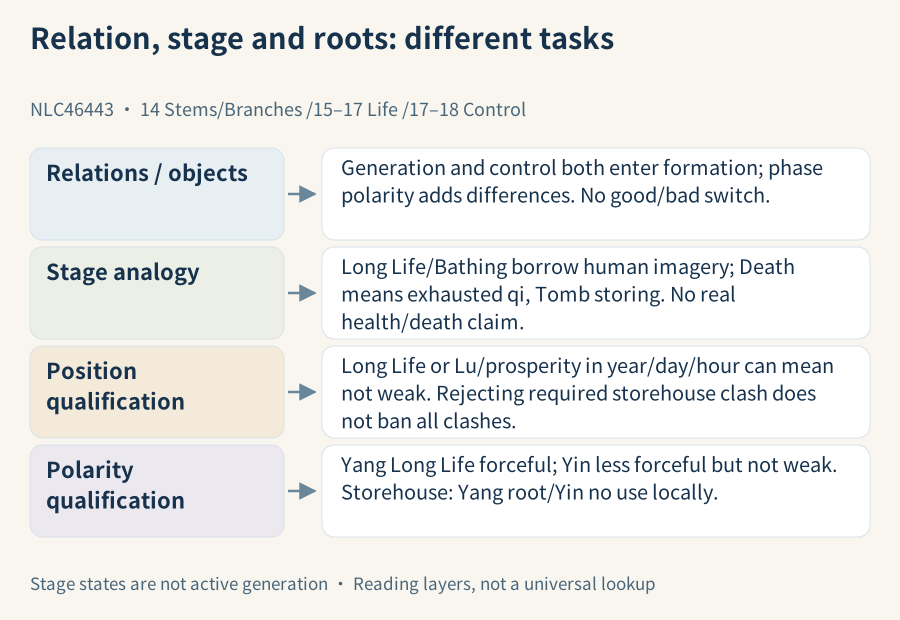
The complete figure is shown below. Select it to enlarge the labels. Open full-size figure · PNG
Generation/Control returns to relationships and differing objects
The separately titled Lun yinyang shengke on scan 17 says “四時之運,相生而成,亦相尅而成”: the movement of the four seasons takes shape through mutual generation and also mutual control. Scan 18, printed 5, adds “以五行之陰陽分配之,則生尅之中,又有異同”: distinguishing and matching the phases' Yin–Yang introduces further differences and similarities within generation/control.[4]
“Generation is good, control is bad” removes the argument that control also participates in formation. The opposite universal approval of control is equally unsupported. The following discussion develops differences through particular stem objects; an identical relationship name does not guarantee an identical operation on every object. These sentences do not supply a natural-science mechanism or a new favorable/unfavorable program.
The boundary helps prevent meanings from crossing unnoticed. Long Life in Life/Death is a stage term; mutual generation in Generation/Control is a relationship. Qi's exhaustion is not the literal equivalent of every controlling relationship. Adjoining placement helps comparison without eliminating the passages' different tasks.
Make a study card that keeps meanings distinct
Four fields help: actual title, current object, term's local task and qualifications still needing joint reading. Long Life records a stage analogy, followed by its positional and polarity connections in the attached discussion. Mutual generation records relationship and differing Yin–Yang objects without supplying actual life creation. Death and Tomb retain exhaustion and storing without filling in a person's fate.
After summarizing, ask whether analogy became event, nonweakness became strength, “but” or “yet” disappeared, polarity qualifications were lost, or a criticized contemporary claim became the work's own conclusion. These questions are our analytical checks on fidelity, not four newly discovered prediction rules.
Table, diagram, translation and interpretation are original, without facsimiles or complete collation of the book or every edition. Main text and attached discussion remain distinct from later commentary. Historical qi stages and relationships are not applied to actual readers' health, psychology, life, death or destiny.
Sources and further reading
Combined volume 2, NLC46443, Lun ganzhi, scan 14, printed 1: qi, movement/stillness, Yin–Yang and four images. View the section
Life/Death and attached strength discussion begins on scan 15, printed 2. Analogies are on scan 16, printed 3 and 17, printed 4. Separate locations are not spliced into one continuous quotation.
Scan 17's attached discussion: month versus year/day/hour, stage and storehouse qualifications, clash criticism and subsequent polarity distinction. View the passage
Generation/Control starts on 17's left half and continues to the next title on 18, printed 5. The two short excerpts retain their respective locations; punctuation is ours.
The combined object has an actual January 1926 publication/distribution colophon on scan 74. Catalogue date and physical imprint remain separately recorded; neither establishes a Qing original or Shen autograph. View the record
For background, see Five Element relationships. Return to Text Editions and Method, or continue to Season and strength.
Evidence and source roles
These roles distinguish ancient text, older commentary, historical scholarship and tool reproduction. The numbered notes in the article retain the precise scan pages and explanations. Library and academic sources do not endorse predictive claims.
- ZP1-P07 · Ancient text evidence: 論干支
Text layer in the witness: Ancient main text / attached discussion, single-line print; actual heading and qualification boundaries retained - ZP1-P08 · Ancient text evidence: 論陰陽生死 附論日主強弱
Text layer in the witness: Ancient main text / attached discussion, single-line print; actual heading and qualification boundaries retained - ZP1-P09 · Ancient text evidence: 論陰陽生死 附論日主強弱
Text layer in the witness: Ancient main text / attached discussion, single-line print; actual heading and qualification boundaries retained - ZP1-P10 · Ancient text evidence: 論陰陽生死 附論日主強弱
Text layer in the witness: Ancient main text / attached discussion, single-line print; actual heading and qualification boundaries retained - ZP1-P11 · Ancient text evidence: 論陰陽生尅
Text layer in the witness: Ancient main text / attached discussion, single-line print; actual heading and qualification boundaries retained - ZP1-P12 · Ancient text evidence: 論陰陽生尅
Text layer in the witness: Ancient main text / attached discussion, single-line print; actual heading and qualification boundaries retained - ZP1-P06 · Ancient text evidence: 刊记
Text layer in the witness: Actual independent end colophon: publication/distribution and other separately arranged fields - ZP1-B01 · Library catalogue fields imported by Commons: NLC46443 combined Yuanhai/Ziping volume 2 object and imported NLC catalogue