Reading Ziping zhenquan cannot begin by placing a familiar chapter count, modern commentary and every preface in one main-text layer. Our combined witness's contents has 45 entries, while its original preface describes 39 handwritten essays. Its main-text bylines also distinguish composition, custody and correction/printing. These differences in count and responsibility should be recorded before anyone attempts to eliminate them.
The phase uses the Qin Shen'an corrected, Wenming combined Yuanhai Ziping / Ziping zhenquan, volume 2, NLC46443, with 75 PDF scans. The catalogue dates it to 1926; actual scan 74 also records publication and distribution in the first month of the Republic's fifteenth year, independently supporting January 1926.[4,6] Qing prefatory dates, main-text bylines and collection order remain separate. A later witness is not thereby a Qing original printing, and a catalogue naming Qin as corrector does not make him the entire text's author.
Three responsibilities appear at the main-text opening
Scan 14, printed 1, has “山陰沈孝瞻先生著,” “長安趙展如中丞藏本” and “湘陰李星科泳蓀甫校刊”: composition attributed to Shen Xiaozhan of Shanyin, a copy held by Zhao Zhanru of Chang'an, and correction/printing attributed to Li Xingke of Xiangyin.[1] The expressions for composition, held copy and correction/printing occupy separate bylines. A summary should preserve their different tasks rather than replace the composer with custodian or corrector.
They establish how this witness presents responsibility, not possession of Shen's autograph, independently verified biographies of all named people, or personal authorship of every preface and small character. Names and places are first recorded from the print. Further identity or transmission claims need further evidence.
Qin Shen'an and Wenming appear in the object catalogue.[4] That is another information location. Both layers can be retained, but they should not become one undifferentiated list of authors: readers then lose the ability to identify main text, prefatory matter and later explanation.
The original preface's 39 is not automatically the present contents count
The original preface on scans 2–3 says “得讀山陰沈孝瞻先生所著子平手錄三十九篇,” describing reading Shen's 39 handwritten essays. Scan 3 ends with a Qianlong forty-first-year, Bing–Shen early-summer date and Hu's signed statement.[2] This records the collection described in the preface. It does not establish that the present physical witness has only 39 entries.
The postface on scans 6–7 separately says “共四十五篇,” 45 essays in total, and ends with Li Xingke's signature. The contents on scans 10–13 independently counts to 45: nine, twelve, twelve and twelve entries, without one continuously numbered series.[2–3] Postface and actual contents agree with each other while differing from the original preface.
That difference does not authorize changing 39 to 45 or treating the six-entry difference as six new bodies of text. The later preface on scan 9 explicitly mentions earlier/later rearrangement and division/combination, “蓋前後間有互易分合故耳.”[2] We have not reconstructed those changes entry by entry or assigned additions to a person and date. Explaining the changes needs matching titles, earlier witnesses and prefatory evidence. We verify this object's preface, postface and contents without inventing a missing transmission chain. A counting difference can remain a research question rather than immediately become a printing error.
Nor can a familiar 48-chapter scheme be imposed here. Circulating titles in the original plan are locating aids; actual writing follows this witness's headings and boundaries. Its 45 contents entries and our planned 19 original reading questions also count different things. The question-based series does not claim that nineteen articles replace the complete classical work.
Qing prefatory dates and the 1926 imprint belong to different layers
The original preface's Qianlong forty-first-year date, scan 4's separate “光緒二十一年歲次乙未” date, and the later preface's “光緒六年庚辰初秋朔” on scan 9 differ from the January 1926 physical imprint.[2,4,6] Each first dates the statement bearing it. The earliest preface does not automatically date the PDF's printing.
Likewise, a later preface does not make every main-text sentence newly composed in its year. A subsequent combined printing can preserve earlier prefatory material; its precise transmission still requires witness evidence. We record preface date, later-preface date, catalogue date and physical imprint separately.
Scan 74 additionally identifies Qin Shen'an of Jiangning as corrector, Wenming as publisher and printer, and Yuanhai Ziping / Ziping zhenquan as a combined two-volume work.[6] This provides physical locations for the Qin/Wenming responsibilities recorded in the catalogue, without replacing the composer's main-text attribution.
The distinction makes dates useful. A page naming a publication year can be asked which layer it relies upon; an author attribution drawn from a preface can return to that preface's actual signature. Names and years then avoid becoming detached labels for the entire book.
Contents organization changes how we locate the argument
The main text starts on scan 14 with Lun ganzhi. Life/Death, with an attached Day Master strength discussion, starts on 15; Generation/Control begins only on 17. Scan 18 starts one combined heading for stem pairing/disposition and combining/not combining.[3] This differs from lists placing Generation/Control before Life/Death or assigning pairing and failed combination separate chapter numbers.
When an article addresses two familiar titles, it therefore states that they occupy one section here, using scan and printed-page locators. An unnumbered contents list does not justify inventing an original chapter-number label. Returning from an article to the image should locate this witness's title, rather than another edition's number.
Organization also affects interpretive scope. The attached strength discussion directly follows Life/Death here, so reading stage terms should not omit subsequent roots, positions and polarity qualifications. Organization offers a real joint-reading route rather than mere typography. It still does not establish that a differently organized witness must express opposite ideas.
Compare modern commentary only at the evidence level obtained
The plan's IUCAT record 14431451 actually describes a 2014 first edition from Xizang Zangwen Guji Chubanshe, with Shen Xiaozhan as author and Xu Lewu as commentator, ISBN 9787805892672 and pagination 6, 4, 242.[5] It supports that edition's bibliographic identity and publication facts, not a claim that we inspected a 1926 or 1936 commentary copyright page.
A separate WorldCat record, 42742938, identifies a 1994 first edition from Zhongzhou Guji Chubanshe, with Shen as original author, Xu as commentator and Sun Zhengzhi as textual/punctuation editor.[7] It supplies another modern editorial responsibility, distinguished from commentary and not retrospectively attributed to Shen or Qin. An official Taiwan catalogue separately lists a 1926 Qin/Wenming combined volume 2 with 164 pages; we have not equated it page-by-page with NLC's 75 scans.[8]
The actual copyright pages of these modern editions have not been obtained. We have not used it for word-by-word collation of the principal witness or excerpted Xu's explanatory text. The catalogue's author/commentator distinction does not automatically turn a modern explanation into the combined witness's main text attributed to Shen. A future commentary quotation would need an actual edition, page, layer and use scope. Ancient composition dates do not automatically free every modern explanation, translation or edition for unrestricted copying.
One 2014 record also cannot establish when the commentary first arose, whether this edition completely preserves an earlier commentary, or whether every note matches the old main text. Without the relevant page, contents and passage, those fields remain unobtained rather than filled from a familiar title.
| Evidence obtained | What it supports | What remains unsupported |
|---|---|---|
| Three main-text bylines | Local composition, custody and correction responsibilities | Autograph, every preface/note's personal author or complete biography |
| Original preface 39; postface/contents 45 | Different collection counts preserved here | Six new texts, an addition author/date, or 39 being a printing error |
| Qing prefatory dates and 1926 imprint/catalogue | Separate dating layers, combined identity and Qin/Wenming tasks | Dating a print solely from its preface or substituting corrector for composer |
| IUCAT's 2014 commentary record | That edition's publication facts and bibliographic roles | An inspected copyright page, unrestricted modern copying or complete note collation |
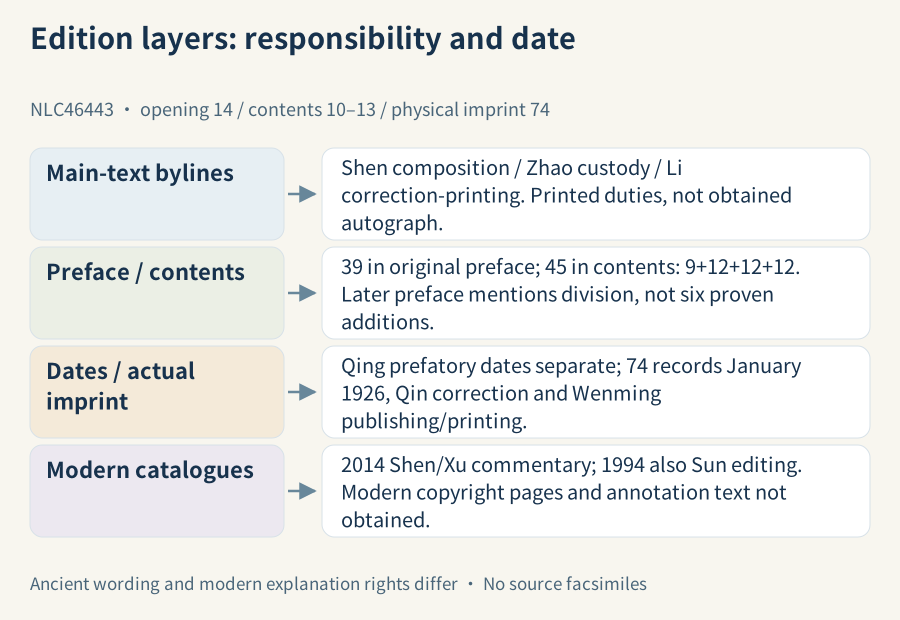
The complete figure is shown below. Select it to enlarge the labels. Open full-size figure · PNG
Give a passage a minimal identity record
A checkable excerpt records object, actual heading, scan and printed page, main text or another layer, and whether punctuation is added. Modern commentary needs its own edition and page fields; the principal witness's page number cannot fill them. An unobtained field can remain explicitly unobtained. Reliability does not require pretending every field is complete.
This phase develops six questions through those records: relationship and stage vocabulary, season and roots, combining and failed combination, clash/combination resolution, and yongshen/xiangshen. Original planned topics remain; arguments follow actual ancient text. Comparison with modern explanation goes only as far as evidence obtained.
Translations, tables, diagrams and analysis are original, without source facsimiles or modern commercial explanatory excerpts. This is not complete collation of the work or every edition. Author attribution, ancient prefatory praise and official cataloguing do not establish scientific validation of fate prediction.
Sources and further reading
NLC46443, combined volume 2, scan 14, printed 1: Shen composition, Zhao custody and Li correction/printing bylines. View the opening
Original preface on scans 2–3, separate preface on 4, postface on 6–7, later preface on 8–9. Dates, counts and signatures retain separate locations.
Actual contents on scans 10–13: 45 entries and actual order, without imposing a 48-chapter scheme.
Commons object catalogue: Qin correction, Wenming, 1926 and 75 scans. Its date and scan 74 imprint remain separate evidence, not dating evidence for other Qin objects.
Indiana University's IUCAT 14431451: 2014 first edition, author/commentator roles, ISBN and pagination. Catalogue evidence, not an obtained copyright page or commentary text.
Actual colophon, scan 74, without a numeric printed page: January 1926 publication/distribution, Qin correction, Wenming publication/printing and combined two-volume title. It dates this object, not another work or Shen autograph.
WorldCat 42742938: 1994 first edition, Shen original author/Xu commentary/Sun Zhengzhi textual editing. No original modern copyright page or text collation obtained.
Official Taiwan record NTL-9900014380: distinct combined volume 2 copy and page count; its image index is not transferred to NLC.
Return to Text Editions and Method, or continue to Yin–Yang, generation and life stages. Compare the preceding book's Yuanli verse and attributed gloss.
Evidence and source roles
These roles distinguish ancient text, older commentary, historical scholarship and tool reproduction. The numbered notes in the article retain the precise scan pages and explanations. Library and academic sources do not endorse predictive claims.
- ZP1-P01 · Ancient text evidence: 原序
Text layer in the witness: Separate old preface/postface or signature, not Shen main text or modern commentary - ZP1-P02 · Ancient text evidence: 原序
Text layer in the witness: Separate old preface/postface or signature, not Shen main text or modern commentary - ZP1-P03 · Ancient text evidence: 序
Text layer in the witness: Separate old preface/postface or signature, not Shen main text or modern commentary - ZP1-P04 · Ancient text evidence: 跋
Text layer in the witness: Separate old preface/postface or signature, not Shen main text or modern commentary - ZP1-P05 · Ancient text evidence: 子平真詮正文题署
Text layer in the witness: Three separately printed main-text bylines, not one continuous paragraph - ZP1-P06 · Ancient text evidence: 刊记
Text layer in the witness: Actual independent end colophon: publication/distribution and other separately arranged fields - ZP1-P27 · Ancient text evidence: 子平真詮目錄
Text layer in the witness: Independent old contents or later-preface layer, distinct from main text - ZP1-P28 · Ancient text evidence: 後序:分合与署年
Text layer in the witness: Independent old contents or later-preface layer, distinct from main text - ZP1-B01 · Library catalogue fields imported by Commons: NLC46443 combined Yuanhai/Ziping volume 2 object and imported NLC catalogue
- ZP1-B02 · Modern-edition catalogue: 子平真诠
Text layer in the catalogue: Modern library catalogue metadata only; no copyright-page image or commentary passage - ZP1-B03 · Modern-edition catalogue: 子平真诠评注
Text layer in the catalogue: Modern library catalogue metadata only; no copyright-page image or commentary passage - ZP1-B04 · Library catalogue record: 淵海子平子平真詮 v.2
Text layer in the witness: Official catalogue of a distinct old copy; no copy-image collation