The opening of Yuanli fu repeatedly presents generation, then places the unfavorable effects of abundance within each pair. It does not first supply five unconditional benefits and leave a commentator to invent five exceptions. The verse already contains its turns. The gloss subsequently groups abundance, flourishing, decline and weakness as excess and insufficiency, explicitly bringing the discussion into the Five Phases and Four Pillars. Separate reading shows what each layer actually adds.
Our passage is in the Qin Shen'an corrected, Wenming witness of Sanming tonghui, NLC42998, juan 12, scan 298, printed 1. Small bylines under Yuanli fu read “徐大升撰” and “萬育吾解”: composed by Xu Dasheng, explained by Wan Yuwu. The volume opening separately reads “育吾山人著.”[1] The object is catalogued as 1926; an independent imprint for that year has not been inspected. These locators do not transfer to the unresolved 1578 mirror.[2]
Three attributions cannot become one author's name
The volume's Yuwu Shanren attribution and the work's separate composition and explanation bylines occupy different positions.[1] A summary should retain that local information. Writing only “Wan says” obscures the verse's stated composer. Assigning the small-type synthesis entirely to Xu Dasheng likewise erases a visible explanatory layer.
The bylines support a precise claim: this witness attributes composition to Xu Dasheng and explanation to Wan Yuwu. They do not establish possession of either person's manuscript, every detail of textual transmission, or personal authorship of every annotation throughout Sanming tonghui. We first record the responsibilities presented on this page.
Type size helps identify the large verse and double-line explanation here, but title, bylines and position still matter. Not every small character in the compilation is automatically Wan's editorial note, and large type does not establish the absence of compilation. The following analysis concerns the actual verse and explanatory layer on this page.
Generation and its abundance qualification occupy the same pair
Five continuous large-type pairs read: “金賴土生,土多金埋。土賴火生,火多土焦。火賴木生,木多火熾。木賴水生,水多木漂。水賴金生,金多水濁。”[1] With punctuation added, a reading translation is: Metal depends on Earth for generation, yet much Earth buries Metal; Earth depends on Fire, yet much Fire scorches Earth; Fire depends on Wood, yet much Wood makes Fire fierce; Wood depends on Water, yet much Water floats Wood; Water depends on Metal, yet much Metal makes Water turbid.
Each pair names a generating source and then turns through the abundance of that same source. Relationship and degree are therefore difficult to detach. Metal's dependence on Earth does not authorize treating any additional Earth as additional benefit. Earth's dependence on Fire does not authorize removing “much Fire scorches Earth” from the same pair.
These images organize traditional phase relationships. They are not measurements from soil, metallurgy, water-quality or combustion experiments. We analyze how the sentences turn without claiming modern scientific support for the model.
The repeated structure aids memory and analogy, but similar construction does not establish one proportional threshold for all five states. The page does not specify how much Earth counts as abundant or how much Water begins to float Wood. It gives no fixed percentage for counting characters in a configuration. Converting the pairs into “generation above a numerical share is unfavorable” adds unsupported parameters and a predictive commitment.
| One large-type pair | Turn already present | Numerical claim not supplied |
|---|---|---|
| Metal depends on Earth; much Earth buries Metal | Abundant generating source turns to burial | A fixed Earth count or weight |
| Earth depends on Fire; much Fire scorches Earth | The same source turns to scorching | A universal Fire–Earth proportion |
| Fire depends on Wood; much Wood makes Fire fierce | Wood abundance and fierce Fire are linked | Physical temperature or a disease measure |
| Wood depends on Water; much Water floats Wood | Water abundance turns to floating | Water always unfavorable or a fixed volume |
| Water depends on Metal; much Metal makes Water turbid | Metal abundance turns to turbidity | Actual water quality or a life outcome |
What the explanation adds to the parallel sentences
The following large type also discusses capacities to generate or control alongside flourishing, abundance, decline and weakness. Under the later weakness group, two secure, separate excerpts from the double-line explanation read “太過不及,各有其害” and “五行四柱,不可不中和也”: excess and insufficiency each have their harms; the Five Phases and Four Pillars must attain appropriate balance.[1] We retain them as separate excerpts, not one continuous line of verse.
The gloss refers back with “此上,” what precedes. Its synthesis concerns more than the five opening instances of abundance: it also refers to the flourishing and weakening groups before it. A diagram attaching excess and insufficiency solely to “Metal depends on Earth” and calling that the commentator's exclusive line-by-line meaning would narrow this backward reference.
The explanation adds three things. First, categorization: abundance, flourishing, decline and weakness are discussed through excess and insufficiency. Second, scope: it explicitly names the Five Phases and Four Pillars, carrying the verse's relationships into configuration reading. Third, a normative requirement of zhonghe, appropriate balance. That requirement does not itself supply a complete calculation for achieving it.
Consequently, “must attain balance” cannot directly mean that each phase occupies exactly one fifth. An equal character count cannot automatically replace season, stems, branches and particular operations. We can verify that the explanation demands balance; implementing that demand through a modern method requires separately stated procedure, evidence and limits.
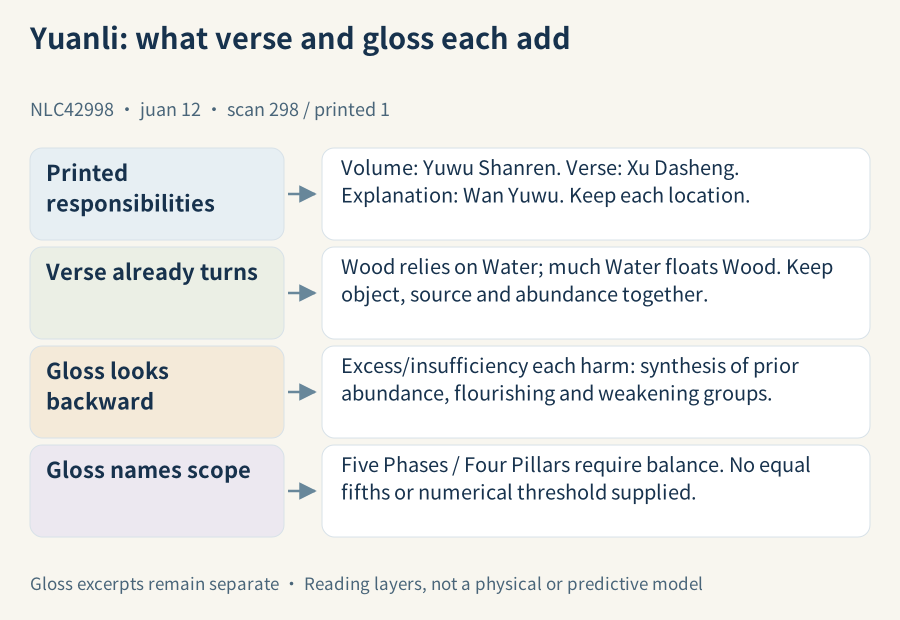
The complete figure is shown below. Select it to enlarge the labels. Open full-size figure · PNG
Test one pair for a change of layer
Take “Wood depends on Water; much Water floats Wood.” Record three supplied components: Wood as the object, Water as the generating source and abundance of Water as the turning qualification. Then ask how the explanation groups this turn with the preceding relationships under excess and insufficiency. This expansion retains object and degree while locating the source of the synthesis.
A study card containing only “Water generates Wood” drops abundance already printed in the verse. A card saying “much Water floats Wood, so Water is always unfavorable” drops the first half, dependence on Water. A card saying “more than two Water characters causes floating” supplies an absent threshold. These errors differ: the first two truncate a relationship; the third adds a parameter.
Next check the gloss's balancing requirement. It invites attention to both insufficiency and abundance, preventing benefit from being accumulated indefinitely in one direction. It does not establish that every unequal character count is condemned on this page. This exercise tests the summary's fidelity; it does not validate phase outcomes through actual people's experiences.
Retain the verse's construction and the explanation's new scope
A checkable record can use four fields: the composer's printed byline; the complete large-type pair; the gloss's backward reference and synthesis; and further questions proposed by our analysis. Readers first see the turn already present in the verse, then the explanation's framework of excess, insufficiency, Four Pillars and balance. Our own analysis remains distinguishable from either ancient layer.
That separation also bounds quotation. The five large-type pairs can be quoted continuously. The short gloss excerpts retain their explanatory location rather than becoming Xu Dasheng's verse. Wan Yuwu's explanation is a responsibility stated on this page; it cannot automatically attribute unsigned endings elsewhere to Wan. The next article's recollection of Xiji and Jishan brings precisely that attribution problem into view.
Our table and diagram are original analysis without source facsimiles. The inspected page and necessary context do not constitute a complete collation of the verse or book. Abundance, balance and harms belong to a historical argument here, not a scientifically validated proportional model or a prediction about a real person's illness, wealth or destiny.
Sources and further reading
Qin/Wenming Sanming tonghui, NLC42998, juan 12, scan 298, printed 1: Yuanli fu, the Xu Dasheng/Wan Yuwu bylines, five opening generation–abundance pairs, and the double-line gloss under the later weakening group. Verse and explanation remain distinct; punctuation and translation are ours. View the page
The 1926 date belongs to the catalogue record, not an independently inspected imprint. Volume attribution and local composition/explanation bylines express different responsibilities. View the record
For background, see Five Elements. Return to Verses Editorial Voices and Comparison, or continue to Recollected verses and visible voices.
Evidence and source roles
These roles distinguish ancient text, older commentary, historical scholarship and tool reproduction. The numbered notes in the article retain the precise scan pages and explanations. Library and academic sources do not endorse predictive claims.
- SM4-P04 · Ancient text evidence: 元理賦:撰/解与关系句
Text layer in the witness: Large verse; small 徐大升撰 / 萬育吾解 bylines; later double-line gloss - SM4-B01 · Library catalogue fields imported by Commons: Qin Shen’an corrected / Wenming Sanming tonghui, NLC42998, catalogued 1926; independent 1926 imprint not inspected