“有氣者急,有情者切” presents two compact judgments. If qi becomes a general strength score and qing becomes ordinary emotion, the phrase soon loses its textual setting. The accompanying gloss actually connects the terms to different tasks: being in season and combining qi. Expanding the phrase means recovering those tasks and stating which further conclusions remain unsupported.
This article uses the Qin Shen'an corrected, Wenming Book Company witness of Sanming tonghui, NLC42998, catalogued as 1926. An independent imprint for that year has not been inspected. In juan 10, scan 219, printed 24, contains the title Yujing aojue; scan 220, printed 25, contains our passage and double-line gloss; scan 241, printed 46, contains an ending poem and prose postscript.[1–4] The proposed 1578 mirror's identity remains unresolved, so these locators are not assigned to a verified 1578 printing.
Keep the byline and postscript in their own positions
Below the title on scan 219, small type reads “安東杜謙著”: attributed to Du Qian of Andong.[1] The prose postscript on scan 241 likewise says “玉井奧訣乃安東杜謙所著,” attributing the work to Du Qian. It ends with “予故表而出之,” a first-person statement about bringing the work forward, and a small signature, Yuwu.[3] We can distinguish the work's printed attribution from the voice presenting it in the postscript.
These locations reinforce the distinction without proving that Du Qian wrote every double-line gloss or that Yuwu personally supplied every explanation. The ending first introduces a poem with “詩曰,” then turns to prose. Poem, postscript and main text cannot be assembled into one continuous statement by Du Qian. A responsible record says that this witness attributes the work to Du Qian and signs the postscript Yuwu, retaining the scope of each observation.
That distinction changes the question. When a gloss supplies examples absent from the compressed verse, we ask how the explanation develops a term. When a postscript describes presenting the work, we ask how a compiling voice introduces it. Both have evidence, but their inclusion in Sanming tonghui does not make every sentence one original argument by Wan.
Qi connects first to season, rather than a total score
The continuous large-type phrase on scan 220 is “有氣者急,有情者切.” A reading translation is: what has qi calls for urgent attention; what has qing calls for close attention. One secure excerpt from its double-line gloss is “有氣乃當時也”: having qi means being in season here.[2] The explanation gives the sixth month's major summer solar term and the flourishing states of Earth and Metal as an example. Its surrounding discussion also concerns visible and hidden stems and branches within and beyond the eight characters.
Season therefore supplies a reference: which period, which characters and which flourishing qualification are being considered? Replacing “in season” with “strong under every circumstance” removes that reference. Turning the Earth–Metal example into a chemical concentration, bodily energy or measurable percentage adds a measurement system that this passage does not provide.
Within this explanation, ji, “urgent,” can be read as an aspect deserving prompt attention. That reading follows the phrase and example together. It does not establish that this factor always precedes every other condition throughout the book. No numerical weighting table for urgent, close, secondary and last is supplied here. We also do not replace the Day Master, Wealth, Officer, Seal or other configuration relationships with one seasonal qualification.
Qing connects to combination, rather than personal feelings
The other secure gloss excerpt is “有情乃合氣也”: having qing means combining qi in this local explanation.[2] Examples include Jia meeting Ji, Bing meeting Xin and Ding meeting Ren, alongside visible and hidden combinations of stems and branches. Qing functions as a relational term here. Translating it directly as affection, kindness or interpersonal closeness would change a symbolic relationship into a judgment about actual people's psychology.
The examples still need their scope. The passage explains qing through the characters and their combinations. This short excerpt does not establish that every combination transforms into a particular phase, or that encountering one cancels every clash, restraint and seasonal condition. Recognizing an example's combination is one reading result; determining how it functions in a larger passage is another task.
A connecting glyph in the gloss has not been securely settled. We quote the clear excerpts and paraphrase the seasonal and combination examples separately. We do not fill the uncertain character from familiar modern wording or present the two excerpts as one fully collated continuous quotation. This preserves the two identifiable entrances while limiting the length of a defensible verbatim transcription.
| Verified phrase | Entrance supplied by the gloss | Questions still needed |
|---|---|---|
| Having qi calls for urgent attention | Being in season; the sixth-month Earth–Metal example | Which season, characters and flourishing qualifications? No universal strength score |
| Having qing calls for close attention | Combining qi; Jia–Ji, Bing–Xin, Ding–Ren examples | Which characters combine, visibly or implicitly? Neither automatic transformation nor emotion |
| Urgent and close placed together | Two aspects worth identifying | Does this passage actually specify priority, weighting or one compulsory outcome? |
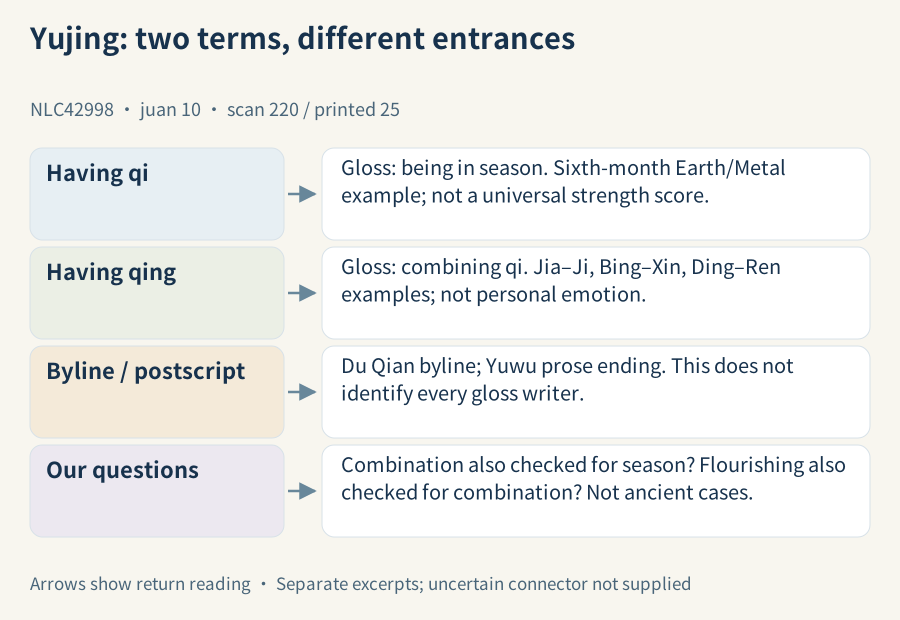
The complete figure is shown below. Select it to enlarge the labels. Open full-size figure · PNG
Expand with questions without inventing ancient counterexamples
A study card can add two questions. After recognizing a combination such as Jia–Ji, have we also checked the gloss's seasonal qualification? After recognizing seasonal flourishing, have we also found the stated combining relationship? These are our editorial questions for testing whether a summary has confused the entrances. They are not two newly discovered ancient cases or experiments validating or refuting fate calculation through real outcomes.
The questions prevent an unnoticed change in inference. A card that starts with “a combination is present” but concludes “seasonal qi is established” crosses between locally distinguished meanings. Using seasonal flourishing as a substitute for combining qi likewise removes the explanation of qing. We can record one qualification as checked and another as unresolved. Completing a card's appearance does not justify filling the missing judgment.
Expanding an argument therefore need not turn each short term into an absolute rule. What needs restoring is its reference, the example's scope and the next question. Other discussions of year, month or hour must be revisited in their own locations; this pair of phrases cannot become the entire book's sole entrance.
Make an expansion card that can be checked
Five fields help: the large-type wording; secure excerpts of the gloss; its seasonal or combination examples; questions proposed by our analysis; and unsettled glyphs or qualifications. Main text and gloss occupy separate fields, with our questions in a third. Readers can then see which meaning is supported by this witness's explanation, which next step is ours and which character remains unresolved.
For “having qing,” the card can retain combination and the listed stem pairs without supplying “harmonious feelings.” For “having qi,” it retains being in season without assigning a flourishing percentage. An attribution field separately records Du Qian's byline and Yuwu's postscript, preserving the difference between responsibility for a work, responsibility for its explanations and the statement introducing its collection.
This article examines one dense passage and the necessary attribution and ending layers. Its table and diagram are original reading aids, not reproduced scans or a complete collation of the work. Qi, combination and comparative emphasis are historical fate-calculation language here; we draw no conclusion about an actual person's emotions, abilities, health or destiny.
Sources and further reading
Qin/Wenming Sanming tonghui, NLC42998, juan 10, scan 219, printed 24: Yujing aojue and “安東杜謙著.” View the title
Scan 220, printed 25: the continuous large-type phrase and double-line gloss. The two gloss excerpts remain separate; punctuation is added, and the uncertain connecting glyph is not supplied. View the passage
Scan 241, printed 46: the prose postscript following the poem, with Yuwu's signature. View the ending
The object's 1926 date is catalogue dating, not an independently inspected imprint or a substitute for the unresolved 1578 mirror. View the record
For background, see Five Elements. Return to Verses Editorial Voices and Comparison, or continue to Yuanli's verse and gloss.
Evidence and source roles
These roles distinguish ancient text, older commentary, historical scholarship and tool reproduction. The numbered notes in the article retain the precise scan pages and explanations. Library and academic sources do not endorse predictive claims.
- SM4-P01 · Ancient text evidence: 玉井奧訣:篇题署
Text layer in the witness: Large title with small printed byline - SM4-P02 · Ancient text evidence: 玉井奧訣:有氣/有情
Text layer in the witness: Large main phrase and double-line accompanying explanation, distinct - SM4-P03 · Ancient text evidence: 玉井奧訣:篇末后语
Text layer in the witness: Prose postscript after a separately introduced 詩曰 poem; small 育吾 signature - SM4-B01 · Library catalogue fields imported by Commons: Qin Shen’an corrected / Wenming Sanming tonghui, NLC42998, catalogued 1926; independent 1926 imprint not inspected