A verse's appearance in another compilation does not necessarily supply a new annotation. The inspected Xiji and Jishan passages in this Sanming tonghui witness are single-line main text, without the independent double-line glosses corresponding to our Yuanhai selections. This result makes attribution the first question: which characters belong to the present section, which small characters remain in the preceding work, and which summaries cannot automatically be assigned to a compiler?
We build on the comparison established in Yuanhai phase 3 rather than repeating its entire rule comparison. The new focus is collection order, section boundaries and visible voices in the Qin Shen'an/Wenming witness, NLC42998, juan 11. It is catalogued as 1926, without an independently inspected imprint. The Yuanhai comparison uses the Shancheng Hall witness catalogued as 1634, fascicles 1 and 2. These dates alone do not establish the direction of textual transmission.[1–8]
A gloss on the same page need not explain the new title
The right side of scan 288, printed 47, still contains the ending of Mingtong fu, with large text and double-line small annotation. A distinct Xiji pian title begins toward the middle-left, followed by single-line text. Scans 289 and 290, printed 48 and 49, continue it. Scan 291, printed 50, ends Xiji toward the upper right, then independently introduces Jishan pian. Jishan continues through scan 297, printed 56, closing juan 11; scan 298 starts juan 12 and Yuanli fu.[1–3]
This sequence resolves a misleading impression. Small double-line characters share the Xiji opening page, but they belong to the preceding Mingtong. A cropped image containing both works can therefore mislead if every small character is labelled Wan's explanation of Xiji. Type size supplies a clue; the actual title boundary limits its attribution.
Across the inspected layout and passages on scans 288–297, we found no corresponding independent line-by-line double-line explanation for Xiji or Jishan. That absence concerns these sections in this witness. It does not establish the absence of annotations in every Sanming edition or a compiler's belief that explanation was unnecessary. Neither the historical collection process nor the reason for this layout can be settled from these observations alone.
The shared Xiji passage retains its turning qualification
The continuous passage after the title on scan 288 reads: “有見不見之形,無時不有。神煞相絆,輕重較量。若乃時逢七煞,見之未必為凶。月制干強,其煞反為權印。”[1] It moves from visible and unseen forms and comparative weighing to Seven Sha in the hour: its appearance is not necessarily unfavorable; with month restraint and a strong stem, it turns toward authority (權印). The Yuanhai counterpart is in large type on scan 31's lower-right band, with double-line old notes and the forms “七殺” and “其殺.”[4] Each witness's glyphs remain recorded rather than silently normalized into an assertion of exact identity.
The essential qualification here is “月制干強,” month restraint and stem strength. Single-line printing has not removed it. “Not necessarily unfavorable” does not mean every Seven Sha is favorable; the reversal cannot be detached from its preceding conditions. A passage without line-by-line explanation still needs its own connections and limits to be read.
Yuanhai phase 3 already compared these large-type words and notes. Here they establish two presentations: the Yuanhai passage has old glosses, while this Qin Sanming passage retains comparable continuous wording without the corresponding explanation. Recurrence of wording is not two independent empirical confirmations, nor proof that one surviving print was copied directly from the other.
Jishan's qualifications survive the absence of a corresponding gloss
After its title on scan 291, Jishan introduces the Month Command as organizing guide and the day stem as principal reference. A subsequent continuous large-type passage reads: “三元要成格局,四柱喜見財官。用神不可損傷,日主最宜健旺.”[2] Its discussion of configurations and Wealth–Officer also preserves protecting yongshen and keeping the Day Master vigorous. It does not offer a Wealth–Officer-only reading.
The corresponding large type on Yuanhai fascicle 2, scan 2's lower-left band, is interspersed with double-line old notes. One secure excerpt, “如月令有官不可傷,” connects protection to an example with Officer in the Month Command. Other explanations develop Wealth and Seal entrances.[5] This is the visible Yuanhai explanation, not a newly discovered hidden annotation by Wan in Qin Sanming.
When placing that gloss in a comparison table, identify its witness. It can prompt questions about yongshen's object and how protection relates to the day-stem qualification. It cannot establish that Sanming adopted every word of the gloss, or that failing to print it means rejecting it. Presence of annotation and agreement with a viewpoint are different kinds of evidence.
| Visible position | Recordable layer or voice | What does not follow automatically |
|---|---|---|
| Qin scan 288 before Xiji's title | Mingtong's ending and double-line explanation | That the explanation belongs to Xiji or is its compiler note |
| Qin scan 288 after the title | Single-line Xiji, retaining month restraint/stem strength | That no corresponding gloss means no conditions |
| Qin scan 291 after Jishan's title | Single-line protection and strength qualifications | Acceptance or rejection of every Yuanhai gloss |
| Selected Yuanhai scan 31 and fascicle 2 scan 2 | Corresponding main text and local old glosses | Independent validation or proven direct copying |
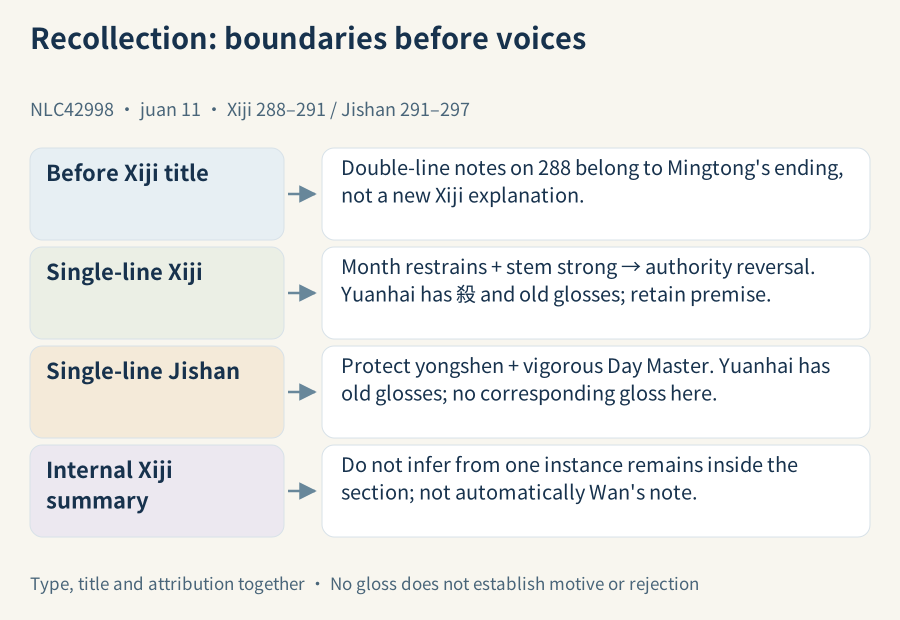
The complete figure is shown below. Select it to enlarge the labels. Open full-size figure · PNG
An ending's advisory tone does not establish its author
The Xiji ending on scan 291 includes “是以陰陽罕測,不可一例而推”: Yin–Yang is difficult to fathom, so one instance cannot determine the inference.[3] It remains inside Xiji, in single-line main text, before the transition to Jishan. We can call it this witness's internal summary. Sounding like an editorial reminder does not establish an independent note by Wan Yuwu.
The sentence explicitly resists inference from one instance. Alongside the earlier weighing of relative importance, it encourages retention of qualifications and scope. But this function is not authorship evidence. An admonition's content and the question of who composed it, when, are distinct. We have verified the former's location without resolving the latter.
The Jishan ending likewise discusses avoiding phase imbalance and attaining appropriate balance. Those statements remain section text rather than separately placed small-type compiler explanation.[3] Ancient claims about a work's own accuracy also do not establish a modern accuracy statistic. Content, responsibility and validation have different boundaries.
Add a collection-and-attribution field to the comparison
Beyond the existing main-text/gloss comparison, this phase can add a field for collection position and attribution. Record neighboring titles and actual boundaries, then classify main text, independent explanation, internal quotation or internal summary. Add explicit signatures where present and leave authorship unresolved where absent. Organizational difference then avoids becoming unsupported proof of one person's change of thought.
A record here can say: Xiji follows the Mingtong ending, and Jishan follows Xiji; the selected Qin sections are single-line, while Yuanhai's corresponding passages have double-line notes. Questions about explicit collection statements, direct sources and annotators remain separate. This bounded check has not answered them, so the table does not fill them with guesses.
The new contribution is a more disciplined use of “compiler's voice.” Actual boundaries, visible layers and absent corresponding explanation are usable evidence; personal intention cannot be extracted from a blank. Our table and diagram are original, without facsimiles. This is not complete collation of the book or all editions, and historical status and fortune language is not applied to actual readers.
Sources and further reading
Qin/Wenming NLC42998, juan 11, scan 288, printed 47: Mingtong ending, Xiji title and selection; scans 289–290 continue it. View the opening
Scan 291, printed 50: Xiji ending and Jishan title with the selected continuous main text. View the boundary
Xiji's internal summary is on 291; Jishan continues through scan 297, printed 56. View Jishan's ending Punctuation is added; no personal note attribution is invented.
Yuanhai's 1634-catalogued fascicle 1: Xiji title on scan 30 left; selected main text and old notes on scan 31 lower right. View the counterpart
Yuanhai fascicle 2, scan 2 lower left: Jishan main text and double-line old explanation. An unsettled numeric printed leaf is not supplied. View the old notes
Qin object record: 1926 is catalogue dating, not an independently inspected imprint.
Yuanhai fascicle 1 record: one 1634-catalogued witness.
Yuanhai fascicle 2 record: volume, scan and local position remain distinct.
See the preceding Yuanhai–Sanming shared-verse comparison. Return to this phase, or continue to Four-word rhythm and qualifications.
Evidence and source roles
These roles distinguish ancient text, older commentary, historical scholarship and tool reproduction. The numbered notes in the article retain the precise scan pages and explanations. Library and academic sources do not endorse predictive claims.
- SM4-P05 · Ancient text evidence: 喜忌篇:起题及选句
Text layer in the witness: Single-line main section after independent title; preceding 明通賦 ends with double-line notes - SM4-P06 · Ancient text evidence: 繼善篇:起题及选句
Text layer in the witness: Independent title followed by single-line main text, no corresponding independent double-line explanation in inspected section - SM4-P07 · Ancient text evidence: 喜忌篇尾/繼善篇末:归属边界
Text layer in the witness: Internal Xiji summary in single-line section text; Jishan ending likewise main text - SM4-P08 · Ancient text evidence: 喜忌篇:对应大字与旧注
Text layer in the witness: Right lower-band large main text with double-line old notes; heading on scan30 left - SM4-P09 · Ancient text evidence: 繼善篇:对应大字间旧注
Text layer in the witness: Left lower-band double-line old gloss between corresponding main-text groups - SM4-B01 · Library catalogue fields imported by Commons: Qin Shen’an corrected / Wenming Sanming tonghui, NLC42998, catalogued 1926; independent 1926 imprint not inspected
- SM4-B02 · Library catalogue fields imported by Commons: Yuanhai Ziping, NLC149610 fascicle 1, one 1634-catalogued Shancheng Hall witness
- SM4-B03 · Library catalogue fields imported by Commons: Yuanhai Ziping, NLC149611 fascicle 2, one 1634-catalogued Shancheng Hall witness